Results by title
6 books match the query 'Herodotus'
Herodotus and the Question Why
By Christopher Pelling
University of Texas Press, 2019
In the 5th century BCE, Herodotus wrote the first known Western history to build on the tradition of Homeric storytelling, basing his text on empirical observations and arranging them systematically. Herodotus and the Question Why offers a comprehensive examination of the methods behind the Histories and the challenge of documenting human experiences, from the Persian Wars to cultural traditions.
In lively, accessible prose, Christopher Pelling explores such elements as reconstructing the mentalities of storyteller and audience alike; distinctions between the human and the divine; and the evolving concepts of freedom, democracy, and individualism. Pelling traces the similarities between Herodotus's approach to physical phenomena (Why does the Nile flood?) and to landmark events (Why did Xerxes invade Greece? And why did the Greeks win?), delivering a fascinating look at the explanatory process itself. The cultural forces that shaped Herodotus's thinking left a lasting legacy for us, making Herodotus and the Question Why especially relevant as we try to record and narrate the stories of our time and to fully understand them.
Herodotus in the Anthropocene
Joel Alden Schlosser
University of Chicago Press, 2020
Schlosser shows that the Histories, which chronicle the interactions among the Greek city-states and their neighbors that culminated in the Persian Wars, illuminate a telling paradox: at those times when humans appear capable of exerting more influence than ever before, they must also assert collective agency to avoid their own downfall. Here, success depends on nomoi, or the culture, customs, and laws that organize human communities and make them adaptable through cooperation. Nomoi arise through sustained contact between humans and their surroundings and function best when practiced willingly and with the support of strong commitments to the equality of all participants. Thus, nomoi are the very substance of political agency and, ultimately, the key to freedom and ecological survival because they guide communities to work together to respond to challenges. An ingenious contribution to political theory, political philosophy, and ecology, Herodotus in the Anthropocene reminds us that the best perspective on the present can often be gained through the lens of the past.
Telling Wonders
Ethnographic and Political Discourse in the Work of HerodotusRosaria Munson
University of Michigan Press, 2001
As he explores the causes of the East-West conflict from its most remote antecedents, Herodotus includes conflicting traditions about different historical periods as well as apparently tangential descriptions of the customs of faraway peoples. What was his aim in combining such diverse material? Rosaria Vignolo Munson argues that Herodotus' aim was two-fold: to use historical narrative to illuminate the present and to describe barbarian customs so that the Greeks might understand themselves.
Herodotus assumes the role of advisor to his audience, acting as a master of metaphor and oracular speech and as an intellectual fully aware of new philosophical and political trends. By comparing, interpreting, and evaluating facts through time and space or simply by pointing them out as objects of "wonder," he teaches that correct political action is linked to an appropriate approach to foreigners and additional "others." Munson relies on traditional scholarship and modern studies in narratology and related critical fields to distinguish between narrative and metanarrative, providing a framework for analyzing the construction of Herodotus' discourse and his presentation of himself through it.
Munson's work will be useful to classicists and ancient historians and will also engage anthropologists interested in cultural interaction and notions of ethnicity and literary critics interested in narrative constructions.
Textual Rivals
Self-Presentation in Herodotus’ HistoriesDavid Branscome
University of Michigan Press, 2013
Textual Rivals studies some of the most debated issues in Herodotean scholarship. One such is Herodotus’ self-presentation: the conspicuousness of his authorial persona is one of the most remarkable features of his Histories. So frequently does he interject first-person comments into the narrative that Herodotus at times almost becomes a character within his own text.
Important issues are tied to Herodotus’ self-presentation. First is the narrator’s relationship to truth: to what extent does he expect readers to trust his narrative? While judgments regarding Herodotus’ overall veracity have often been damning, scholars have begun to concentrate on how Herodotus presents his truthfulness. Second is the precise genre Herodotus means to create with his work. Excluding the anachronistic term historian, exactly what would Herodotus have called himself, as author? Third is the presence of “self-referential” characters, whose actions often mirror Herodotus’ as narrator/researcher, in the Histories.
David Branscome’s investigative text points to the rival inquirers in Herodotus’ Histories as a key to unraveling these interpretive problems. The rival inquirers are self-referential characters Herodotus uses to further his authorial self-presentation. Through the contrast Herodotus draws between his own exacting standards as an inquirer and the often questionable standards of those rivals, Herodotus underlines just how truthful readers should find his own work.
Textual Rivals speaks to those interested in Greek history and historiography, narratology, and ethnography. Those in the growing ranks of Herodotus fans will find much to invite and intrigue.
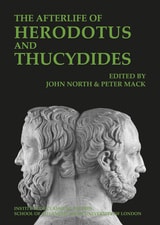
The Afterlife of Herodotus and Thucydides
Edited by John North and Peter Mack
University of London Press, 2019
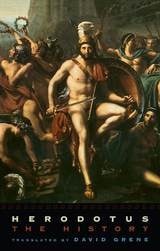
The History
Herodotus
University of Chicago Press, 1988
Here is the historian, investigating and judging what he has seen, heard, and read, and seeking out the true causes and consequences of the great deeds of the past. In his History, the war between the Greeks and Persians, the origins of their enmity, and all the more general features of the civilizations of the world of his day are seen as a unity and expressed as the vision of one man who as a child lived through the last of the great acts in this universal drama.
In Grene's remarkable translation and commentary, we see the historian as a storyteller, combining through his own narration the skeletal "historical" facts and the imaginative reality toward which his story reaches. Herodotus emerges in all his charm and complexity as a writer and the first historian in the Western tradition, perhaps unique in the way he has seen the interrelation of fact and fantasy.