Results by title
31 books match the query 'Finding'
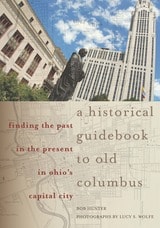
A Historical Guidebook to Old Columbus
Finding the Past in the Present in Ohio’s Capital CityBob Hunter
Ohio University Press, 2012
Ever look at a modern skyscraper or a vacant lot and wonder what was there before? Or maybe you have passed an old house and been curious about who lived there long ago. This richly illustrated new book celebrates Columbus, Ohio’s, two-hundred-year history and supplies intriguing stories about the city’s buildings and celebrated citizens, stopping at individual addresses, street corners, parks, and riverbanks where history was made. As Columbus celebrates its bicentennial in 2012, a guide to local history is very relevant.
Like Columbus itself, the city’s history is underrated. Some events are of national importance; no one would deny that Abraham Lincoln’s funeral procession down High Street was a historical highlight. But the authors have also included a wealth of social and entertainment history from Columbus’s colorful history as state capital and destination for musicians, artists, and sports teams.
The book is divided into seventeen chapters, each representing a section of the city, including Statehouse Square, German Village, and Franklinton, the city’s original settlement in 1797. Each chapter opens with an entertaining story that precedes the site listings. Sites are clearly numbered on maps in each section to make it easy for readers to visit the places that pique their interest. Many rare and historic photos are reproduced along with stunning contemporary images that offer insight into the ways Columbus has changed over the years.
A Historical Guidebook to Old Columbus invites Columbus’s families to rediscover their city with a treasure trove of stories from its past and suggests to visitors and new residents many interesting places that they might not otherwise find. This new book is certain to amuse and inform for years to come.
Developing Information Literacy Skills
A Guide to Finding, Evaluating, and Citing SourcesJanine Carlock
University of Michigan Press, 2020
This text has been structured around the six critical elements of the ACRL Framework for Information Literacy in Higher Education, contextualizing these elements by fitting them into the research and writing process. The book focuses on providing students with the critical-thinking and problem-solving skills needed to: (1) identify the conversation that exists around a topic, (2) clarify their own perspective on that topic, and (3) efficiently and effectively read and evaluate what others have said that can inform their perspective and research. The critical-thinking and problem-solving skills practiced here are good preparation for what students will encounter in their academic and professional lives.
As an experienced writing instructor, the author has evaluated the final written products of hundreds of students who were trained through one-shot workshops and first-year introductory courses. She has applied that knowledge to create the tasks in this book so that students have the skills to successfully find, evaluate, and use sources and then produce a paper that incorporates valid research responsibly and effectively.
Finding a Clear Path
JIM MINICK
West Virginia University Press, 2006
Finding a Clear Path intertwines literature, agriculture, and ecology as author Jim Minick takes the reader on many journeys, allowing you to float on a pond, fly with a titmouse, gather ginseng, and grow the lowly potato. The reader visits monarch butterflies and morel mushrooms, encountering beavers, black snakes, and bloodroot along the way. Using his background as a blueberry farmer, gardener and naturalist, Minick explores the Appalachian region and also introduces information that can be appreciated from a scientific point of view, explaining, for example, the ears of an owl, or the problems with the typical Christmas tree. Reading this collection of essays invites you to search for ways to better understand and appreciate this marvelous world, opening paths for journeys of your own.
Finding a Common Thread
Reading Great Texts from Homer to O'ConnorRobert C. Roberts
St. Augustine's Press, 2013
In this book, a group of prominent scholar-teachers meditate on how to read, in the context of a specifically Christian university or college education, some of the greatest texts of the Western tradition. Each author devotes himself or herself to a single text. In many cases, the authors have been reading, rereading, marking, ruminating, inwardly digesting, teaching, and discussing their text for several decades, so that they offer here a distillation of years of familiarity and reflection.
The texts span nearly 3,000 years. They are pre-Christian, Christian, and post-Christian. Each kind of text – indeed, each individual text – offers its own special opportunities and challenges for Christian interpretation. From these diverse readings emerges a sense that these texts all belong to a single great tradition, one to which Christianity made and continues to make enormous contributions. Medieval Christian writers exploit and transform pagan texts, and post-Christian writers like Nietzsche and Joyce are often preoccupied with Christian themes. In one way or another all the texts are about what it is to be a human being and what a good human life might look like. Thus “common threads” bind one text to the next, creating countless resonances among them.
The authors of the essays in this book all address the question, “How shall we read these texts from the vantage point of faith in God and Jesus Christ? Moreover, how shall we read them as members of a community with a common vision of the human good, aiming to nurture our students in that vision by reading with them some of the profoundest and most delightful things the human hand has penned?” As the Introduction suggests, the volume hopes to contribute to a renewal of the original intention of university education: to cultivate minds and hearts formed and informed by wisdom, the highest of intellectual goods.

Finding a Public Voice
Barbara Fister as a Case StudyDanielle Theiss
Assoc of College & Research Libraries, 2013
Finding a Public Voice
Barbara Fister as a Case StudyDanielle Theiss
Assoc of College & Research Libraries, 2013
Finding a Way to the Heart
Feminist Writings on Aboriginal and Women’s History in CanadaRobin Jarvis Brownlie
University of Manitoba Press, 2012
Finding the Answers to Legal Questions
Virginia M. Tucker
American Library Association, 2017

Finding the Answers to Legal Questions
A How-To-Do-It ManualAmerican Library Association, 2011
Finding the Arctic
History and Culture Along a 2,500-Mile Snowmobile Journey from Alaska to Hudson’s BayMatthew Sturm
University of Alaska Press, 2012
Finding the Beautiful Commons
Confessions of a Bourgeois EnvironmentalistCathy Gere
University of Chicago Press, 2027
A call to pleasurable and sustainable action that centers our shared stewardship of shared spaces.
Environmentally-conscious decision-making can seem like an exercise in self-denial: don’t fly, don’t drive, don’t eat meat. But bringing our tote bags to the grocery store will never be enough to solve the climate crisis, nor will dropping out of society. Many of us crave a collective movement that acknowledges the value of comfort, a framework for making choices that are inherently imperfect, but ones we can live with.
In Finding the Beautiful Commons, historian Cathy Gere offers a relatable and inspiring guide to environmental action in a consumerist culture. Recounting her experiences as a young activist at the Greenham Common Women’s Peace Camp in Berkshire, as an anarchist and guerrilla gardener in a New York City squat, and as an academic working to decarbonize the University of California system, Gere argues for initiatives grounded in common property—streets, libraries, parks, and other shared spaces—where our communal interests can drive sustainability. These are also sites where we can put bourgeois values like beauty and personal enjoyment to good use protecting local landscapes and resources.
Funny, wise, and honest about the contradictions of life during climate crisis, Gere shows us that the commons we already know—the everyday infrastructure of mass transit, natural reserves, and public beaches—is the very foundation for a livable future.
Finding the Lost Year
What Happened When Little Rock Closed Its Public SchoolsSondra Gordy
University of Arkansas Press, 2009
Much has been written about the Little Rock School Crisis of 1957, but very little has been devoted to the following year—the Lost Year, 1958–59—when Little Rock schools were closed to all students, both black and white. Finding the Lost Year is the first book to look at the unresolved elements of the school desegregation crisis and how it turned into a community crisis, when policymakers thwarted desegregation and challenged the creation of a racially integrated community and when competing groups staked out agendas that set Arkansas’s capital on a path that has played out for the past fifty years.
In Little Rock in 1958, 3,665 students were locked out of a free public education. Teachers’ lives were disrupted, but students’ lives were even more confused. Some were able to attend schools outside the city, some left the state, some joined the military, some took correspondence courses, but fully 50 percent of the black students went without any schooling. Drawing on personal interviews with over sixty former teachers and students, black and white, Gordy details the long-term consequences for students affected by events and circumstances over which they had little control.
“Fifty years ago segregationists trying to keep black students out of Little Rock Central High inadvertently broke up one of the country’s greatest football dynasties. . . . Wait a minute. . . . Who said you can’t have a high school football team just because you don’t have a high school? Canceling football, Faubus decreed, would be ‘a cruel and unnecessary blow to the children.’ O.K. then, everyone agreed. Play ball!”
—“Blinded by History,” Sports Illustrated
Finding the Middle Ground
Krestovskii, Tur, and the Power of Ambivalence in Nineteenth-Century Russian Women's ProseJehanne Gheith
Northwestern University Press, 2004
Finding the Movement
Sexuality, Contested Space, and Feminist ActivismFinn Enke
Duke University Press, 2007
By considering the development of feminism through an analysis of public space, Enke expands and revises the historiography of second-wave feminism. She suggests that the movement was so widespread because it was built by people who did not identify themselves as feminists as well as by those who did. Her focus on claims to public space helps to explain why sexuality, lesbianism, and gender expression were so central to feminist activism. Her spatial analysis also sheds light on hierarchies within the movement. As women turned commercial, civic, and institutional spaces into sites of activism, they produced, as well as resisted, exclusionary dynamics.
Finding the People who Flaked the Stone at English Camp
Close, Angela E
University of Utah Press, 2006

Finding the Public Domain
Copyright Review Management System ToolkitMelissa Levine, Kristina Eden, Justin Bonfiglio, and Richard Adler
Michigan Publishing Services, 2016
How can I tell if something is in the public domain? This is the central question addressed daily by the Copyright Review Management System (CRMS) project. It is a special question and one essential to the social bargain that society has struck with authors and rights holders.
It is also a deceptively simple question. There should be a straightforward answer, especially for books. It should be easy to know when something is—or is not—subject to copyright. And yet, in an age of absolute fluidity of media and medium, even plain old books can be highly complex embodiments of copyright. We need to make it easier to ascertain whether a work is in the public domain. If the rights of copyright holders are to be respected and valued as part of the social bargain, the public domain as a matter of copyright law should be ascertainable and enjoyed
.
Given this complexity, consider the determination of the copyright status of a given creative work as a design problem. How do we move the copyright status of works in the collections of our libraries, museums, and archives from confusion and uncertainty to clarity and opportunity? Working over a span of nearly eight years, the University of Michigan Library received three grants from the Institute of Museum and Library Services (IMLS) to generously fund CRMS, a cooperative effort by partner research libraries to identify books in the public domain in HathiTrust. The Toolkit is a resource that aims to allow others to understand and replicate the work done by CRMS.

Finding the Right Place on the Map
Central and Eastern European Media Change in a Global PerspectiveEdited by Karol Jakubowicz and Miklós Sükösd
Intellect Books, 2008
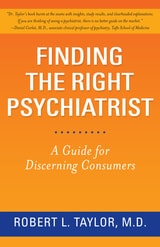
Finding the Right Psychiatrist
A Guide for Discerning ConsumersRobert L. Taylor, M.D.
Rutgers University Press, 2014
Combining over forty years of experience as a practicing psychiatrist with an insider’s perspective of current psychiatric practice, Dr. Robert Taylor provides invaluable guidance to persons considering psychiatric treatment or contemplating a change of doctor in an effort to find better treatment. Cautioning readers against settling for a psychiatrist who views psychodrugs as the treatment, Dr. Taylor provides specific suggestions for avoiding the growing number of psychiatrists who write scripts automatically.
In recent decades, psychiatric care has been overly reliant on psychodrugs. Patient diagnoses are being seriously questioned. Finding the Right Psychiatrist encourages people to seek care from a complete psychiatrist—one able and willing to pursue matters of mind and brain/body, rather than settling on psychodrugs as the main treatment.
Throughout the book, readers learn about the proper uses and limits of psychiatric diagnosis. Dr. Taylor carefully outlines an individualized approach to psychiatric care guided more by a patient’s particular problems and situation than by diagnoses that often mislead more than help. He provides a realistic appraisal of psychiatric medications: what they can and cannot do as well, a discussion of mind work tools, traits of effective psychiatrists, suggestions for how to deal with common insurance company obstacles, and an explanation of the confusing politics of psychiatry.
An indispensable resource for anyone seeking psychiatric help or tasked with advising someone of what to look for in a doctor, Finding the Right Psychiatrist gives hope and guidance to those searching for complete and personalized care.
View a three minute video of Dr. Robert L. Taylor speaking about Finding the Right Psychiatrist.
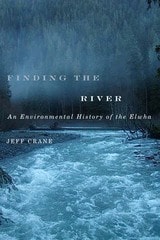
Finding the River
An Environmental History of the ElwhaJeff Crane
Oregon State University Press, 2011
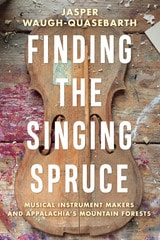
Finding the Singing Spruce
Musical Instrument Makers and Appalachia's Mountain ForestsJasper Waugh-Quasebarth
West Virginia University Press, 2023
Environment, craft, and meaning in the work of Appalachian instrument makers.
How can the craft of musical instrument making help reconnect people to place and reenchant work in Appalachia? How does the sonic search for musical tone change relationships with trees and forests? Following three craftspeople in the mountain forests of Appalachia through their processes of making instruments, Finding the Singing Spruce considers the meanings of work, place, and creative expression in drawing music from wood.
Jasper Waugh-Quasebarth explores the complexities and contradictions of instrument-making labor, which is deeply rooted in mountain forests and expressive traditions but also engaged with global processes of production and consumption. Using historical narratives and sensory ethnography, among other approaches, he finds that the craft of lutherie speaks to the past, present, and future of the region’s work and nature.

Finding the Trail of Life
Rufus M. Jones
QuakerPress, 2014
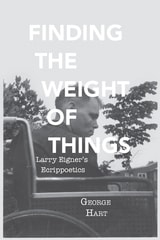
Finding the Weight of Things
Larry Eigner's EcrippoeticsGeorge Hart
University of Alabama Press, 2022
Where language, body, and form converge in the poetry of Larry Eigner.
Larry Eigner (1927–1996) wrote thousands of poems in his lifetime, despite profound physical limitations caused by cerebral palsy. Using only the thumb and index finger of his right hand, Eigner generated a torrent of urgent and rich language, participating in vital correspondences as well as publishing widely in literary magazines and poetry journals.
While Eigner wrote before the emergence of ecopoetics, his poetry reflected a serious engagement with scientific writing and media, including Rachel Carson’s seminal Silent Spring. Eigner was writing about environmental disasters and climate change long before such concerns took on a moral incumbency. Similarly, Eigner was ahead of his time in his exploration of disability. The field of disability studies has expanded rapidly in the new millennium. Eigner was not an overtly biographical poet, at least as far as his physical limitations were concerned, but his poetry spoke volumes on the idea of embodiment in all its forms.
Finding the Weight of Things: Larry Eigner’s Ecrippoetics is the first full-length study of Eigner’s poetry, covering his entire career from the beginning of his mature work in the 1950s to his last poems of the 1990s. George Hart charts where Eigner’s two central interests intersect, and how their interaction fueled his work as a poet-critic—one whose work has much to tell us about the ecology and embodiment of our futures. Hart sees Eigner’s overlapping concerns for disability, ecology, and poetic form as inextricable, and coins the phrase ecrippoetics here to describe Eigner’s prescient vision.
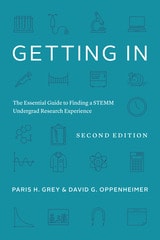
Getting In
The Essential Guide to Finding a STEMM Undergrad Research ExperienceParis H. Grey and David G. Oppenheimer
University of Chicago Press, 2023
Conducting research is an important foundation for many undergraduates on STEMM career paths. But landing an extremely competitive research spot that is also an enriching experience involves knowing how to present yourself effectively and an awareness of your goals and expectations. In this book, an expert lab manager and a longtime principal investigator share their secrets for obtaining these coveted positions.
Offering advice to students in a wide variety of STEMM fields at both research-intensive universities and primarily undergraduate institutions, Getting In helps students navigate the hidden curriculum of academia, unofficial rules that disproportionately affect first-generation college students and those from low-income backgrounds and communities historically underrepresented in science. The authors provide not only an overview of STEMM research and lab opportunities but also specific strategies for the entire application process—including how to write emails that get noticed by busy professors, how to ask for a research position during office hours, and interview questions to prepare for—so students can claim their place in research settings.
With its emphasis on the many interpersonal and professional benefits of research experiences, Getting In equips all STEMM undergrads with the tools they need both to secure these valued positions and to develop habits that will build productive relationships with their future research mentors.
As an undergrad, Getting In will help you:
- determine how much time you can spend on research by evaluating your current activity level and goals.
- find the time to do research without giving up your social life or risking your GPA.
- avoid common mistakes in the search, application, or interview that make it harder to find a research experience.
- write emails that get you noticed by busy professors by customizing the included templates.
- prepare for tough interview questions so you’ll impress the interviewer with your answers, and be able to determine if the position is right for you.
As a research mentor, Getting In will help your students:
- navigate the hidden curriculum of finding a research experience in science, technology, engineering, math, and medicine (STEMM).
- set realistic expectations for their research experience.
- understand why conducting research requires effort and will include some failure and other challenges.
- be active participants in their success in the lab.
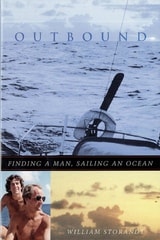
Outbound
Finding a Man, Sailing an OceanWilliam Storandt
University of Wisconsin Press, 2001
is the story of two voyages: an Atlantic crossing in the 33-foot cutter
Clarity, bound for Scotland; and the hard voyage of self-discovery that finally brought Bill Storandt to his life partner.
Storandt’s account of the adventure he had carefully planned with longtime partner Brian Forsyth and their friend Bob soon turns into a white-knuckled sailing tale, as they encounter a fierce storm four hundred miles from the Irish coast that tests their courage and all their sailing skills. The sea story, vividly evoking life in a small boat on a big ocean, is interwoven with Storandt’s flashbacks to his earlier life. Outbound delivers its share of excitement, but it’s also a moving reflection on how circuitous our paths can be, even when the destination is clear and beckoning.
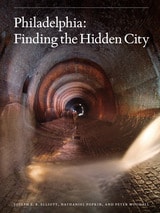
Philadelphia
Finding the Hidden CityJoseph E. B. Elliott
Temple University Press, 2017
Philadelphia possesses an exceptionally large number of places that have almost disappeared—from workshops and factories to sporting clubs and societies, synagogues, churches, theaters, and railroad lines. In Philadelphia: Finding the Hidden City, urban observers Nathaniel Popkin and Peter Woodall uncover the contemporary essence of one of America’s oldest cities. Working with accomplished architectural photographer Joseph Elliott, they explore secret places in familiar locations, such as the Metropolitan Opera House on North Broad Street, the Divine Lorraine Hotel, Reading Railroad, Disston Saw Works in Tacony, and mysterious parts of City Hall.
Much of the real Philadelphia is concealed behind facades. Philadelphia artfully reveals its urban secrets. Rather than a nostalgic elegy to loss and urban decline, Philadelphia exposes the city’s vivid layers and living ruins. The authors connect Philadelphia’s idiosyncratic history, culture, and people to develop an alternative theory of American urbanism, and place the city in American urban history. The journey here is as much visual as it is literary; Joseph Elliott’s sumptuous photographs reveal the city's elemental beauty.

Politics for People
Finding a Responsible Public VoiceDavid Mathews
University of Illinois Press, 1999
The College Student's Research Companion
Finding, Evaluating, and Citing the Resources You Need to SucceedArlene Rodda Quaratiello
American Library Association, 2010
The Future Academic Librarians Toolkit
FindingMegan Hodge
Assoc of College & Research Libraries, 2019
Truth After Post-Truth
Finding a Way ForwardEdited by Anthony Nadler, Molly O’Rourke-Friel, and Doron Taussig
University of Massachusetts Press, 2027
Examining truth, expertise, and authority in the contemporary United States
In an era defined by accusations of “fake news,” declining institutional trust, and deepening political polarization, Truth After Post-Truth reframes the debate about knowledge and democracy in the United States. Rather than treating the so-called post-truth crisis as a failure of public reasoning or the product of bad-faith actors and digital misinformation, this interdisciplinary volume argues that the problem runs deeper and that solutions require renewed democratic deliberation about how public knowledge itself should be produced, evaluated, and shared.
Contributors move beyond familiar diagnoses that blame either misinformed citizens or manipulative media systems. Instead, they interrogate the intellectual and political norms that underwrite claims about truth, expertise, and authority. This book challenges the assumption that restoring democracy depends on returning the public to a fixed set of knowledge practices and calls instead for open debate about which norms and institutions best serve a pluralistic society. Organized around three urgent questions—what relationship a healthy democracy should have to experts, whether a shared and cross-partisan news sphere is necessary or achievable, and whether media reform or media literacy is the more pressing priority—the essays are rigorous, provocative, and often in productive tension with one another. Together, they model the kind of critical engagement needed to rebuild a more resilient democratic information environment.
Timely and forward-looking, Truth After Post-Truth will be essential reading for readers concerned with the future of democratic public life, as well as for scholars and students of media, politics, and communication.
Contributors include the volume editors as well as Mark Andrejevic, Matt Carlson, Vivek Chibber, Belinha de Abreu, John Nerone, Whitney Phillips, Sue Robinson, Michael Schudson, Nik Usher, Andrea Wenzel, and Alex Worsnip.
Wide Skies
Finding a Home in the WestGary Holthaus
University of Arizona Press, 1997
A true place in the world: how many people have looked for it and how many have finally found it in the American West? Here, with writer Gary Holthaus, readers will reflect upon their own sense of place as they travel the lands and enter the lives of people in small towns and on ranches all over the West from Utah to Oregon to Alaska. Farmers and merchants, writers and teachers, truckers and trappers: their stories ring with hope and fear as their wide-open spaces increasingly come under siege.
Here are reflections on a long journey, together with notes of a personal odyssey and a plea for preserving the West's natural beauty-its meadows and mountains, its bears and Golden Eagles, its antelope and wolverines. This is important, says Holthaus, because if the region is home for him and for others, too, then it is crucial for newcomers and old-timers alike not to "further foul a nest that is becoming increasingly crowded." As he finds his way and adjusts his eyes to modern realities of greed and indifference, he also comes to grips with loss and learns to balance "the harm one inevitably does" with acts of compassion and positive change.
Deep in the national consciousness, the mythical West of film and fiction continues to shape our vision of ourselves as Americans. This book is a view not from the media, not from think tanks or legislators or policy makers, but from Westerners themselves, who tell us about the circumstances of their lives. Their West is indisputably the real West, and only as we come to understand better its realities will we come to know ourselves both as individuals and as a nation.

Worlding
Finding a Way in Broken TimesKathleen Stewart
Duke University Press, 2027