Results by title
4 books match the query 'High Stakes'

Enforcement at the EPA
High Stakes and Hard Choices, Revised EditionBy Joel A. Mintz
University of Texas Press, 2012
The only published work that treats the historical evolution of EPA enforcement, this book provides a candid inside glimpse of a crucial aspect of the work of an important federal agency. Based on 190 personal interviews with present and former enforcement officials at EPA, the U.S. Department of Justice, and key congressional staff members—along with extensive research among EPA documents and secondary sources—the book vividly recounts the often tumultuous history of EPA’s enforcement program. It also analyzes some important questions regarding EPA’s institutional relationships and the Agency’s working environment.
This revised and updated edition adds substantial new chapters examining EPA enforcement during the Clinton and George W. Bush administrations. Its treatment of issues of civil service decline and the applicability of captive agency theory is also new and original.

HIGH STAKES
BIGTIME SPORTS & DOWNTOWN REDEVELOPMENTTimothy Jon Curry, Kent Schwirian, and Rachael A. Woldoff
The Ohio State University Press, 2004
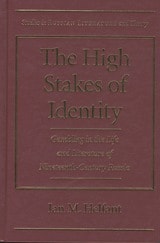
High Stakes of Identity
Gambling in the Life and Literature of Nineteenth-Century RussiaIan M. Helfant
Northwestern University Press, 2002
During the reigns of Alexander I and Nicholas I, Ian Helfant argues, gambling became an essential proving-ground and symbolic locus for noble identity in Russia--a way for the nobility to assert its values (fearlessness, disdain for money, implacable self-possession, deification of whim and will, and stylish performance) against nineteenth-century economics and bourgeois sentimentality. In <i>The High Stakes of Identity</i> Helfant's twin concerns are to analyze the structural components of the myth of the noble "beau joueur" and to show how gambling performances in society and in literature reciprocally reinforced, complicated, and eventually disintegrated its mystique.
Using a broad variety of sources--memoiristic, epistolary, journalistic, legal, fictional, theatrical--Helfant reconstructs both the prevalence and the particular codes of gambling's cultural system in the first few decades of the nineteenth century. These codes allow him to interpret the iconoclastic performances of truly legendary gamblers and to assess the importance and purpose of gambling in works ranging from Pushkin's "Queen of Spades" to Lermontov's "Masquerade." Throughout, Helfant gives voice to the rich variety of discourses, from tsarist laws to moralistic tracts, that came to bear on the culture of gambling in the 1830s and eventually led to its displacement as the key marker of nobility.

High Stakes
Florida Seminole Gaming and SovereigntyJessica R. Cattelino
Duke University Press, 2008
Cattelino presents a vivid ethnographic account of the history and consequences of Seminole gaming. Drawing on research conducted with tribal permission, she describes casino operations, chronicles the everyday life and history of the Seminole Tribe, and shares the insights of individual Seminoles. At the same time, she unravels the complex connections among cultural difference, economic power, and political rights. Through analyses of Seminole housing, museum and language programs, legal disputes, and everyday activities, she shows how Seminoles use gaming revenue to enact their sovereignty. They do so in part, she argues, through relations of interdependency with others. High Stakes compels rethinking of the conditions of indigeneity, the power of money, and the meaning of sovereignty.