Results by title
7 books match the query 'Hiltebeitel, Alf'

History of Religious Ideas, Volume 3
From Muhammad to the Age of ReformsMircea Eliade
University of Chicago Press, 1985
As in his previous work, Eliade pays particular attention to heresies, folk beliefs, and cults of secret wisdom, such as alchemy and sorcery, and continues the discussion, begun in earlier volumes, of pre-Christian shamanistic practices in northern Europe and the syncretistic tradition of Tibetan Buddhism. These subcultures, he maintains, are as important as the better-known orthodoxies to a full understanding of Judaism, Christianity, and Islam.
Rethinking India's Oral and Classical Epics
Draupadi among Rajputs, Muslims, and DalitsAlf Hiltebeitel
University of Chicago Press, 1999
Using his own fieldwork as a starting point, Alf Hiltebeitel analyzes how the oral tradition of the south Indian cult of the goddess Draupadi and five regional martial oral epics compare with one another and tie in with the Sanskrit epics. Drawing on literary theory and cultural studies, he reveals the shared subtexts of the Draupadi cult Mahabharata and the five oral epics, and shows how the traditional plots are twisted and classical characters reshaped to reflect local history and religion. In doing so, Hiltebeitel sheds new light on the intertwining oral traditions of medieval Rajput military culture, Dalits ("former Untouchables"), and Muslims.
Breathtaking in scope, this work is indispensable for those seeking a deeper understanding of South Asia's Hindu and Muslim traditions.
This work is the third volume in Hiltebeitel's study of the Draupadi cult. Other volumes include Mythologies: From Gingee to Kuruksetra (Volume One), On Hindu Ritual and the Goddess (Volume Two), and Rethinking the Mahabharata (Volume Four).
Rethinking the Mahabharata
A Reader's Guide to the Education of the Dharma KingAlf Hiltebeitel
University of Chicago Press, 2001
This work is the fourth volume in Hiltebeitel's study of the Draupadi cult. Other volumes include Mythologies: From Gingee to Kuruksetra (Volume One), On Hindu Ritual and the Goddess (Volume Two), and Rethinking India's Oral and Classical Epics (Volume Three).
Stories about Posts
Vedic Variations around the Hindu GoddessMadeleine Biardeau
University of Chicago Press, 2004
After exploring several ethnographic facts that have escaped the notice of previous observers, Biardeau presents a variety of hunches, hypotheses, and insights building up to the provocative thesis of Stories about Posts: that the variations found in the contemporary cult of the Goddess—in both her royal and rural village aspects—reveal untraced regional histories of the Vedic sacrificial post, the yupa. Biardeau's work opens up new ways of thinking about Vedic sacrificial themes and elements as they recur in post-Vedic texts and iconographies. It also connects wayside stones in Maharashtra named after the buffalo to stones, posts, and people named after a so-called Buffalo King in Maharashtra, Andhra Pradesh, Karnataka, and Tamilnadu.
A work of magnificent scholarship and fieldwork, Stories about Posts, in ways no previous work has attempted, much less accomplished, unravels much of the mystery surrounding contemporary Hindu ritual by connecting it to the ancient Sanskrit epics. As such, it will fascinate students of Indology, religious studies, and anthropology for years to come.
The Cult of Draupadi, Volume 1
Mythologies: From Gingee to KuruksetraAlf Hiltebeitel
University of Chicago Press, 1988
Volume 1 focuses on the Draupadī cult’s own double mythology, moving from its stories about Draupadī’s “primal temple” near the capital of the medieval South Indian Kingdom of Gingee to its version of the Mahābhārata war on the North Indian plain of Kurukṣetra. Throughout, Hiltebeitel intertwines “regional” data, gathered from both oral and written sources, with the “epic,” drawn from the cult’s own performative traditions as well as from classical versions of the Mahābhārata in both Tamil and Sanskrit. Pivotal to the overlap of these Gingee and Kurukṣetra mythologies are two folk figures unknown to classical epic traditions: Draupadī’s two guardians, Pōttu Rāja and Muttāl Rāvuttaṉ.
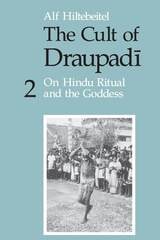
The Cult of Draupadi, Volume 2
On Hindu Ritual and the GoddessAlf Hiltebeitel
University of Chicago Press, 1991
Volume 2 looks at the cultic rituals and argues that these rituals cannot be interpreted independent of other Hindu traditions. Hiltebeitel draws upon his recent fieldwork to demonstrate the remarkable regional and local variations in the practice of the Draupadī cult rituals, from the core area around the ancient center of gingee to the thanjavur area just to the south. He brings to the forefront the differences between the complex rituals of cities, towns, and villages and discusses variations related to their proximity to the central temple in gingee and to the castes from which their customs are derived. using as its model the festival of the Tindivanam temple, Hiltebeitel’s study follows the order of the festival itself and investigates in turn the festival’s four interrelated arenas: the Draupadī temple, a drama stage, a ritual battlefield (paṭukaḷam), and a firewalking area. He explains how the Draupadī festival orchestrates movements back and forth between these arenas to produce a “ritual of battle” in which Draupadī emerges as the victorious goddess.

The Destiny of a King
Georges Dumézil
University of Chicago Press, 1988
The Destiny of a King examines one of the "little" epics within the Mahabharata—the legend of King Yayati, a distant ancestor of the Pandavas, the heroes of the larger epic. Dumézil compares Yayati's attributes and actions with those of the legendary Celtic king Eochaid Feidlech and also finds striking similarities in the stories surrounding the daughters of these two kings, the Indian Madhavi and the Celtic Medb. When he compares these two traditions with the "first king" legends from Iran, he finds such common themes as the apportionment of the earth and the "sin of the sovereign."