Results by title
6 books match the query 'Hindus'
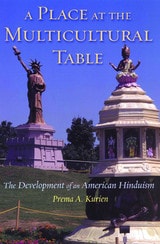
A Place at the Multicultural Table
The Development of an American HinduismKurien, Prema
Rutgers University Press, 2007
In A Place at the Multicultural Table, Prema A. Kurien shows how various Hindu American organizations--religious, cultural, and political--are attempting to answer the puzzling questions of identity outside their homeland. Drawing on the experiences of both immigrant and American-born Hindu Americans, Kurien demonstrates how religious ideas and practices are being imported, exported, and reshaped in the process. The result of this transnational movement is an American Hinduism--an organized, politicized, and standardized version of that which is found in India.
This first in-depth look at Hinduism in the United States and the Hindu Indian American community helps readers to understand the private devotions, practices, and beliefs of Hindu Indian Americans as well as their political mobilization and activism. It explains the differences between immigrant and American-born Hindu Americans, how both understand their religion and their identity, and it emphasizes the importance of the social and cultural context of the United States in influencing the development of an American Hinduism.
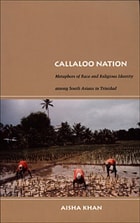
Callaloo Nation
Metaphors of Race and Religious Identity among South Asians in TrinidadAisha Khan
Duke University Press, 2004
Khan combines ethnographic research she conducted in Trinidad over the course of a decade with extensive archival research to explore how Hindu and Muslim Indo-Trinidadians interpret authority, generational tensions, and the transformations of Indian culture in the Caribbean through metaphors of mixing. She demonstrates how ambivalence about the desirability of a callaloo nation—a multicultural society—is manifest around practices and issues, including rituals, labor, intermarriage, and class mobility. Khan maintains that metaphors of mixing are pervasive and worth paying attention to: the assumptions and concerns they communicate are key to unraveling who Indo-Trinidadians imagine themselves to be and how identities such as race and religion shape and are shaped by the politics of multiculturalism.
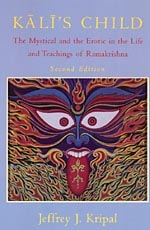
Kali's Child
The Mystical and the Erotic in the Life and Teachings of RamakrishnaJeffrey J. Kripal
University of Chicago Press, 1998
In a substantial new preface to this second edition, Kripal answers his critics, addresses the controversy the book has generated in India, and traces the genealogy of his work in the history of psychoanalytic discourse on mysticism, Hinduism, and Ramakrishna himself. Kali's Child has already proven to be provocative, groundbreaking, and immensely enjoyable.
"Only a few books make such a major contribution to their field that from the moment of publication things are never quite the same again. Kali's Child is such a book."—John Stratton Hawley, History of Religions
Winner of the American Academy of Religion's History of Religions Prize for the Best First Book of 1995

Kali's Child
The Mystical and the Erotic in the Life and Teachings of RamakrishnaJeffrey J. Kripal
University of Chicago Press, 1995
In this work, Jeffrey J. Kripal attempts to untangle the paradox. He demonstrates that Ramakrishna's famous mystical experiences were driven by erotic energies that he neither fully accepted nor understood; the key to understanding this extraordinary figure, Kripal argues, lies in Tantra and its ritual, symbolic, and doctrinal equation of the mystical and the erotic.
Moving through Ramakrishna's world both chronologically and conceptually, Kali's Child employs two complementary interpretive strategies, a nuanced phenomenological reinterpretation of original Bengali texts and a nonreductive psychoanalytic reading of Ramakrishna's mystical eroticism. Kripal shows how the heterosexual structure of Tantric symbolism, the abusive way its rituals were often forced upon the saint, and Ramakrishna's own homosexual desires all came together to produce in him profound feelings of shame, disgust, and fear. Kripal establishes that the homosexuality of this great, if unwilling, Tantric mystic is linked inextricably to virtually every aspect of his life and teachings.
The Colors of Violence
Cultural Identities, Religion, and ConflictSudhir Kakar
University of Chicago Press, 1996
With honesty, insight, and unsparing self-reflection, Kakar confronts the profoundly enigmatic relations that link individual egos to cultural moralities and religious violence. His innovative psychological approach offers a framework for understanding the kind of ethnic-religious conflict that has so vexed social scientists in India and throughout the world.
Through riveting case studies, Kakar explores cultural stereotypes, religious antagonisms, ethnocentric histories, and episodic violence to trace the development of both Hindu and Muslim psyches. He argues that in early childhood the social identity of every Indian is grounded in traditional religious identifications and communalism. Together these bring about deep-set psychological anxieties and animosities toward the other. For Hindus and Muslims alike, violence becomes morally acceptable when communally and religiously sanctioned. As the changing pressures of modernization and secularism in a multicultural society grate at this entrenched communalism, and as each group vies for power, ethnic-religious conflicts ignite. The Colors of Violence speaks with eloquence and urgency to anyone concerned with the postmodern clash of religious and cultural identities.
The People, in Parts
The Majoritarian Work of the Minority FormNatasha S. Raheja
University of Chicago Press, 2027
Offers a new theory of the minority as a political form and shows how majoritarian projects are built through its appropriation.
Around the world, national majorities are telling themselves a potent story: that they are the ones in danger. In the United States and Serbia, Christian and white nationalists warn of “replacement.” In Turkey and Pakistan, Muslim nationalists cast religious “others” as existential threats. In India, Hindu nationalists claim that Hindus are becoming minorities in “their own” land. These movements, and the migration and citizenship policies that accompany them, are not aberrations, but rather expressions of a logic embedded in the modern nation-state—a logic that turns people into numbers, numbers into votes, and difference into enmity.
In The People, in Parts, anthropologist Natasha S. Raheja homes in on a paradox visible along the India-Pakistan border. When Hindus cross into India from Pakistan seeking refuge, they are admitted as minorities in need of protection. Yet in India, their welcome into the putative majority is selective and conditional. How does majority-minority status shift by crossing a border? Drawing on long-term research in the Thar Desert region, across Sindh and Rajasthan, Raheja traces how caste and religion shape people's encounters with the state and argues that this bureaucratic confusion is political machinery. Where liberal democracy treats the minority as a shifting, procedural category, nation-state governance fixes it as a substantive identity. The suffering of minoritized populations becomes raw material for majoritarian projects, converted into demographic justification, electoral arithmetic, and nationalist grievance. The minority form, in other words, does majoritarian work.
The People, in Parts offers not only a searing diagnosis of minority-majority politics and the governance of migration but a reframing: the problem is not simply about who belongs and who does not, but how nationalist belonging crosses state borders, pointing to strains within liberal democracy and the nation-state order.