Results by title
14 books match the query 'Historian'

A Historian and His World
A Life of Christopher Dawson, 1889-1970Christina Scott
Catholic University of America Press, 2023
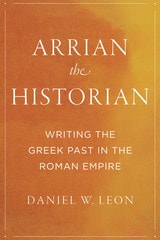
Arrian the Historian
Writing the Greek Past in the Roman EmpireBy Daniel W. Leon
University of Texas Press, 2021
During the first centuries of the Roman Empire, Greek intellectuals wrote a great many texts modeled on the dialect and literature of Classical Athens, some 500 years prior. Among the most successful of these literary figures were sophists, whose highly influential display oratory has been the prevailing focus of scholarship on Roman Greece over the past fifty years. Often overlooked are the period’s historians, who spurned sophistic oral performance in favor of written accounts. One such author is Arrian of Nicomedia.
Daniel W. Leon examines the works of Arrian to show how the era's historians responded to their sophistic peers’ claims of authority and played a crucial role in theorizing the past at a time when knowledge of history was central to defining Greek cultural identity. Best known for his history of Alexander the Great, Arrian articulated a methodical approach to the study of the past and a notion of historical progress that established a continuous line of human activity leading to his present and imparting moral and political lessons. Using Arrian as a case study in Greek historiography, Leon demonstrates how the genre functioned during the Imperial Period and what it brings to the study of the Roman world in the second century.
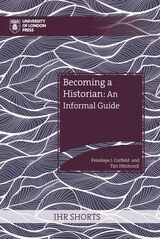
Becoming a Historian
An Informal GuideEdited by Penelope J. Corfield and Tim Hitchcock
University of London Press, 2022
Writing history is both an art and a craft. This handbook is designed as an instructional guide to support students, independent scholars, and more. Becoming a Historian guides prospective historians on how best to participate in this vibrant community of scholars. This friendly guide will teach readers how to design research projects, how to differentiate between quantitative and qualitative research methodologies, and how to follow a project through to a positive conclusion. Becoming a Historian is also frank about the pains and pleasures of sticking with a long-term project. Finally, this guide explains how to present original research to wider audiences, including the appropriate use of social media, the art of public lecturing, and strategies for publication.
Written by esteemed historians Penelope J. Corfield and Tim Hitchcock, who bring more than forty years of collective experience to the project, Becoming a Historian explodes the myths and systems that can make the world of research seem intimidating. Instead, this guide offers step-by-step advice designed to make it easier to join this community of scholarship.
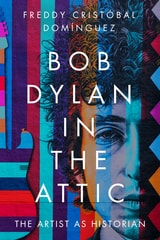
Bob Dylan in the Attic
The Artist as HistorianFreddy Cristóbal Domínguez
University of Massachusetts Press, 2022
Bob Dylan is an iconic American artist, whose music and performances have long reflected different musical genres and time periods. His songs tell tales of the Civil War, harken back to 1930s labor struggles, and address racial violence at the height of the civil rights movement, helping listeners to think about history, and history making, in new ways. While Dylan was warned by his early mentor, Dave Van Ronk, that, “You’re just going to be a history book writer if you do those things. An anachronism,” the musician has continued to traffic in history and engage with a range of source material—ancient and modern—over the course of his career.
In this beautifully crafted book, Freddy Cristóbal Domínguez makes a provocative case for Dylan as a historian, offering a deep consideration of the musician’s historical influences and practices. Utilizing interviews, speeches, and the close analysis of lyrics and live performances, Bob Dylan in the Attic is the first book to consider Dylan’s work from the point of view of historiography.
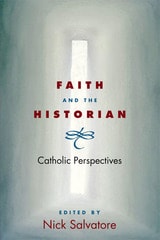
Faith and the Historian
CATHOLIC PERSPECTIVESEdited by Nick Salvatore
University of Illinois Press, 2006
Faith and the Historian collects essays from eight experienced historians discussing the impact of being "touched" by Catholicism on their vision of history. That first graduate seminar, these essays suggest, did not mark the inception of one's historical sensibilities; rather, that process had deeper, and earlier, roots. The authors--ranging from "cradle to the grave" Catholics to those who haven’t practiced for forty years, and everywhere in between--explicitly investigate the interplay between their personal lives and beliefs and the sources of their professional work. A variety of heartfelt, illuminating, and sometimes humorous experiences emerge from these stories of intelligent people coming to terms with their Catholic backgrounds as they mature and enter the academy. Contributors include: Philip Gleason, David Emmons, Maureen Fitzgerald, Joseph A. McCartin, Mario T. Garcia, Nick Salvatore, James R. Barrett, and Anne M. Butler.
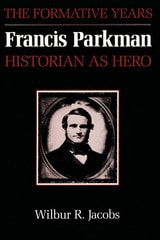
Francis Parkman, Historian as Hero
The Formative YearsBy Wilbur R. Jacobs
University of Texas Press, 1991
A historian who lived the kind of history he wrote, Francis Parkman is a major—and controversial—figure in American historiography. His narrative style, while popular with readers wanting a "good story," has raised many questions with professional historians. Was Parkman writing history or historical fiction? Did he color historical figures with his own heroic self-image? Was his objectivity compromised by his "unbending, conservative, Brahmin" values? These are some of the many issues that Wilbur Jacobs treats in this thought-provoking study.
Jacobs carefully considers the "apprenticeship" of Francis Parkman, first spent in facing the rigors of the Oregon Trail and later in struggling to write his histories despite a mysterious, frequently incapacitating illness. He shows how these events allowed Parkman to create a heroic self-image, which impelled his desire for fame as a historian and influenced his treatment of both the "noble" and the "savage" characters of his histories.
In addition to assessing the influence of Parkman's development and personality on his histories, Jacobs comments on Parkman's relationship to basic social and cultural issues of the nineteenth century. These include the slavery question, Native American issues, expansion of the suffrage to new groups, including women, and anti-Catholicism.
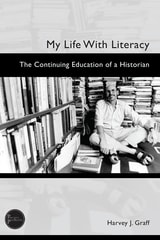
My Life with Literacy
The Continuing Education of a HistorianHarvey J. Graff
University Press of Colorado, 2025
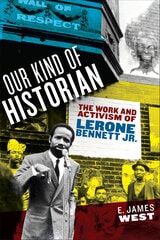
Our Kind of Historian
The Work and Activism of Lerone Bennett Jr.E. James West
University of Massachusetts Press, 2022
Journalist, activist, popular historian, and public intellectual, Lerone Bennett Jr. left an indelible mark on twentieth-century American history and culture. Rooted in his role as senior editor of Ebony magazine, but stretching far beyond the boundaries of the Johnson Publishing headquarters in Chicago, Bennett’s work and activism positioned him as a prominent advocate for Black America and a scholar whose writing reached an unparalleled number of African American readers.
This critical biography—the first in-depth study of Bennett’s life—travels with him from his childhood experiences in Jim Crow Mississippi and his time at Morehouse College in Atlanta to his later participation in a dizzying range of Black intellectual and activist endeavors. Drawing extensively on Bennett’s previously inaccessible archival collections at Emory University and Chicago State, as well as interviews with close relatives, colleagues, and confidantes, Our Kind of Historian celebrates his enormous influence within and unique connection to African American communities across more than half a century of struggle.
Technology and the Historian
Transformations in the Digital AgeAdam Crymble
University of Illinois Press, 2021
Historians have seen their field transformed by the digital age. Research agendas, teaching and learning, scholarly communication, the nature of the archive—all have undergone a sea change that in and of itself constitutes a fascinating digital history. Yet technology's role in the field's development remains a glaring blind spot among digital scholars.
Adam Crymble mines private and web archives, social media, and oral histories to show how technology and historians have come together. Using case studies, Crymble merges histories and philosophies of the field, separating issues relevant to historians from activities in the broader digital humanities movement. Key themes include the origin myths of digital historical research; a history of mass digitization of sources; how technology influenced changes in the curriculum; a portrait of the self-learning system that trains historians and the problems with that system; how blogs became a part of outreach and academic writing; and a roadmap for the continuing study of history in the digital era.
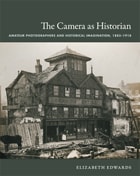
The Camera as Historian
Amateur Photographers and Historical Imagination, 1885-1918Elizabeth Edwards
Duke University Press, 2012
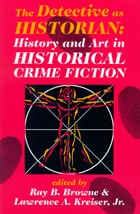
The Detective as Historian
History and Art in Historical Crime FictionEdited by Ray B. Browne and Lawrence A. Kreiser, Jr.; Preface by Robin W. Winks
University of Wisconsin Press, 2000
Topics include: Ellis Peter’s Brother Cadfael; Umberto Eco’s Name of the Rose; Susanna Gregory’s Doctor Matthew Bartholomew; Peter Heck’s Mark Twain as detective; Anne Perry and her Victorian-era world; Caleb Carr’s works; and Elizabeth Peter’s Egyptologist-adventurer tales.

The Historian and Believer
The Morality of Historical Knowledge and Christian BeliefVan A. Harvey
University of Illinois Press, 1952
theology--available again!
"As a critic of the contemporary
theological scene, Van Harvey has few, if any, competitors. This is nowhere
clearer than in The Historian and the Believer . . . the classic
discussion of its topic. Rich in insight and penetrating in argument,
it is one book that belongs in the library of every theologian and seminarian."
-- Schubert M. Ogden, author of Doing Theology Today
Is it possible to be both
a historian and a Christian? Van Harvey's classic The Historian and
the Believer posed that question when it was first published.
In this printing, the author
has provided a new introduction in which he reflects on how he would reframe
his original argument in order to bring out more fully the basic theological
intention underlying his view that Christian faith cannot rest on dubious
historical claims.
From reviews of the first
edition:
"Probably the most interesting
piece of American theological writing to appear this year." -- John
Reumann, Union Seminary Quarterly Review
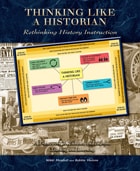
Thinking Like a Historian
Rethinking History InstructionNikki Mandell
Wisconsin Historical Society Press, 2008
The contributors to Thinking Like a Historian are experienced historians and educators from elementary through university levels. This philosophical and pedagogical guide to history as a discipline uses published standards of the American Historical Association, the Organization of American Historians, the National Council for History Education, the National History Standards and state standards for Wisconsin and California.
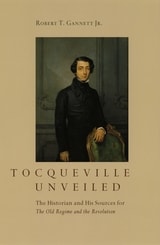
Tocqueville Unveiled
The Historian and His Sources for The Old Regime and the RevolutionRobert T. Gannett Jr.
University of Chicago Press, 2003
Drawing on his unprecedented access to Tocqueville's papers—access made possible by the late French historian Francois Furet—Robert T. Gannett Jr. reveals the ingenuity of Tocqueville's analyses of issues such as landownership, administrative centralization, and public opinion in prerevolutionary France. He also sheds light on the benefits Tocqueville reaped from unexpected intellectual encounters with such authors as Burke, Constant, and Dareste de la Chavanne. A literary detective at work, Gannett tracks Tocqueville as the author himself tracked the French Revolution—and brings him to life as a meticulous historian and an ardent defender of liberty.
An ideal companion to The Old Regime and the Revolution, Volumes 1 and 2, both published by the University of Chicago Press, Tocqueville Unveiled will be a valuable resource for revolutionary historians and Tocqueville enthusiasts alike.