Results by title
75 books match the query 'Historic Preservation' and 8 start with a
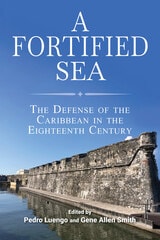
A Fortified Sea
The Defense of the Caribbean in the Eighteenth CenturyEdited by Pedro Luengo and Gene Allen Smith
University of Alabama Press, 2024
WINNER OF THE SOCIETY FOR MILITARY HISTORY'S 2025 DISTINGUISHED BOOK AWARD
A multinational, interdisciplinary study illuminating how fortifications reshaped the Caribbean as a contested imperial borderland in the eighteenth century.
A Fortified Sea illuminates the key role of military forts in the greater Caribbean during the long eighteenth century. The historical Caribbean, with its multiple contested boundaries at the periphery of European western expansion, typically has been analyzed as part of an empire. European powers, including Spain, the Netherlands, England, and Denmark, carved up the Caribbean Sea into a cultural patchwork. These varied cultural contexts were especially evident during regional and national conflicts throughout the eighteenth century and prompted the construction of more fortifications to protect imperial interests. The emergence of Anglo-American colonies during the eighteenth century and later the United States gradually altered previous geopolitical balances, redefining the cultural and geopolitical boundaries of the region.
This collection of essays incorporates several historiographical traditions—from Spanish to American—all portraying the borderland as a breakthrough contested cultural, social, economic, and military boundary. A multinational roster of contributors approaches topics through a war studies lens as well as architecturally and historically, enriching a usually monothematic view. As well, discussion of cultural management of the historical remains of forts shows local communities trying to preserve and interpret the role of forts in society.
Part I defines the training of military engineers in Spain. Part II engages with British defensive military plans and settlements in the Caribbean and shows how the British dealt with the rhetorical image of the empire. Part III clarifies the building processes of fortifications in Santiago de Cuba, Cartagena de Indias, Havana, and Veracruz, among other places. Copious period maps complement the prodigious research. The book will appeal to readers interested in the history of the Caribbean, military history, and European imperial expansion.
CONTRIBUTORS
Mónica Cejudo Collera / Pedro Cruz Freire / María Mercedes Fernández Martín / Aaron Graham / Manuel Gámez Casado / Francisco Javier Herrera García / Nuria Hinarejos Martín / Pedro Luengo / Ignacio J. López-Hernández / José Miguel Morales Folguera / Alfredo J. Morales / Juan Miguel Muñoz Corbalán / Jesús Maria Ruiz Carrasco / Germán Segura García / Gene Allen Smith / Christopher K. Waters
A Passion to Preserve
Gay Men as Keepers of CultureWill Fellows
University of Wisconsin Press, 2005
From large cities to rural communities, gay men have long been impassioned pioneers as keepers of culture: rescuing and restoring decrepit buildings, revitalizing blighted neighborhoods, saving artifacts and documents of historical significance. A Passion to Preserve explores this authentic and complex dimension of gay men’s lives by profiling early and contemporary preservationists from throughout the United States, highlighting contributions to the larger culture that gays are exceptionally inclined to make.

A President, a Church and Trails West
Competing Histories in Independence, MissouriJon E. Taylor
University of Missouri Press, 2008
Over the past century, three nationally significant histories have vied for space and place in Independence, Missouri. Independence was declared Zion by Joseph Smith, served as a gathering and provisioning point for trails west, and was called home by President Harry S. Truman for sixty-four years. Historian Jon E. Taylor has integrated research from newspapers, public documents, oral histories, and private papers to detail how the community has preserved and remembered these various legacies.
Truman’s legacy would appear to have been secured in Independence via three significant designations—his presidential library opened there in 1957, his neighborhood was designated a national historic landmark in 1972, and his home was declared a national historic site in 1982. However, Taylor argues that Truman’s seeming dominance in the community’s memory is in fact endangered by competition from the other aspects of the town’s historical heritage.
Taylor considers the role Mormon history has played in the city's history and chronicles how the Reorganized Church of Jesus Christ of Latter Day Saints returned to Independence to fulfill Joseph Smith's dream of creating Zion in the city, a situation that impacted neighborhoods near the Truman home. Taylor also examines the city's fascination with the Santa Fe, Oregon, and California trails, detailing how that history was lost and remembered and is now immortalized on the Independence square and in the National Frontier Trails Museum.
In the 1980s, the city council reduced the size of the Truman Heritage District, created to maintain Truman’s association with his neighborhood, after church opposition. At the same time, city officials pushed to make Independence a major tourist destination, a move largely dependent upon the city capitalizing on its association with Truman. These inconsistent policies and incongruous goals have led to innumerable changes in the landscape Truman enjoyed during his legendary morning walks.
A President, a Church, and Trails West chronicles one city’s struggle to preserve its history and the built environment. Taylor places the role of preservation in Independence not only within the larger context of preservation in the United States but also within the context of American environmental history. This volume is sure to appeal to anyone interested in public history, historic preservation, history and memory, and local history.
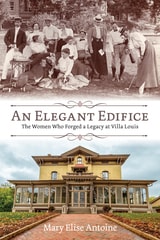
An Elegant Edifice
The Women Who Forged a Legacy at Villa LouisMary Elise Antoine
Wisconsin Historical Society Press, 2026
On the banks of the upper Mississippi River at Prairie du Chien, Wisconsin, stands Villa Louis, the majestic Italianate-style mansion and estate built by the prosperous Dousman family in 1871. An Elegant Edifice tells the stories of the women of the Dousman residence. Jane, who outlived her husband by fourteen years, oversaw the estate and maintained the family’s presence in Prairie du Chien. Jane’s daughter-in-law, Nina, managed the property and assumed the role of head of the family following her husband’s death, ensuring stability for her children during times of tragedy. Finally, Nina’s daughters Violet and Virginia helped to restore the family home in the 1930s, secure its future as a historic site, and record the Dousmans’ history for posterity.
An Elegant Edifice illustrates the broad strokes of American expansionism through the backgrounds and activities of these influential women, complete with marriages and separations, births and deaths, business disputes, lawsuits, and reconciliations. With stories of St. Louis and St. Paul society, the stylish shops of New York City, and the prominence of Prairie du Chien in the nineteenth century, this book reveals the leisure activities and extravagant lifestyle afforded to the family by their wealth—Tiffany jewelry and housewares, William Morris wallpaper and fabrics, Jaccard silver, and a fine art collection to rival the public museums of the era.
Thanks to the women’s fortitude and shared conviction in the importance of family, Villa Louis has been preserved and restored to its 1890s splendor and is today considered one of the most authentically restored Italianate villas in the United States. While previous histories have focused on the Dousman patriarchs, public historian Mary Elise Antoine offers a new perspective on the Dousman family history by bringing into focus Jane, Nina, Violet, and Virginia. These women’s lives—historically less well-documented than the lives of their husbands, fathers, and sons—contributed greatly to the preservation of Villa Louis and to our understanding of an important chapter in American history.
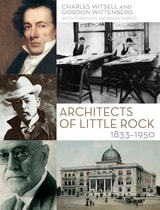
Architects of Little Rock
1833-1950Charles Witsell
University of Arkansas Press, 2014
Published in collaboration with the Fay Jones School of Architecture.
Architecture and Fire
A Psychoanalytic Approach to ConservationStamatis Zografos
University College London, 2019
Founded in inventive interdisciplinary research that ranges across architecture and conservation, archival theory, classical mythology, evolutionary theory, philosophy, and psychoanalysis, Architecture and Fire draws on the insights of psychoanalysis to offer such a reassessment. Among the topics discussed are the ambivalent nature of fire, seen through the conflicting philosophies of Gaston Bachelard and Henri Bergson; the ways in which architecture evolves by absorbing and accommodating fire; and the destruction of buildings by fire as a critical moment of architectural evolution, with a focus on the tragic disaster at London’s Grenfell Tower in 2017. Stamatis Zografos concludes with thoughts on Freud’s drive theory. He argues that the practice of architectural conservation is an expression of the life drive and a simultaneous repression of the death drive, which suggests controlled destruction should be an integral part of the conservation agenda.
Architecture of Middle Tennessee
The Historic American Buildings SurveyThomas B. Brumbaugh
Vanderbilt University Press, 1974
Vanderbilt staffers discovered a treasure trove of photos and diagrams from the HABS survey that did not make the original edition in the Press archives. This new, expanded edition contains all of the original text and images from the first volume, plus many of the forgotten archived materials collected by HABS in the 1970s.
In her new introduction to this reissue, Aja Bain discusses why these buildings were saved and wonders about what lessons preservationists can learn now about how to preserve a wider swath of our shared history.
Asylum on the Hill
History of a Healing LandscapeKatherine Ziff
Ohio University Press, 2012
Asylum on the Hill is the story of a great American experiment in psychiatry, a revolution in care for those with mental illness, as seen through the example of the Athens Lunatic Asylum. Built in southeast Ohio after the Civil War, the asylum embodied the nineteenth-century “gold standard” specifications of moral treatment. Stories of patients and their families, politicians, caregivers, and community illustrate how a village in the coalfields of the Hocking River valley responded to a national movement to provide compassionate care based on a curative landscape, exposure to the arts, outdoor exercise, useful occupation, and personal attention from a physician.
Katherine Ziff’s compelling presentation of America’s nineteenth-century asylum movement shows how the Athens Lunatic Asylum accommodated political, economic, community, family, and individual needs and left an architectural legacy that has been uniquely renovated and repurposed. Incorporating rare photos, letters, maps, and records, Asylum on the Hill is a fascinating glimpse into psychiatric history.