Results by title
19 books match the query 'Historical Perspectives'
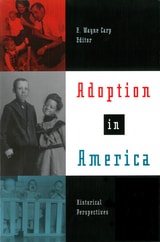
Adoption in America
Historical PerspectivesE. Wayne Carp, Editor
University of Michigan Press, 2004
---Choice
"Sheds new light on the roots of this complex and fascinating institution."
---Library Journal
"Well-written and accessible . . . showcases the wide-ranging scholarship underway on the history of adoption."
---Adoptive Families
"[T]his volume is a significant contribution to the literature and can serve as a catalyst for further research."
---Social Service Review
Adoption affects an estimated 60 percent of Americans, but despite its pervasiveness, this social institution has been little examined and poorly understood. Adoption in America gathers essays on the history of adoptions and orphanages in the United States. Offering provocative interpretations of a variety of issues, including antebellum adoption and orphanages; changing conceptions of adoption in late-nineteenth-century novels; Progressive Era reform and adoptive mothers; the politics of "matching" adoptive parents with children; the radical effect of World War II on adoption practices; religion and the reform of adoption; and the construction of birth mother and adoptee identities, the essays in Adoption in America will be debated for many years to come.

Another's Country
Archaeological and Historical Perspectives on Cultural Interactions in the Southern ColoniesEdited by J.W. Joseph and Martha Zierden
University of Alabama Press, 2001
The 18th-century South was a true melting pot, bringing together colonists from England, France, Germany, Ireland, Switzerland, and other locations, in addition to African slaves—all of whom shared in the experiences of adapting to a new environment and interacting with American Indians. The shared process of immigration, adaptation, and creolization resulted in a rich and diverse historic mosaic of cultures.
The cultural encounters of these groups of settlers would ultimately define the meaning of life in the nineteenth-century South. The much-studied plantation society of that era and the Confederacy that sprang from it have become the enduring identities of the South. A full understanding of southern history is not possible, however, without first understanding the intermingling and interactions of the region’s eighteenth-century settlers. In the essays collected here, some of the South’s leading historical archaeologists examine various aspects of the colonial experience, attempting to understand how cultural identity was expressed, why cultural diversity was eventually replaced by a common identity, and how the various cultures intermeshed.
Written in accessible language, this book will be valuable to archaeologists and non-archaeologists alike. Cultural, architectural, and military historians, cultural anthropologists, geographers, genealogists, and others interested in the cultural legacy of the South will find much of value in this book.

Biological Individuality
Integrating Scientific, Philosophical, and Historical PerspectivesEdited by Scott Lidgard and Lynn K. Nyhart
University of Chicago Press, 2017
Bringing together biologists, historians, and philosophers, this book provides a multifaceted exploration of biological individuality that identifies leading and less familiar perceptions of individuality both past and present, what they are good for, and in what contexts. Biological practice and theory recognize individuals at myriad levels of organization, from genes to organisms to symbiotic systems. We depend on these notions of individuality to address theoretical questions about multilevel natural selection and Darwinian fitness; to illuminate empirical questions about development, function, and ecology; to ground philosophical questions about the nature of organisms and causation; and to probe historical and cultural circumstances that resonate with parallel questions about the nature of society. Charting an interdisciplinary research agenda that broadens the frameworks in which biological individuality is discussed, this book makes clear that in the realm of the individual, there is not and should not be a direct path from biological paradigms based on model organisms through to philosophical generalization and historical reification.

Changing Pacific Forests
Historical Perspectives on the Pacific Basin Forest EconomyJohn Dargavel and Richard P. Tucker, eds.
Duke University Press, 1992
Drawing on a 1991 conference sponsored by the Forest History Society and the International Union of Forestry Research Organizations held in Honolulu, these papers address a range of topics related to the changing Pacific forests, including the remnants of colonialism, the emergence of the Third World, people and resources caught in the middle of policy decisions, land management, national forests, and subsistence use of the forest by indigenous peoples. Essays also explore macroeconomic theories of international trade and the interests of the United States and the former Soviet Union in the economic health of the region. Changing Pacific Forests will be of interest to scholars of the economy and environment of the Pacific Basin as well as of land management and the history of land use in general.
Contributors. Charles S. Backman, Thomas R. Cox, John Dargavel, Elizabeth Flint, Lim Hin Fui, G. R. Henning, Kenneth E. Jackson, Hiroaki Kakizawa, Nicholas K. Menzies, Andrew Price, John F. Richards, Jr., M. M. Roche, I. Gustin M. Tantra, Conrad Totman, Richard P. Tucker, Thomas R. Waggener
Changing Tropical Forests
Historical Perspectives on Today’s Challenges in Central and South AmericaHarold K. Steen and Richard P. Tucker, eds.
Duke University Press, 1991
Contributors. William Balée, James R. Barborak, Peter Boomgaard, Larissa V. Brown, Gerardo Budowski, John Dargavel, Warren Dean, Silvia del Amo R., Elizabeth Graham, J. Régis Guillaumon, Rhena Hoffmann, Sally P. Horn, Sebastião Kengen, Herman W. Konrad, Mary Pamela Lehmann, Robert D. Leier, Murdo J. MacLeod, M. Patricia Marchak, Elinor G. K. Melville, David M. Pendergast, Susan M. Pierce, Leslie E. Sponsel, Richard P. Tucker, Terry West

Coordination and Information
Historical Perspectives on the Organization of EnterpriseEdited by Naomi R. Lamoreaux and Daniel M. G. Raff
University of Chicago Press, 1995
In an ideal world, the market would be the optimal provider of coordination, but in the real world of incomplete information, some activities are better coordinated in other ways. Divided into three parts, this book addresses coordination within firms, at the borders of firms, and outside firms, providing a picture of the overall incidence and logic of economic coordination. The case studies—drawn from the late nineteenth and early twentieth century, when the modern business enterprise was evolving, address such issues as the relationship between coordination mechanisms and production techniques, the logic of coordination in industrial districts, and the consequences of regulation for coordination.
Continuing the work on information and organization presented in the influential Inside the Business Enterprise, this book provides material for business historians and economists who want to study the development of the dissemination of information and the coordination of economic activity within and between firms.
Creative Urban Milieus
Historical Perspectives on Culture, Economy, and the CityEdited by Martina Heßler and Clemens Zimmermann
Campus Verlag, 2008
Skeptical of the current euphoria surrounding the commercialization of culture, a distinguished group of contributors apply a comparative and historical perspective to probe how creative works have affected the global economy. Drawing on lessons from urban planning, art history, and cultural spectacles alike, Creative Urban Milieus will change the way we think about the symbiotic relationship between cities and innovation.

Defending the Homeland
Historical Perspectives on Radicalism, Terrorism, and State ResponsesMELINDA M. HICKS
West Virginia University Press, 2007
Terrorism and national security have been in the foreground of the nation’s political landscape since the uncertain times brought on by the attacks of September 11, 2001. This collection of scholarly essays provides a chance to learn from the past by offering an analytic—and sometimes provocative—look at the inseparability of security and history. This work is divided into separate elements depicting security on the national and international levels. "Part One–The US and National Security," focuses on topics such as “Rank-And-File Rednecks: Radicalism and Union Leadership in the West Virginia Mine Wars,” among others. "Part Two–International Terrorism," looks at violence overseas, such as “Beyond Victims and Perpetrators: Women Terrorists and Their Own Stories.”
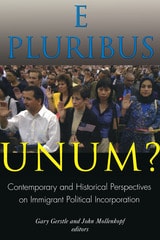
E Pluribus Unum?
Contemporary and Historical Perspectives on Immigrant Political IncorporationGary Gerstle
Russell Sage Foundation, 2001
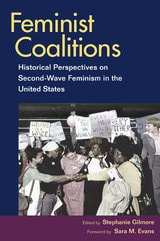
Feminist Coalitions
Historical Perspectives on Second-Wave Feminism in the United StatesEdited by Stephanie Gilmore. Foreword by Sara Evans.
University of Illinois Press, 2007
Much of the scholarship on second-wave feminism has focused on divisions within the women's movement and its narrow conception of race and class, but the contributors to this volume remind readers that feminists in the 1960s and 1970s also formed many strong partnerships, often allying themselves with a diverse range of social justice efforts on a local grassroots level. These essays focus on coalitions and alliances in which feminists and other activists joined forces to address crucial social justice issues such as reproductive rights, the peace movement, women's health, Christianity and other religions, and neighborhood activism, as well as alliances crossing boundaries of race, class, political views, and sexual identity. The contributors bring fresh perspectives to feminist history by calling attention to how women struggled to include and represent diverse women without minimizing the difficulties of conceptualizing a singular feminism.
Contributors are Maria Bevacqua, Tamar Carroll, Marisa Chappell, Andrea Estepa, Sara M. Evans, Amy Farrell, Stephanie Gilmore, Cynthia Harrison, Elizabeth Kaminski, Wendy Kline, Premilla Nadasen, Caryn Neumann, Anne M. Valk, and Emily Zuckerman.

Gender and Sexuality in the Midwest
Historical PerspectivesKatherine Jellison
Ohio University Press, 2027
This book is a collection of eleven essays, an introduction, and a conclusion that discuss issues of gender and sexuality in the twelve states of the Midwest. The book covers 200 years of midwestern history—from the early nineteenth century to the early twenty-first century—and includes the experiences of midwesterners of diverse races, religions, and sexualities. The essays are arranged according to three topical categories. Essays in the first section of the book deal with some aspect of Memory and Methodology, those in the second section engage matters of Community and Belief, and the chapters in the final third of the manuscript address intersections of Biography and Politics. The authors of all eleven essays firmly ground their analyses within the categories of gender and/or sexuality. Essayists include discussion of men and masculinity as well as women and femininity. In addition, several of the essays address situations outside the realm of heterosexual monogamy: plural marriage, celibacy, LGBTQ+ relationships. In other words, the book engages with developments in subject matter and methodology that have changed the gender studies field over the past 15-30 years.
Authors have written their essays with an eye toward a broad audience. The book is appropriate reading for historians of women, gender, and sexuality; scholars of midwestern history and midwestern studies; undergraduate and graduate students in women’s and gender history courses; undergraduate and graduate students in women’s, gender, and sexuality studies courses; and non-academic readers with a particular interest in the Midwest or gender history.
Contributors
Kristin Mapel Bloomberg
Nikki Berg Burin
Stewart Davenport
Kara M. French
Barbara Handy-Marchello
Birgit Hans
Dean J. Kotlowski
David Mislin
Cynthia C. Prescott
Ashley Rattner
Jordan Zdinak

Global Health in Africa
Historical Perspectives on Disease ControlTamara Giles-Vernick
Ohio University Press, 2013
Global Health in Africa is a first exploration of selected histories of global health initiatives in Africa. The collection addresses some of the most important interventions in disease control, including mass vaccination, large-scale treatment and/or prophylaxis campaigns, harm reduction efforts, and nutritional and virological research.The chapters in this collection are organized in three sections that evaluate linkages between past, present, and emergent. Part I, “Looking Back,” contains four chapters that analyze colonial-era interventions and reflect upon their implications for contemporary interventions. Part II, “The Past in the Present,” contains essays exploring the historical dimensions and unexamined assumptions of contemporary disease control programs. Part III, “The Past in the Future,” examines two fields of public health intervention in which efforts to reduce disease transmission and future harm are premised on an understanding of the past.
This much-needed volume brings together international experts from the disciplines of demography, anthropology, and historical epidemiology. Covering health initiatives from smallpox vaccinations to malaria control to HIV campaigns, Global Health in Africa offers a first comprehensive look at some of global health’s most important challenges.
Growing Explanations
Historical Perspectives on Recent ScienceM. Norton Wise, ed.
Duke University Press, 2004
Written by leading historians and philosophers of science, these essays examine the range of subjects, people, and goals involved in changing the character of scientific analysis over the last several decades. They highlight the alternatives that fields as diverse as string theory, fuzzy logic, artificial life, and immunology bring to the forms of explanation that have traditionally defined scientific modernity. A number of the essays deal with the mathematical and physical sciences, addressing concerns with hybridity and the materials of the everyday world. Other essays focus on the life sciences, where questions such as “What is life?” and “What is an organism?” are undergoing radical re-evaluation. Together these essays mark the contours of an ongoing revolution in scientific explanation.
Contributors. David Aubin, Amy Dahan Dalmedico, Richard Doyle, Claus Emmeche, Peter Galison, Stefan Helmreich, Ann Johnson, Evelyn Fox Keller, Ilana Löwy, Claude Rosental, Alfred Tauber
Inside the Business Enterprise
Historical Perspectives on the Use of InformationEdited by Peter Temin
University of Chicago Press, 1991
Because business enterprises are complex institutions, these questions can prove difficult to address. All too often, firms are treated as the atoms of economics, the irreducible unit of analysis. This accessible volume, suitable for course use, looks more closely at the American firm—into its internal workings and its genesis in the Gilded Age. Focusing on the crucial role of imperfect and asymmetric information in the operation of enterprises, Inside the Business Enterprise forges an innovative link between modern economic theory and recent business history.
Muslim Communities Reemerge
Historical Perspectives on Nationality, Politics, and Opposition in the Former Soviet Union and YugoslaviaAndreas Kappeler, Gerhard Simon, and Georg Brunner, eds.
Duke University Press, 1994
In fourteen chapters and an updated introduction, European and North American specialists examine the recent evolution of Islamic expression and practice in these former Communist regions, as well as its political significance within officially atheistic regimes. Representing a wide range of disciplines and perspectives, the authors detail how the modern ethno-religious situation developed and matured in hostile circumstances, the degree of latitude the local Muslims achieved in religious expression, and what prospect the future seemed to offer just before the breakup of the Soviet Union and the Federal Republic of Yugoslavia. Overall, the book provides a thorough analysis of the coincidence and tension between ethnic and religious identity in two countries officially devoted to the separation of ethnic groups in domestic cultural arrangements but not in the social or political realm.
Contributors. Edward Allworth, Hans Bräker, Marie Broxup, Georg Brunner, Bert G. Fragner, Uwe Halbach, Wolfgang Höpken, Andreas Kappeler, Edward J. Lazzerini, Richard Lorenz, Alexandre Popovi´c, Sabrina Petra Ramet, Azade-Ayse Rorlich, Gerhard Simon, Tadeusz Swietochowski

Past Scents
Historical Perspectives on SmellJonathan Reinarz
University of Illinois Press, 2014
In this comprehensive and engaging volume, medical historian Jonathan Reinarz offers a historiography of smell from ancient to modern times. Synthesizing existing scholarship in the field, he shows how people have relied on their olfactory sense to understand and engage with both their immediate environments and wider corporal and spiritual worlds.
This broad survey demonstrates how each community or commodity possesses, or has been thought to possess, its own peculiar scent. Through the meanings associated with smells, osmologies develop--what cultural anthropologists have termed the systems that utilize smells to classify people and objects in ways that define their relations to each other and their relative values within a particular culture. European Christians, for instance, relied on their noses to differentiate Christians from heathens, whites from people of color, women from men, virgins from harlots, artisans from aristocracy, and pollution from perfume.
This reliance on smell was not limited to the global North. Around the world, Reinarz shows, people used scents to signify individual and group identity in a morally constructed universe where the good smelled pleasant and their opposites reeked.
With chapters including "Heavenly Scents," "Fragrant Lucre," and "Odorous Others," Reinarz's timely survey is a useful and entertaining look at the history of one of our most important but least-understood senses.
Preserving the Sacred
Historical Perspectives on the Ojibwa MidewiwinMichael Angel
University of Manitoba Press, 2002
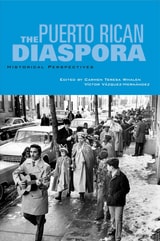
Puerto Rican Diaspora
Historical PerspectivesCarmen Teresa Whalen
Temple University Press, 2005

Smugglers, Brothels, and Twine
Historical Perspectives on Contraband and Vice in North America’s BorderlandsEdited by Elaine Carey and Andrae M. Marak
University of Arizona Press, 2011
By studying the historical flows of contraband and vice across North American borders, the contributors seek to bring a greater understanding of borderlanders, the actual agents of historical change who often remain on the periphery of most historical analyses that focus on the state or on policy.
To examine the political, economic, and social shifts resulting from the transnational movement of goods, people, and ideas, these contributions employ the analytical categories of race, class, modernity, and gender that underlie this evolution. Chapters focus on the ways power relations created opportunities for engaging in “deviance,” thus questioning the constructs of economic reality versus concepts of criminal behavior. Looking through the lens of transnational flows of contraband and vice, the authors develop a new understanding of nation, immigration, modernization, globalization, consumer society, and border culture.