Results by title
12 books match the query 'Historical museums'
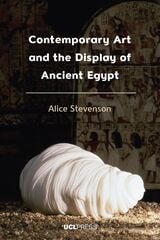
Contemporary Art and the Display of Ancient Egypt
Alice Stevenson
University College London, 2025
Contemporary art installations in Egyptian galleries are often framed as dialogues between past and present—but what if they are, instead, shaped by the museum itself? Contemporary Art and the Display of Ancient Egypt argues that both contemporary and ancient works are mediated through the structures and ideologies of the museum space. In this seminal work, Alice Stevenson examines how artists’ work influences museum discourse and public engagement with ancient artifacts.
Drawing on case studies from the British Museum, the Egyptian Museum in Turin, and the State Museum of Egyptian Art in Munich, this book assesses the motivations behind these interventions and their lasting impact. Through an evidence-based approach, Stevenson offers new insights into how curators, scholars, and artists can collaborate to create more meaningful and politically engaged museum experiences. Of particular interest to Egyptologists, museum professionals, and contemporary art scholars, this work redefines the role of artistic intervention in shaping our understanding of ancient cultures.
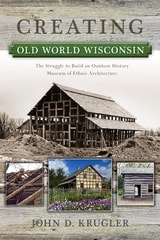
Creating Old World Wisconsin
The Struggle to Build an Outdoor History Museum of Ethnic ArchitectureJohn D. Krugler
University of Wisconsin Press, 2013
Visionaries, researchers, curators, and volunteers launched a massive preservation initiative to salvage fast-disappearing immigrant and migrant architecture. Dozens of historic buildings in the 1970s were transported from locations throughout the state to the Kettle Moraine State Forest. These buildings created a backdrop against which twenty-first-century interpreters demonstrate nineteenth- and early twentieth-century agricultural techniques and artisanal craftsmanship. The site, created and maintained by the Wisconsin Historical Society, offers visitors a unique opportunity to learn about the state’s rich and ethnically diverse past through depictions of the everyday lives of its Norwegian, Danish, Finnish, German, Polish, African American, and Yankee inhabitants.
Creating Old World Wisconsin chronicles the fascinating and complex origins of this outdoor museum, highlighting the struggles that faced its creators as they worked to achieve their vision. Even as Milwaukee architect and preservationist Richard W. E. Perrin, the Society's staff, and enthusiastic volunteers opened the museum in time for the national bicentennial in 1976, the site was plagued by limited funds, bureaucratic tangles, and problems associated with gaining public support. By documenting the engaging story of the challenges, roadblocks, false starts, and achievements of the site's founders, Krugler brings to life the history of the dedicated corps who collected and preserved Wisconsin's diverse social history and heritage.
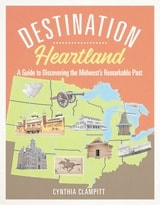
Destination Heartland
A Guide to Discovering the Midwest's Remarkable PastCynthia Clampitt
University of Illinois Press, 2022
An informative handbook and introduction to the Midwest's colorful past, Destination Heartland provides travelers with a knowledgeable companion on the highways and backroads of history.
States covered in the book: Illinois, Indiana, Iowa, Kansas, Michigan, Minnesota, Missouri, Nebraska, North Dakota, Ohio, South Dakota, and Wisconsin.
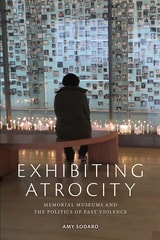
Exhibiting Atrocity
Memorial Museums and the Politics of Past ViolenceSodaro, Amy
Rutgers University Press, 2018
Today, nearly any group or nation with violence in its past has constructed or is planning a memorial museum as a mechanism for confronting past trauma, often together with truth commissions, trials, and/or other symbolic or material reparations. Exhibiting Atrocity documents the emergence of the memorial museum as a new cultural form of commemoration, and analyzes its use in efforts to come to terms with past political violence and to promote democracy and human rights.
Through a global comparative approach, Amy Sodaro uses in-depth case studies of five exemplary memorial museums that commemorate a range of violent pasts and allow for a chronological and global examination of the trend: the U.S. Holocaust Memorial Museum in Washington, DC; the House of Terror in Budapest, Hungary; the Kigali Genocide Memorial Centre in Rwanda; the Museum of Memory and Human Rights in Santiago, Chile; and the National September 11 Memorial Museum in New York. Together, these case studies illustrate the historical emergence and global spread of the memorial museum and show how this new cultural form of commemoration is intended to be used in contemporary societies around the world.
Download open access ebook.
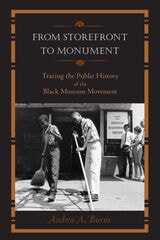
From Storefront to Monument
Tracing the Public History of the Black Museum MovementAndrea A. Burns
University of Massachusetts Press, 2013
Winner of the 2015 National Council on Public History Book Award
Today well over two hundred museums focusing on African American history and culture can be found throughout the United States and Canada. Many of these institutions trace their roots to the 1960s and 1970s, when the struggle for racial equality inspired a movement within the black community to make the history and culture of African America more “public.”
This book tells the story of four of these groundbreaking museums: the DuSable Museum of African American History in Chicago (founded in 1961); the International Afro-American Museum in Detroit (1965); the Anacostia Neighborhood Museum in Washington, D.C. (1967); and the African American Museum of Philadelphia (1976). Andrea A. Burns shows how the founders of these institutions, many of whom had ties to the Black Power movement, sought to provide African Americans with a meaningful alternative to the misrepresentation or utter neglect of black history found in standard textbooks and most public history sites. Through the recovery and interpretation of artifacts, documents, and stories drawn from African American experience, they encouraged the embrace of a distinctly black identity and promoted new methods of interaction between the museum and the local community.
Over time, the black museum movement induced mainstream institutions to integrate African American history and culture into their own exhibits and educational programs. This often controversial process has culminated in the creation of a National Museum of African American History and Culture, now scheduled to open in the nation's capital in 2015.
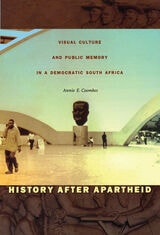
History after Apartheid
Visual Culture and Public Memory in a Democratic South AfricaAnnie E. Coombes
Duke University Press, 2003
History after Apartheid explores the dilemmas posed by a wide range of visual and material culture including key South African heritage sites. How prominent should Nelson Mandela and the African National Congress be in the museum at the infamous political prison on Robben Island? How should the postapartheid government deal with the Voortrekker Monument mythologizing the Boer Trek of 1838? Coombes highlights the contradictory investment in these sites among competing constituencies and the tensions involved in the rush to produce new histories for the “new” South Africa.
She reveals how artists and museum officials struggled to adequately represent painful and difficult histories ignored or disavowed under apartheid, including slavery, homelessness, and the attempted destruction of KhoiSan hunter-gatherers. Describing how contemporary South African artists address historical memory and the ambiguities uncovered by the Truth and Reconciliation Commission, Coombes illuminates a body of work dedicated to the struggle to simultaneously remember the past and move forward into the future.
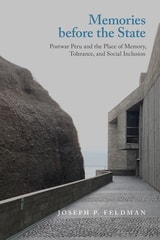
Memories before the State
Postwar Peru and the Place of Memory, Tolerance, and Social InclusionJoseph P. Feldman
Rutgers University Press, 2021
Memories before the State examines the discussions and debates surrounding the creation of the Place of Memory, Tolerance, and Social Inclusion (LUM), a national museum in Peru that memorializes the country’s internal armed conflict of the 1980s and 1990s. Emerging from a German donation that the Peruvian government initially rejected, the Lima-based museum project experienced delays, leadership changes, and limited institutional support as planners and staff devised strategies that aligned the LUM with a new class of globalized memorial museums and responded to political realities of the country’s postwar landscape. The book analyzes forms of authority that emerge as an official institution seeks to incorporate and manage diverse perspectives on recent violence.
Mickey Mouse History and Other Essays on American Memory
Michael Wallace
Temple University Press, 1996
Museums, Monuments, and National Parks
Toward a New Genealogy of Public HistoryDenise D. Meringolo
University of Massachusetts Press, 2012
All of these developments included interpretive activities that shaped public understanding of the past. Yet it was not until the emergence of the education-oriented National Park Service history program in the 1920s and 1930s that public history found an institutional home that grounded professional practice simultaneously in the values of the emerging discipline and in government service. Even thereafter, tensions between administrators in Washington and practitioners on the ground at National Parks, monuments, and museums continued to define and redefine the scope and substance of the field. The process of definition persists to this day, according to Meringolo, as public historians establish a growing presence in major universities throughout the United States and abroad.
Seeing Historic Alabama
Fifteen Guided ToursVirginia Van der Veer Hamilton
University of Alabama Press, 1996
Revised and updated.
A trusted guide to Alabama's historic treasures and cultural landmarks.
Don’t drive anywhere in this state without taking along this useful, handy guide. Originally published in 1982, Professor Hamilton’s much acclaimed Seeing Historic Alabama: Fifteen Guided Tours was enthusiastically received around the state. Reviewers throughout Alabama praised her work, her artist’s eye for landscape and architecture, as well as her “historian’s devotion to fact and motorist’s appreciation for specific directions.” This praise extended beyond the state lines to publications in the greater Southeast, which recommend the volume to readers planning travel to or through Alabama.
Hamilton and Matte's thoroughly revised and updated edition of Seeing Historic Alabama introduces readers to the history of Alabama by way of visits to the buildings and sites where historic events took place, from prehistoric time to the present. Its aim is to appeal to a wide range of readers and travelers—natives and residents of Alabama, students of all ages, newcomers to the state, and tourists. This guide offers tours arranged in geographical segments that can be taken in a few hours, in a day trip, or over the course of several days. A handy guide to keep at ready in the glove compartment for easy reference wherever you travel.
The Museum in the Cultural Sciences
Collecting, Displaying, and Interpreting Material Culture in the Twentieth CenturyEdited by Peter N. Miller
Bard Graduate Center, 2021
The Museum in the Cultural Sciences offers the first full English translations of these articles, which remain influential in conversations about the implications of art, historical, and ethnographic museums. They show how sophisticated the discussion of museums and museum display was in the early twentieth century and how much could be gained from revisiting these reflections today. Accompanied by short commentaries from museum professionals, these articles offer an intervention into and intensification of the current debate about the function and purpose of museums.
War, Genocide, and Justice
Cambodian American Memory WorkCathy J. Schlund-Vials
University of Minnesota Press, 2012
In the three years, eight months, and twenty days of the Khmer Rouge’s deadly reign over Cambodia, an estimated 1.7 million Cambodians perished as a result of forced labor, execution, starvation, and disease. Despite the passage of more than thirty years, two regime shifts, and a contested U.N. intervention, only one former Khmer Rouge official has been successfully tried and sentenced for crimes against humanity in an international court of law to date. It is against this background of war, genocide, and denied justice that Cathy J. Schlund-Vials explores the work of 1.5-generation Cambodian American artists and writers.
Drawing on what James Young labels “memory work”—the collected articulation of large-scale human loss—War, Genocide, and Justice investigates the remembrance work of Cambodian American cultural producers through film, memoir, and music. Schlund-Vials includes interviews with artists such as Anida Yoeu Ali, praCh Ly, Sambath Hy, and Socheata Poeuv. Alongside the enduring legacy of the Killing Fields and post-9/11 deportations of Cambodian American youth, artists potently reimagine alternative sites for memorialization, reclamation, and justice. Traversing borders, these artists generate forms of genocidal remembrance that combat amnesic politics and revise citizenship practices in the United States and Cambodia.
Engaged in politicized acts of resistance, individually produced and communally consumed, Cambodian American memory work represents a significant and previously unexamined site of Asian American critique.