Results by title
9 books match the query 'History of Biblical events'
History of Ancient Israel
Christian Frevel
SBL Press, 2023
This English translation of the second edition of Christian Frevel’s essential textbook Geschichte Israels (Kohlhammer, 2018) covers the history of Israel from its beginnings until the Bar Kokhba revolt (132–135 CE). Frevel draws on archaeological evidence, inscriptions and monuments, as well as the Bible to sketch a picture of the history of ancient Israel within the context of the southern Levant that is sometimes familiar but often fresh and unexpected. Frevel has updated the second German edition with the most recent research of archaeologists and biblical scholars, including those based in Europe. Tables of rulers, a glossary, a timeline of the ancient Near East, and resources arranged by subject make this book an accessible, essential textbook for students and scholars alike.
In the Shadow of Empire
Israel and Judah in the Long Sixth Century BCEPamela Barmash
SBL Press, 2021
Empires Come and Go, Homelands Never
Readers of the Hebrew Bible know the basic story line: during the early sixth century BCE the Babylonian ruler Nebuchadnezzar sacked Jerusalem, deported a portion of the population to Mesopotamia, and triggered a crisis of faith in the minds of prophets, priests, and liturgists that still echoes through the centuries. Though many Judahites chose to make their way home under Persian imperial control, the straightforward biblical story of exile and return masks many complex issues of evidence and fact. Unlike previous studies that focused narrowly on the Babylonian exile of the Judahite elites, this volume widens the geographical and temporal scope to include the Assyrian, Babylonian, and Persian Empires. Improved access to and understanding of relevant texts, iconography, and material culture provide an opportunity for scholars to reappraise methods of imperial control and the responses of those in exile and under occupation. Contributors Pamela Barmash, Ryan P. Bonfiglio, Caralie Cooke, Lisbeth S. Fried, Martien A. Halvorson-Taylor, Mark W. Hamilton, Matt Waters, and Ian D. Wilson lay a firm foundation for future work on the long sixth century.
John, Jesus, and History, Volume 1
Critical Appraisals of Critical ViewsPaul N. Anderson
SBL Press, 2007
John, Jesus, and History, Volume 2
Aspects of Historicity in the Fourth GospelPaul N. Anderson
SBL Press, 2009
This groundbreaking volume draws together an international group of leading biblical scholars to consider one of the most controversial religious topics in the modern era: Is the Gospel of John—the most theological and distinctive among the four canonical Gospels—historical or not? If not, why does John alone among the Gospels claim eyewitness connections to Jesus? If so, why is so much of John’s material unique to John? Using various methodologies and addressing key historical issues in John, these essays advance the critical inquiry into Gospel historiography and John’s place within it, leading to an impressive consensus and convergences along the way. The contributors are Paul N. Anderson; Mark Appold; Richard Bauckham; Helen K. Bond; Richard A. Burridge; James H. Charlesworth; Jaime Clark-Soles; Mary Coloe; R. Alan Culpepper; Craig A. Evans; Sean Freyne; Jeffrey Paul Garcia; Brian D. Johnson; Peter J. Judge; Felix Just, S.J.; Craig S. Keener; Edward W. Klink III; Craig R. Koester; Michael Labahn; Mark A. Matson; James F. McGrath; Susan Miller; Gail R. O’Day; Bas van Os; Tom Thatcher; Derek M. H. Tovey; Urban C. von Wahlde; and Ben Witherington III.
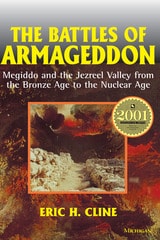
The Battles of Armageddon
Megiddo and the Jezreel Valley from the Bronze Age to the Nuclear AgeEric H. Cline
University of Michigan Press, 2002
> Best Popular Book on Archaeology
--Biblical Archaeology Society
Apocalypse. Judgment Day. The End Time. Armageddon. Students of the Bible know it as the place where the cataclysmic battle between the forces of good and the forces of evil will unfold. Many believe that this battle will take place in the very near future. But few know that Armageddon is a real place--one that has seen more fighting and bloodshed than any other spot on earth.
The name Armageddon is a corruption of the Hebrew phrase Har Megiddo, and it means "Mount of Megiddo." More than thirty bloody conflicts have been fought at the ancient site of Megiddo and adjacent areas of the Jezreel Valley during the past four thousand years. Egyptians, Israelites, Greeks, Muslims, Crusaders, Mongols, British, Germans, Arabs, and Israelis have all fought and died here. The names of the warring leaders reverberate throughout history: Thutmose III, Deborah, Gideon, Saul and Jonathan, Jezebel, Saladin, Napoleon, and Allenby, to name but the most famous. Throughout history Megiddo and the Jezreel Valley have been ground zero for battles that determined the very course of civilization. No wonder that the author of Revelation believed Armageddon, the penultimate battle between good and evil, would also take place here!
The Battles of Armageddon introduces readers to a rich cast of ancient and modern warriors, while bringing together for the first time the wide range of conflicts that have been fought at Megiddo and the Jezreel Valley from the Bronze Age to the Nuclear Age.
Eric H. Cline has participated in more than seventeen seasons of excavation and survey in Israel, Egypt, Jordan, Greece, and the United States. He is currently a Senior Staff Archaeologist at the ongoing excavations of Megiddo.
The King David Report
Stefan Heym
Northwestern University Press, 1997
Written by one of Germany's most acclaimed dissident authors, The King David Report is both an analysis of the writer's obligations to truth, and an astute satire on the workings of history and politics in a totalitarian state.
The Kingdoms of Israel and Judah in the Eighth and Seventh Centuries B.C.E.
Antoon Schoors
SBL Press, 2013
The Last Century in the History of Judah
The Seventh Century BCE in Archaeological, Historical, and Biblical PerspectivesFilip Čapek
SBL Press, 2019
An incomparable interdisciplinary study of the history of Judah
Experts from a variety of disciplines examine the history of Judah during the seventh century BCE, the last century of the kingdom’s existence. This important era is well defined historically and archaeologically beginning with the destruction layers left behind by Sennacherib’s Assyrian campaign (701 BCE) and ending with levels of destruction resulting from Nebuchadnezzar’s Babylonian campaign (588-586 BCE). Eleven essays develop the current ongoing discussion about Judah during this period and extend the debate to include further important insights in the fields of archaeology, history, cult, and the interpretation of Old Testament texts.
Features
- A new chronological frame for the Iron Age IIB-IIC
- Close examinations of archaeology, texts, and traditions related to the reigns of Hezekiah, Manasseh, and Josiah
- An evaluation of the religious, cultic, and political landscape < /UL>
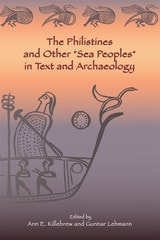
The Philistines and Other Sea Peoples in Text and Archaeology
Ann E. Killebrew
SBL Press, 2013