143 books match the query 'History of doctrines' and 14 start with a
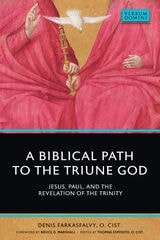
cover of A Biblical Path to the Triune God: Jesus, Paul and the Revelation of the Trinity

A Biblical Path to the Triune God

Jesus, Paul and the Revelation of the Trinity

Denis Farkasfalvy

Catholic University of America Press, 2021
This short volume, finished just before Denis Farkasfalvy’s death in 2020, serves effectively as his last theological testament. Throughout his scholarly career, Farkasfalvy aimed to reconcile and unite theological disciplines that had increasingly become isolated from each other, most notably the biblical, patristic, and systematic. In A Biblical Path to the Triune God, the Cistercian abbot identifies the earliest biblical witnesses to the Church’s teaching about God, formulated at the Council of Nicaea, as Father, Son, and Holy Spirit. Jesus’ famous praise of the Father, found almost word-for-word in Matthew 11:25-27 and Luke 10:21-22, is Farkasfalvy’s point of departure for his bold assertion that in the earliest sources, we find abundant evidence that “it was not Jesus who revealed his own divine sonship; rather, the Father revealed it to those whom Jesus had chosen and were open to respond in faith.” Farkasfalvy demonstrates that Jesus reveals his relationship to the Father in terms of intimate and experiential knowledge, transforming the procreative metaphor of filiation from the physical (as in the Psalms and 2 Samuel 7) to the epistemological realm of knowledge, what he calls “love within cognitive dimensions.” Just decades after Jesus’ ministry, numerous independent apostolic witnesses, from the Synoptic Gospels and John to Paul (especially Romans 1:1-4 and Galatians 1:15-16), indicate a robust and widespread understanding of the Father’s self-disclosure in Jesus the Son. Farkasfalvy concludes his brief but intense reflection by outlining how a single organic process of revelation binds together the Father and the Son, and then extends that loving communion to believers in the Spirit, a communion made possible only by the incarnate Son’s crucifixion and subsequent glorification. This book accomplishes the admirable feat of showing that far from being the invention of later centuries, the Trinitarian doctrine of the Church is firmly rooted in the very first reflections on Jesus’ ministry and mystery by the biblical authors.
[more]
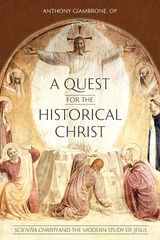
cover of A Quest for the Historical Christ: Scientia Christi and the Modern Study of Jesus

A Quest for the Historical Christ

Scientia Christi and the Modern Study of Jesus

Anthony Giambrone, OP

Catholic University of America Press, 2021
A Catholic Quest for the Historical Christ brings together a collection of interrelated essays on the historical Jesus and primitive Christology. Sensitive to the diverse, but traditionally Protestant assumptions and perspectives of the "Quest" as well as to the widely lamented disconnect between New Testament exegesis and classical dogmatic theology, an alternative approach is proposed in these pages. Ecumenical and conciliar reference points, along with non-confessional historical methods (e.g. archeology) shape the basic project, which nevertheless assumes some distinctive and important Catholic contours. This particular synthesis injects the voice of a missing interlocutor into an established conversation that has not infrequently been both historically confused and dogmatically (and philosophically) numb. The book is divided into three sections: Historical Foundations, Theological Perspectives, and Jesus and the Scriptures. While the individual chapters represent independent probes, the cumulative argument and arc of the study drives in clear and concerted directions. After a first approach to the Gospel data, attentive at once to historiographical and historical questions, a series of interventions reorienting the present scholarly discussion are suggested. These various, foundational essays lead, finally, to a sustained mediation on the mind of Christ, considered as a unique reader of the Scriptures: a meditation having its proper reflex and reflection in the way Christians themselves, as readers of the Gospels, participate in the Lord's own encounter with the living Word.
[more]
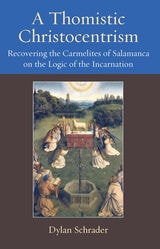
cover of A Thomistic Christocentrism: Recovering the Carmelites of Salamanca on the Logic of the Incarnation

A Thomistic Christocentrism

Recovering the Carmelites of Salamanca on the Logic of the Incarnation

Dylan Schrader

Catholic University of America Press, 2021
Saint Thomas Aquinas famously held the opinion that, in God’s actual plan for the world, the Word would not have become flesh except to redeem us from sin. Conversely, Blessed John Duns Scotus argued that God intended Christ first, such that Christ would have come even if there had been no sin. While Aquinas and Scotus were far from the first to consider this question, they became emblematic of two seemingly irreconcilable approaches. In this book, Father Dylan Schrader recovers the thought of the Salmanticenses, the Discalced Carmelites writing at the University of Salamanca in the seventeenth century. The Salmanticenses argue that Christ is primary in God’s intention precisely as redeemer, so that it is true both that God has made everything else for the sake of Christ and that Christ’s coming is essentially redemptive, connected with sin. In this way, the Salmanticenses offer a Thomistic Christocentrism. This book summarizes the historical background to the Salmanticenses, from the time of Anselm up through the early-modern period. Next, it presents and defends the Salmanticenses’ argument for the primacy of Christ the redeemer. A Thomistic Christocentrism then turns to two key post-conciliar figures, Karl Rahner and Hans Urs von Balthasar. Rahner sees Christ as the culmination of the world’s opening up to God. Balthasar sees Christ as the reconciler of divine and human freedom through his cross, descent, and resurrection. Both Christocentric approaches have good aspirations but suffer from serious flaws. In its final chapters, this book applies the Salamanca theory to Rahner and Balthasar, showing its enduring value for post-conciliar Christocentrism.
[more]
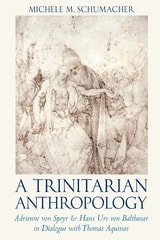
cover of A Trinitarian Anthropology: Adrienne von Speyr & Hans Urs von Balthasar in Dialogue with Thomas Aquinas

A Trinitarian Anthropology

Adrienne von Speyr & Hans Urs von Balthasar in Dialogue with Thomas Aquinas

Michele M. Schumacher

Catholic University of America Press, 2014
In this magisterial work, Michele M. Schumacher seeks to promote dialogue between disciples of the Swiss theologian Hans Urs von Balthasar (d. 1988) and those of the church's common doctor, St. Thomas Aquinas (d. 1274) on a critical theological question. How are analogies and metaphors from the philosophy and theology of the person (anthropology) rightly used to address the mystery of the Trinity? She does so by considering the specific setting of Balthasar's theology: the inseparability of his work from that of the Swiss physician and mystic Adrienne von Speyr (d. 1967).
[more]
cover of Adam's Sin, Our Humanity, and Christ's Redemption in Cyril of Alexandria: An Eastern Christian Theological Anthropology

Adam's Sin, Our Humanity, and Christ's Redemption in Cyril of Alexandria

An Eastern Christian Theological Anthropology

Anthony Bibawy

Catholic University of America Press, 2026
As a result of the neo-patristic movement of the early twentieth century, the teachings of original sin and atonement as understood in the West were questioned and reformulated based on what was believed to be early Eastern Christian patristic thought. This new paradigm proposed that humanity inherited death and corruption, but not sin, from Adam and that the purpose of the incarnation and salvific work of Christ was to restore humanity from death and corruption, but not an inherent sinfulness. In contrast to this popular and seemingly dogmatic paradigm and false dichotomy between Western and Eastern teaching on sin and redemption, this book proposes that the writings of many Eastern fathers of the early fifth century incorporate many, if not the majority, of the terms and teachings behind what have been labeled as Western departures concerning the relationship between Adam’s sin, humanity, and its redemption in Christ. Through a comprehensive analysis of the writings of Cyril of Alexandria and some of his contemporaries in the early fifth century East during the time of the Pelagian controversy, this book demonstrates that a central and consistent theme of their soteriology revolves around the sinfulness and guilt of all humanity that is rooted in Adam’s sin and is resolved only through recapitulation into the new root, the second Adam, the impeccable Christ. Christ’s impeccability is necessary to correct the state of sinfulness and guilt in humanity through his incarnation and spotless sacrifice on the cross as a ransom and substitute on behalf of and in exchange of all to satisfy the divine justice and to restore humanity to its original state in the divine image.
[more]
cover of All Abraham's Children: Changing Mormon Conceptions of Race and Lineage

All Abraham's Children

Changing Mormon Conceptions of Race and Lineage

Armand L. Mauss

University of Illinois Press, 2003

All Abraham’s Children is Armand L. Mauss’s long-awaited magnum opus on the evolution of traditional Mormon beliefs and practices concerning minorities. He examines how members of the Church of Jesus Christ of Latter-day Saints have defined themselves and others in terms of racial lineages.
 
Mauss describes a complex process of the broadening of these self-defined lineages during the last part of the twentieth century as the modern Mormon church continued its world-wide expansion through massive missionary work.
 
Mauss contends that Mormon constructions of racial identity have not necessarily affected actual behavior negatively and that in some cases Mormons have shown greater tolerance than other groups in the American mainstream.
 
Employing a broad intellectual historical analysis to identify shifts in LDS behavior over time, All Abraham’s Children is an important commentary on current models of Mormon historiography.
 
[more]
cover of Angels and Demons

Angels and Demons

Serge-Thomas Bonino

Catholic University of America Press, 2016
Angels occupy a significant space in contemporary popular spirituality. Yet, today more than ever, the belief in the existence of intermediary spirits between the human and divine realms needs to be evangelized and Christianized. Angels and Demons offers a detailed synthesis of the givens of the Christian tradition concerning the angels and demons, as systematized in its essential principles by St. Thomas Aquinas. Certainly, the doctrine of angels and demons is not at the heart of Christian faith, but its place is far from negligible. On the one hand, as part of faith seeking understanding, angelology has been and can continue to be a source of enrichment for philosophy. Thus, reflection on the ontological constitution of the angel, on the modes of angelic knowledge, and on the nature of the sin of Satan can engage and shed light on the most fundamental areas of metaphysics, epistemology, and ethics. On the other hand, angelology, insofar as it is inseparable from the ensemble of the Christian mystery (from the doctrine of creation to the Christian understanding of the spiritual life), can be envisioned from an original and fruitful perspective.
[more]
cover of Anti-Apollinarian Writings

Anti-Apollinarian Writings

Catholic University of America Press, 2016
The translation is interweaved with a commentary to provide the reader with some guidance through the complexities of Gregory's arguments. The introduction includes an overview of the history of Apollinarianism and discusses the extent to which it is possible to reconstruct, from the fragments quoted by Gregory, the arguments of Apolinarius's Apodeixis to which he is responding. It also examines the background to and the chronology of both of Gregory's anti-Apollinarian works, and looks critically at the arguments that they deploy.
[more]
cover of Anti-Judaism and Christian Orthodoxy: Ephrem's Hymns in Fourth-century Syria (Patristic Monograph Series)

Anti-Judaism and Christian Orthodoxy

Ephrem's Hymns in Fourth-century Syria (Patristic Monograph Series)

Christine Shepardson

Catholic University of America Press, 2008
This book investigates the complex anti-Jewish and anti-Judaizing rhetoric of Ephrem, a fourth-century poet, deacon, and theologian from eastern Roman Syria whose Syriac-language writings remain unfamiliar and linguistically inaccessible to centuries of scholars who study the well-known Greek and Latin writings of his contemporaries.
[more]
cover of Approaching the Assumption, 1863-1950: Revelation, Scripture, and the Laity in the Development of a Marian Dogma

Approaching the Assumption, 1863-1950

Revelation, Scripture, and the Laity in the Development of a Marian Dogma

Eric Lafferty

Catholic University of America Press, 2026
The Assumption of Mary refers to the ancient Christian belief that the Mother of God was taken up into Heaven, body and soul, at the end of her earthly life. For centuries, Catholics and other Christians celebrated the Assumption as a liturgical feast and meditated on the miraculous event in the Rosary. Nevertheless, its relationship to Revelation remained undefined. This changed in 1950 when Pope Pius XII declared the Assumption of Mary a dogma of the Catholic Church. In this rare exercise of papal authority, Pius XII infallibly and irrevocably taught that the Assumption was a truth revealed by God. This book explores how the definition of this Marian dogma came to fruition. After a brief history of the prior three Marian dogmas — Mother of God, Ever-Virgin, and the Immaculate Conception — this book narrates the major moments in the effort to obtain a dogmatic definition of the Assumption. The beginning of this “Assumptionist movement” can be dated to 1863 when Queen Isabel II of Spain petitioned the pope to declare the Assumption a dogma. Subsequently, petitionary efforts and scholarly inquiry increased and spread throughout the world. In addition to the narrative of this movement, this book gives special consideration to three vital aspects: debate over the Assumption’s definability as a dogma, if and how Scripture reveals the Assumption, and the contribution of the laity on a matter of doctrine. Collectively, the Assumptionist movement emerges as a critical event in the nineteenth- and twentieth-century Catholic Church. Culminating in a dogmatic definition shortly before the opening of Vatican II, it also serves as a key point of inquiry for continuity and development of doctrine. A final chapter argues that the operative beliefs pertaining to Revelation, Scripture, and the laity during the Assumptionist movement stand in continuity with the teachings of Vatican II.
[more]
cover of Aquinas and Analogy

Aquinas and Analogy

Ralph McInerny

Catholic University of America Press, 1996
The basic distinctions McInerny introduces, his criticism of the central piece in the literature, Cajetan's De nominum analogia, the applications he makes to problems such as that of the nature of metaphysics or of logic, his knowledge of contemporary debates on related topics, combine to make his contribution unique
[more]
cover of Aquinas on Transubstantiation

Aquinas on Transubstantiation

Reinhard Hutter

Catholic University of America Press, 2019
Aquinas on Transubstantiation treats one of the most frequently mis-understood and mis-represented teachings of Thomas Aquinas—Eucharistic transubstantiation. The study interprets Aquinas’s teaching as an exercise of “holy teaching” (sacra doctrina) that intends to show theologically and back up philosophically the simple yet profound thesis that “transubstantiation” affirms nothing but the truth of Christ’s words at the Last Supper—“This is my body,” “This is my blood.” Yet in order to achieve a contemporary ressourcement of this simple yet profound truth, it is necessary to probe the depths of Thomas Aquinas’s philosophical interpretation of it. For Thomas Aquinas, in regarding the truth of Eucharistic conversion, it is faith that preserves the human intellect from missing or dismissing the mystery announced in Christ’s words. Faith, however, is not intellectually blind, a faith that, as is often erroneously held, is commanded by arbitrary divine dictates to which the will submits in blind obedience. Rather, Aquinas takes faith is sustained, but not constituted, by an intellectual contemplation of the proposed mystery of faith, by faith seeking understanding. Thomas Aquinas unfolds this exercise of understanding guided by faith in the medium of a metaphysical contemplation that affords a profound intellectual appreciation of this central mystery of faith—precisely as mystery. Thomas’s metaphysical contemplation of Eucharistic conversion gestures toward the blinding light of superintelligibility, experienced as the unique darkness that surrounds this sublime mystery of faith. A ressourcement in Thomas Aquinas’s doctrine of transubstantiation also affords an renewed appreciation of the Church’s affirmation of transubstantiation as the most apt term for the interpretation of the mystery of Eucharistic conversion and a greater precision of what is centrally at stake in this mystery in the ongoing ecumenical conversation of this most central Christian teaching. A doctrinally sound, ecumenically informed, and philosophically reflected contemporary Catholic theology cannot afford to ignore or dismiss Aquinas’s surpassing account of Eucharistic conversion.
[more]
cover of Aquinas: God and Action

Aquinas

God and Action

David B. Burrell C.S.C.

University of Scranton Press, 2008
First published 30 years ago and long out of print, Aquinas: God and Action appears here for the first time in paperback. This classic volume by eminent philosopher and theologian David Burrell argues that Aquinas’s is not the god of Greek metaphysics, but a god of both being and activity. Aquinas’s plan in the Summa Theologiae, according to Burrell, is to instruct humans how to find eternal happiness through acts of knowing and loving. Featuring a new foreword by the author, this edition will be welcomed by philosophers and theologians alike.
 
[more]
cover of Aquinas’s Neoplatonism in the Summa Theologiae on God: A Short Introduction

Aquinas’s Neoplatonism in the Summa Theologiae on God

A Short Introduction

Wayne J. Hankey

St. Augustine's Press, 2016

[more]