Results by title
3 books match the query 'Hobo'
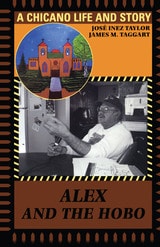
Alex and the Hobo
A Chicano Life and StoryBy José Inez Taylor and James M. Taggart
University of Texas Press, 2003
When a ten-year-old boy befriends a mysterious hobo in his southern Colorado hometown in the early 1940s, he learns about evil in his community and takes his first steps toward manhood by attempting to protect his new friend from corrupt officials. Though a fictional story, Alex and the Hobo is written out of the life experiences of its author, José Inez (Joe) Taylor, and it realistically portrays a boy's coming-of-age as a Spanish-speaking man who must carve out an honorable place for himself in a class-stratified and Anglo-dominated society.
In this innovative ethnography, anthropologist James Taggart collaborates with Joe Taylor to explore how Alex and the Hobo sprang from Taylor's life experiences and how it presents an insider's view of Mexicano culture and its constructions of manhood. They frame the story (included in its entirety) with chapters that discuss how it encapsulates notions that Taylor learned from the Chicano movement, the farmworkers' union, his community, his father, his mother, and his religion. Taggart gives the ethnography a solid theoretical underpinning by discussing how the story and Taylor's account of how he created it represent an act of resistance to the class system that Taylor perceives as destroying his native culture.
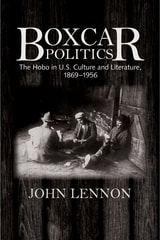
Boxcar Politics
The Hobo in U.S. Culture and Literature, 1869-1956John Lennon
University of Massachusetts Press, 2014
John Lennon maps the rise and demise of the political hobo from the nineteenth-century introduction of the transcontinental railroad to the Federal Aid Highway Act of 1956. Intertwining literary, historical, and theoretical representations of the hobo, he explores how riders and writers imagined alternative ways that working-class people could use mobility to create powerful dissenting voices outside of fixed hierarchal political organizations. Placing portrayals of hobos in the works of Jack London, Jim Tully, John Dos Passos, and Jack Kerouac alongside the lived reality of people hopping trains (including hobos of the IWW, the Scottsboro Boys, and those found in numerous long-forgotten memoirs), Lennon investigates how these marginalized individuals exerted collective political voices through subcultural practices.
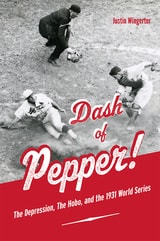
Dash of Pepper!
The Depression, The Hobo, and the 1931 World SeriesJustin Wingerter
University of Missouri Press, 2027
Dash of Pepper!: The Depression, The Hobo, and the 1931 World Series is the first book about the 1931 World Series and its unlikely star, Johnnie Leonard Roosevelt “Pepper” Martin. Born in Oklahoma in 1904, Martin grew up in poverty, performing farm labor with his family and attending school only sporadically (he was eventually expelled for his lack of shoes). Local sandlots served as his introduction to baseball, bringing him into an unpretentious world of hand-me-down leather, battered balls bursting at the seams, and boyhood. He was immediately hooked.
Martin spent his adolescence working a variety of odd jobs and playing for even odder baseball teams before making a living as a player for the East Texas League beginning in 1925, the owner of which sold him to the St. Louis Cardinals later that year. Martin played for the Cardinals’ minor league affiliates for the next two years, all while continuing his boyhood habit of “hoboing” freight trains to travel to games. Promoted to the major leagues in 1927, Martin was sent back down to the minors two years later, making his return to the Big Leagues in 1931 and soon thereafter emerging as the star of that year’s World Series. Historians still credit Martin, with his .500 batting average, 4 doubles, 1 home run, and 5 RBIs, for the Cardinals’ taking the championship.
Author Justin Wingerter documents the words of reporters from every state who told of a Depression-weary nation enthralled by the self-described hobo with endless hustle — “Don’t say Pepper, say STAR,” wrote The St. Louis Star (a play on its motto, “Don’t say ‘paper,’ say STAR”) after the Cardinals’ Game Three win. As Wingerter argues, Martin became a symbol of the forgotten man at a time when his fellow Americans needed a hero. His performance in the 1931 Series was followed obsessively by farmers, businesspeople, industrial workers, and even inmates, all of whom found in Martin a source of solace in a time of widespread misery. As one sportswriter opined in Waterloo, Iowa, “The Pepper Martins have a way of making us forget it all.”
In Dash of Pepper!, Wingerter explores the 1931 World Series in the context of the era’s national mood, populating the book’s pages with a host of colorful characters reaching far beyond Martin: One-Eyed Connelly, the famed gatecrasher who eventually met his match; the masked assailants of the St. Louis Milk War, a violent labor action that shared the city’s frontpages with the Series; banking regulators rushing to save deposits at Philadelphia’s Franklin Trust, and more.
With Dash of Pepper!, Wingerter makes an original contribution to the field, its focus on American society making it particularly valuable to lovers of United States history in addition to baseball fans.