Results by title
8 books match the query 'Holy Roman Empire'
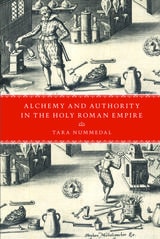
Alchemy and Authority in the Holy Roman Empire
Tara Nummedal
University of Chicago Press, 2007
Drawing on criminal trial records, contracts, laboratory inventories, satires, and vernacular alchemical treatises, Alchemy and Authority in the Holy Roman Empire situates the everyday alchemists, largely invisible to modern scholars until now, at the center of the development of early modern science and commerce. Reconstructing the workaday world of entrepreneurial alchemists, Tara Nummedal shows how allegations of fraud shaped their practices and prospects. These debates not only reveal enormously diverse understandings of what the “real” alchemy was and who could practice it; they also connect a set of little-known practitioners to the largest questions about commerce, trust, and intellectual authority in early modern Europe.
Autobiography of Emperor Charles IV and his Legend of St Wenceslas
Balázs Nagy
Central European University Press, 2001
One of the few autobiographies to have survived from the Middle Ages, this life history of one of the most influential rulers of the fourteenth century, Charles IV of Bohemia, covers his life from birth until his election as King of Germany in 1346.
Charles IV describes his childhood, spent mainly in the court of French kings, his juvenile years, his marriage and his first steps into the international political scene during the early part of the fourteenth century.
A unique addition to this volume is the first ever English translation of the Legend of Saint Wenceslas, written by Charles IV of Luxemburg.
Europe (c.1400-1458)
Aeneas Silvius Piccolomini
Catholic University of America Press, 2013
Frederick II
The Wonder of the WorldRichard Bressler
Westholme Publishing, 2010
One of the most remarkable personalities of the Middle Ages, Frederick II of Hohenstaufen was born in 1194. His parents—the reigning Holy Roman Emperor and the heiress to the Kingdom of Sicily—belonged to two of the leading ruling families in medieval Europe. The lands controlled by these two families extended from southern Denmark to Sicily, from modern Belgium to Bohemia. Frederick II eventually ruled the joint kingdom, and the story of how he gained and maintained this status is the primary thread running through his life. As a child in Sicily, Frederick was a ward of Pope Innocent III. When he came of age, he sought to be crowned Holy Roman Emperor but only succeeded in 1220 after many years of negotiations with the Vatican, which was reluctant to give up or share power. Resenting the influence and pressure from the papacy, Frederick became its leading opponent. As a result, the new pope, Gregory IX, condemned Frederick as the Antichrist. However, Frederick believed he was a sincere Christian, and led the Sixth Crusade to the Holy Land while under excommunication.
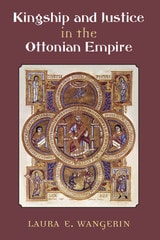
Kingship and Justice in the Ottonian Empire
Laura E. Wangerin
University of Michigan Press, 2019
Scholars have recognized the importance of ritual and symbolic behaviors in the Ottonian political sphere, while puzzling over the apparent lack of administrative organization, a contradiction between what we know about the Ottonians as successful rulers and their traditional characterization as rulers of a disorganized polity. Trying to account for the apparent disparity between their political and military achievements, cultural and artistic efflorescence, and relative dynastic stability, which seemingly accompanied a disinterest in writing law or creating a centralized hierarchical administration, is a tension that persists in the scholarship. This book argues that far from being accidental successes or employing primitive methods of governance, the Ottonians were shrewd rulers and administrators who exploited traditional methods of conflict resolution and delegated jurisdictional authority to keep control over their vast empire. Thus, one of the important things that this book aims to accomplish is to challenge our preconceived notions of what successful government looks like.
Living in the Tenth Century
Mentalities and Social OrdersHeinrich Fichtenau
University of Chicago Press, 1991
"Living in the Tenth Century resembles an anthropological field study more than a conventional historical monograph, and represents a far more ambitious attempt to see behind the surface of avowals and events than others have seriously attempted even for much more voluminously documented periods. . . . It is remarkably rich and readable."—R.I. Moore, Times Higher Education Supplement
"Fichtenau offers a magnificent survey of all the main spheres of life: the social order, the rural economy, schooling and religious belief and practice in both the secular and monastic church. His command, especially of the narrative sources, their fine nuances of attitude emotion and underlying norms, is masterly and he employs them here with all the sensitiveness and feel for the subject that have always been the hallmarks of his work."—Karl Leyser, Francia
The Medieval Constitution of Liberty
Political Foundations of Liberalism in the WestAlexander William Salter and Andrew T. Young
University of Michigan Press, 2023
Why did enduring traditions of economic and political liberty emerge in Western Europe and not elsewhere? Representative democracy, constitutionalism, and the rule of law are crucial for establishing a just and prosperous society, which we usually treat as the fruits of the Renaissance and Enlightenment, as Western European societies put the Dark Ages behind them.
In The Medieval Constitution of Liberty, Salter and Young point instead to the constitutional order that characterized the High Middle Ages. They provide a historical account of how this constitutional order evolved following the fall of the Western Roman Empire. This account runs from the settlements of militarized Germanic elites within the imperial frontiers, to the host of successor kingdoms in the sixth and seventh centuries, and through the short-lived Carolingian empire of the late eighth and ninth centuries and the so-called “feudal anarchy” that followed its demise. Given this unique historical backdrop, Salter and Young consider the resulting structures of political property rights. They argue that the historical reality approximated a constitutional ideal type, which they term polycentric sovereignty. Salter and Young provide a theoretical analysis of polycentric sovereignty, arguing that bargains between political property rights holders within that sort of constitutional order will lead to improvements in governance.
The Standard Bearer of the Roman Church
Lawrence of Brindisi and Capuchin Missions in the Holy Roman Empire (1599-1613)Andrew J.G. Drenas
Catholic University of America Press, 2018