Results by title
6 books match the query 'Home and school'
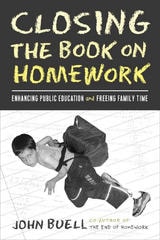
Closing The Book On Homework
Enhancing Public EducationJohn Buell
Temple University Press, 2003
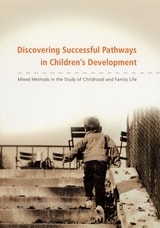
Discovering Successful Pathways in Children's Development
Mixed Methods in the Study of Childhood and Family LifeEdited by Thomas S. Weisner
University of Chicago Press, 2005
This volume includes new studies of minority and immigrant families, school achievement, culture, race and gender, poverty, identity, and experiments and interventions meant to improve family and child contexts. Discovering Successful Pathways in Children's Development will be of enormous value to everyone interested in the issues of human development, education, and social welfare, and among professionals charged with the task of improving the lives of children in our communities.
Family Life and School Achievement
Why Poor Black Children Succeed or FailReginald M. Clark
University of Chicago Press, 1984
To support his contentions, Clark offers ten intimate portraits of Black families in Chicago. Visiting the homes of poor one- and two-parent families of high and low achievers, Clark made detailed observations on the quality of home life, noting how family habits and interactions affect school success and what characteristics of family life provide children with "school survival skills," a complex of behaviors, attitudes, and knowledge that are the essential elements in academic success.
Clark's conclusions lead to exciting implications for educational policy. If school achievement is not dependent on family structure or income, parents can learn to inculcate school survival skills in their children. Clark offers specific suggestions and strategies for use by teachers, parents, school administrators, and social service policy makers, but his work will also find an audience in urban anthropology, family studies, and Black studies.
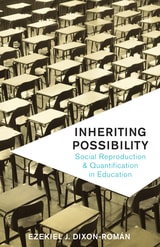
Inheriting Possibility
Social Reproduction and Quantification in EducationEzekiel J. Dixon-Román
University of Minnesota Press, 2017
How has the dominant social scientific paradigm limited our understanding of the impact of inherited economic resources, social privilege, and sociocultural practices on multigenerational inequality? In what ways might multiple forces of social difference haunt quantitative measurements of ability such as the SAT? Building on new materialist philosophy, Inheriting Possibility rethinks methods of quantification and theories of social reproduction in education, demonstrating that test performance results and parenting practices convey the impact of materially and historically contingent patterns of differential possibility.
Ezekiel J. Dixon-Román explores the dualism of nature and culture that has undergirded theories of inheritance, social reproduction, and human learning and development. Research and debate on the reproduction of power relations have rested on a premise that nature is made up of fixed universals on which the creative, intellective, and discursive play of culture are based. Drawing on recent work in the physical and biological sciences, Dixon-Román argues that nature is culture. He contends that by assuming a rigid nature/culture binary, we ultimately limit our understanding of how power relations are reproduced.
Through innovative analyses of empirical data and cultural artifacts, Dixon-Román boldly reconsiders how we conceptualize the processes of inheritance and approach social inquiry in order to profoundly sharpen understanding and address the reproducing forces of inequality.
Parents and Schools
The 150-Year Struggle for Control in American EducationWilliam W. Cutler III
University of Chicago Press, 2000
Cutler shows how in the 1920s and 1930s schools expanded their responsibility for children's well-being outside the classroom. These efforts sowed the seeds for later conflict as schools came to be held accountable for solving society's problems. Finally, he brings the reader into recent decades, in which a breakdown of trust, racial tension, and "parents' rights" have taken the story full circle, with parents and schools once again at odds.
Cutler's book is an invaluable guide to understanding how parent-teacher cooperation, which is essential for our children's educational success, might be achieved.
Race at the Top
Asian Americans and Whites in Pursuit of the American Dream in Suburban SchoolsNatasha Warikoo
University of Chicago Press, 2022
The American suburb conjures an image of picturesque privilege: manicured lawns, quiet streets, and—most important to parents—high-quality schools. These elite enclaves are also historically white, allowing many white Americans to safeguard their privileges by using public schools to help their children enter top colleges. That’s changing, however, as Asian American professionals increasingly move into wealthy suburban areas to give their kids that same leg up for their college applications and future careers.
As Natasha Warikoo shows in Race at the Top, white and Asian parents alike will do anything to help their children get to the top of the achievement pile. She takes us into the affluent suburban East Coast school she calls “Woodcrest High,” with a student body about one-half white and one-third Asian American. As increasing numbers of Woodcrest’s Asian American students earn star-pupil status, many whites feel displaced from the top of the academic hierarchy, and their frustrations grow. To maintain their children’s edge, some white parents complain to the school that schoolwork has become too rigorous. They also emphasize excellence in extracurriculars like sports and theater, which maintains their children’s advantage.
Warikoo reveals how, even when they are bested, white families in Woodcrest work to change the rules in their favor so they can remain the winners of the meritocracy game. Along the way, Warikoo explores urgent issues of racial and economic inequality that play out in affluent suburban American high schools. Caught in a race for power and privilege at the very top of society, what families in towns like Woodcrest fail to see is that everyone in their race is getting a medal—the children who actually lose are those living beyond their town’s boundaries.