Results by title

10 books match the query 'Homosexuality and art'
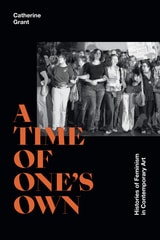
cover of A Time of One's Own: Histories of Feminism in Contemporary Art

A Time of One's Own

Histories of Feminism in Contemporary Art

Catherine Grant

Duke University Press, 2022

In A Time of One’s Own Catherine Grant examines how contemporary feminist artists are turning to broad histories of feminism ranging from political organizing and artworks from the 1970s to queer art and activism in the 1990s. Exploring artworks from 2002 to 2017 by artists including Sharon Hayes, Mary Kelly, Allyson Mitchell, Deirdre Logue, Lubaina Himid, Pauline Boudry, and Renate Lorenz, Grant maps a revival of feminism that takes up the creative and political implications of forging feminist communities across time and space. Grant characterizes these artists’ engagement with feminism as a fannish, autodidactic, and collective form of learning from history. This fandom of feminism allows artists to build relationships with previous feminist ideas, artworks, and communities that reject a generational model and embrace aspects of feminism that might be seen as embarrassing, queer, or anachronistic. Accounting for the growing interest in feminist art, politics, and ideas across generations, Grant demonstrates that for many contemporary feminist artists, the present moment can only be understood through an embodied engagement with history in which feminist pasts are reinhabited and reimagined.
[more]
cover of Between You and Me: Queer Disclosures in the New York Art World, 1948-1963

Between You and Me

Queer Disclosures in the New York Art World, 1948-1963

Gavin Butt

Duke University Press, 2005

In the decades preceding the Stonewall riots—in the wake of the 1948 publication of Alfred Kinsey’s controversial report on male sexuality and in the midst of a cold war culture of suspicion and paranoia—discussions of homosexuality within the New York art world necessarily circulated via gossip and rumor. Between You and Me explores this informal, everyday talk and how it shaped artists’ lives, their work, and its reception. Revealing the “trivial” and “unserious” aspects of the postwar art scene as key to understanding queer subjectivity, Gavin Butt argues for a richer, more expansive concept of historical evidence, one that supplements the verifiable facts of traditional historical narrative with the gossipy fictions of sexual curiosity.

Focusing on the period from 1948 to 1963, Butt draws on the accusations and denials of homosexuality that appeared in the popular press, on early homophile publications such as One and the Mattachine Review, and on biographies, autobiographies, and interviews. In a stunning exposition of Larry Rivers’s work, he shows how Rivers incorporated gossip into his paintings, just as his friend and lover Frank O’Hara worked it into his poetry. He describes how the stories about Andy Warhol being too “swish” to be taken seriously as an artist changed following his breakthrough success, reconstructing him as an asexual dandy. Butt also speculates on the meanings surrounding a MoMA curator’s refusal in 1958 to buy Jasper Johns’s Target with Plaster Casts on the grounds that it was too scandalous for the museum to acquire. Between You and Me sheds new light on a pivotal moment in American cultural production as it signals new directions for art history.
[more]
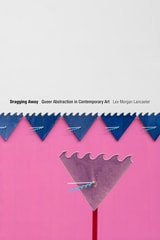
cover of Dragging Away: Queer Abstraction in Contemporary Art

Dragging Away

Queer Abstraction in Contemporary Art

Lex Morgan Lancaster

Duke University Press, 2022
In Dragging Away Lex Morgan Lancaster traces the formal and material innovations of contemporary queer and feminist artists, showing how they use abstraction as a queering tactic for social and political ends. Through a process Lancaster theorizes as a drag—dragging past aesthetics into the present and reworking them while pulling their work away from direct representation—these artists reimagine midcentury forms of abstraction and expose the violence of the tendency to reduce abstract form to a bodily sign or biographical symbolism. Lancaster outlines how the geometric enamel objects, grid paintings, vibrant color, and expansive installations of artists ranging from Ulrike Müller, Nancy Brooks Brody, and Lorna Simpson to Linda Besemer, Sheila Pepe, and Shinique Smith offer direct challenges to representational and categorical legibility. In so doing, Lancaster demonstrates that abstraction is not apolitical, neutral, or universal; it is a form of social praxis that actively contributes to queer, feminist, critical race, trans, and crip politics.
[more]
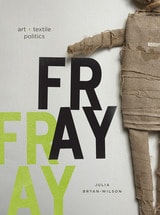
cover of Fray: Art and Textile Politics

Fray

Art and Textile Politics

Julia Bryan-Wilson

University of Chicago Press, 2017

In 1974, women in a feminist consciousness-raising group in Eugene, Oregon, formed a mock organization called the Ladies Sewing Circle and Terrorist Society. Emblazoning its logo onto t-shirts, the group wryly envisioned female collective textile making as a practice that could upend conventions, threaten state structures, and wreak political havoc. Elaborating on this example as a prehistory to the more recent phenomenon of “craftivism”—the politics and social practices associated with handmaking—Fray explores textiles and their role at the forefront of debates about process, materiality, gender, and race in times of economic upheaval.

Closely examining how amateurs and fine artists in the United States and Chile turned to sewing, braiding, knotting, and quilting amid the rise of global manufacturing, Julia Bryan-Wilson argues that textiles unravel the high/low divide and urges us to think flexibly about what the politics of textiles might be. Her case studies from the 1970s through the 1990s—including the improvised costumes of the theater troupe the Cockettes, the braided rag rugs of US artist Harmony Hammond, the thread-based sculptures of Chilean artist Cecilia Vicuña, the small hand-sewn tapestries depicting Pinochet’s torture, and the NAMES Project AIDS Memorial Quilt—are often taken as evidence of the inherently progressive nature of handcrafted textiles. Fray, however, shows that such methods are recruited to often ambivalent ends, leaving textiles very much “in the fray” of debates about feminized labor, protest cultures, and queer identities; the malleability of cloth and fiber means that textiles can be activated, or stretched, in many ideological directions.

The first contemporary art history book to discuss both fine art and amateur registers of handmaking at such an expansive scale, Fray unveils crucial insights into how textiles inhabit the broad space between artistic and political poles—high and low, untrained and highly skilled, conformist and disobedient, craft and art.
 
[more]
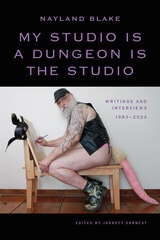
cover of My Studio Is a Dungeon Is the Studio: Writings and Interviews, 1983–2024

My Studio Is a Dungeon Is the Studio

Writings and Interviews, 1983–2024

Nayland Blake. Edited and with an Introduction by Jarrett Earnest.

Duke University Press, 2025

For four decades, artist, writer, curator, and teacher Nayland Blake has been at the center of discussions of queer aesthetics and contemporary art. Their work has examined racial hybridity, the ins and outs of the BDSM world, and the importance of self-representation. From interviews and critical essays to performance scripts and collage pieces, My Studio Is a Dungeon Is the Studio gathers forty years of Blake’s groundbreaking thought and writing on their personal explorations of kink and creativity as well as on the making, teaching, and curating of art and queer culture. Whether delving into furry fandom or analyzing art, Blake bridges the art and queer kink communities. They also argue that queer artists must champion the work of their peers and elders. As Blake demonstrates throughout, sexual self-expression is an extension of artistic self-expression: they are the same. The volume includes an introduction by artist and critic Jarrett Earnest.
[more]
cover of Oscar Wilde Prefigured: Queer Fashioning and British Caricature, 1750-1900

Oscar Wilde Prefigured

Queer Fashioning and British Caricature, 1750-1900

Dominic Janes

University of Chicago Press, 2016

“I do not say you are it, but you look it, and you pose at it, which is just as bad,” Lord Queensbury challenged Oscar Wilde in the courtroom—which erupted in laughter—accusing Wilde of posing as a sodomite. What was so terrible about posing as a sodomite, and why was Queensbury’s horror greeted with such amusement? In Oscar Wilde Prefigured, Dominic Janes suggests that what divided the two sides in this case was not so much the question of whether Wilde was or was not a sodomite, but whether or not it mattered that people could appear to be sodomites. For many, intimations of sodomy were simply a part of the amusing spectacle of sophisticated life.

Oscar Wilde Prefigured is a study of the prehistory of this “queer moment” in 1895. Janes explores the complex ways in which men who desired sex with men in Britain had expressed such interests through clothing, style, and deportment since the mid-eighteenth century. He supplements the well-established narrative of the inscription of sodomitical acts into a homosexual label and identity at the end of the nineteenth century by teasing out the means by which same-sex desires could be signaled through visual display in Georgian and Victorian Britain. Wilde, it turns out, is not the starting point for public queer figuration. He is the pivot by which Georgian figures and twentieth-century camp stereotypes meet. Drawing on the mutually reinforcing phenomena of dandyism and caricature of alleged effeminates, Janes examines a wide range of images drawn from theater, fashion, and the popular press to reveal new dimensions of identity politics, gender performance, and queer culture.
[more]
cover of Queer Networks: Ray Johnson's Correspondence Art

Queer Networks

Ray Johnson's Correspondence Art

Miriam Kienle

University of Minnesota Press, 2023

How the queer correspondence art of Ray Johnson disrupted art world conventions and anticipated today’s highly networked culture


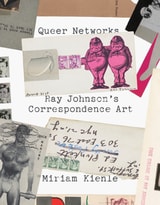
Once regarded as “New York’s most famous unknown artist,” Ray Johnson was a highly visible outlier in the art world, his mail art practice reflecting the changing social relations and politics of queer communities in the 1960s. A vital contribution to the growing scholarship on this enigmatic artist, Queer Networks analyzes how Johnson’s practice sought to undermine the dominant mechanisms of the art market and gallery system in favor of unconventional social connections.


Utilizing the postal service as his primary means of producing and circulating art, Johnson cultivated an international community of friends and collaborators through which he advanced his idiosyncratic body of work. Applying both queer theory and network studies, Miriam Kienle explores how Johnson’s radical correspondence art established new modes of connectivity that fostered queer sensibilities and ran counter to the conventional methods by which artists were expected to develop their reputation.


While Johnson was significantly involved with the Pop, conceptual, and neo-Dada art movements, Queer Networks crucially underscores his resistance to traditional art historical systems of categorization and their emphasis on individual mastery. Highlighting his alternative modes of community building and playful antagonism toward art world protocols, Kienle demonstrates how Ray Johnson’s correspondence art offers new ways of envisioning togetherness in today’s highly commodified and deeply networked world.
[more]
cover of Sexuality and Form: Caravaggio, Marlowe, and Bacon

Sexuality and Form

Caravaggio, Marlowe, and Bacon

Graham Hammill

University of Chicago Press, 2000

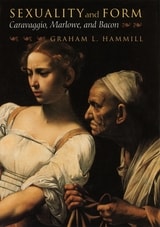
This ambitious, wide-ranging study of sexuality, aesthetics, and epistemology covers everything from the aesthetics of war to the works of Caravaggio, Michaelangelo, Christopher Marlowe, and Francis Bacon, synthesizing queer theory and psychoanalysis and demonstrating the role of the body and the flesh as both a problem and a promise within the narrative arts.
[more]
cover of The Logic of the Lure

The Logic of the Lure

John Paul Ricco

University of Chicago Press, 2002
The attraction of a wink, a nod, a discarded snapshot—such feelings permeate our lives, yet we usually dismiss them as insubstantial or meaningless. With The Logic of the Lure, John Paul Ricco argues that it is precisely such fleeting, erotic, and even perverse experiences that will help us create a truly queer notion of ethics and aesthetics, one that recasts sociality and sexuality, place and finitude in ways suggested by the anonymity and itinerant lures of cruising. Shifting our attention from artworks to the work that art does, from subjectivity to becoming, and from static space to taking place, Ricco considers a variety of issues, including the work of Doug Ischar, Tom Burr, and Derek Jarman and the minor architecture of sex clubs, public restrooms, and alleyways.
[more]
cover of Unruly Visions: The Aesthetic Practices of Queer Diaspora

Unruly Visions

The Aesthetic Practices of Queer Diaspora

Gayatri Gopinath

Duke University Press, 2018

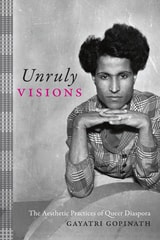
In Unruly Visions Gayatri Gopinath brings queer studies to bear on investigations of diaspora and visuality, tracing the interrelation of affect, archive, region, and aesthetics through an examination of a wide range of contemporary queer visual culture. Spanning film, fine art, poetry, and photography, these cultural forms—which Gopinath conceptualizes as aesthetic practices of queer diaspora—reveal the intimacies of seemingly disparate histories of (post)colonial dwelling and displacement and are a product of diasporic trajectories. Countering standard formulations of diaspora that inevitably foreground the nation-state, as well as familiar formulations of queerness that ignore regional gender and sexual formations, she stages unexpected encounters between works by South Asian, Middle Eastern, African, Australian, and Latinx artists such as Tracey Moffatt, Akram Zaatari, and Allan deSouza. Gopinath shows how their art functions as regional queer archives that express alternative understandings of time, space, and relationality. The queer optics produced by these visual practices creates South-to-South, region-to-region, and diaspora-to-region cartographies that profoundly challenge disciplinary and area studies rubrics. Gopinath thereby provides new critical perspectives on settler colonialism, empire, military occupation, racialization, and diasporic dislocation as they indelibly mark both bodies and landscapes.
[more]