Results by title
25 books match the query 'Hopi Indians'
A Hopi Social History
By Scott Rushforth and Steadman Upham
University of Texas Press, 1992
All anthropologists and archaeologists seek to answer basic questions about human beings and society. Why do people behave the way they do? Why do patterns in the behavior of individuals and groups sometimes persist for remarkable periods of time? Why do patterns in behavior sometimes change?
A Hopi Social History explores these basic questions in a unique way. The discussion is constructed around a historically ordered series of case studies from a single sociocultural system (the Hopi) in order to understand better the multiplicity of processes at work in any sociocultural system through time. The case studies investigate the mysterious abandonments of the Western Pueblo region in late prehistory, the initial impact of European diseases on the Hopis, Hopi resistance to European domination between 1680 and 1880, the split of Oraibi village in 1906, and some responses by the Hopis to modernization in the twentieth century.
These case studies provide a forum in which the authors examine a number of theories and conceptions of culture to determine which theories are relevant to which kinds of persistence and change. With this broad theoretical synthesis, the book will be of interest to students and scholars in the social sciences.
A Study of Southwestern Archaeology
Stephen H. Lekson
University of Utah Press, 2018
Focusing on the enigmatic monumental center at Chaco Canyon, the book provides a historical analysis of how Southwest archaeology confined itself, how it can break out of those confines, and how it can proceed into the future. Lekson suggests that much of what we believe about the ancient Southwest should be radically revised. Looking past old preconceptions brings a different Chaco Canyon into view: more than an eleventh-century Pueblo ritual center, Chaco was a political capital with nobles and commoners, a regional economy, and deep connections to Mesoamerica. By getting the history right, a very different science of the ancient Southwest becomes possible and archaeology can be reinvented as a very different discipline.
Notes
https://uofupress.lib.utah.edu/wp-content/uploads/sites/21/2019/04/Lekson-Notes.pdf

An 1860 English-Hopi Vocabulary Written in the Deseret Alphabet
Kenneth R. Beesley
University of Utah Press, 2014
The volume reproduces all 486 vocabulary entries of the original manuscript, presenting the Deseret and the modern English and Hopi translations. It explains the history of the Deseret Alphabet as well as that of the Mormon missions to the Hopi, while fleshing out the background of the two missionaries, Marion Jackson Shelton, who wrote the manuscript, and his companion, Thales Hastings Haskell. The book will be of interest to linguists, historians, ethnographers, and others who are curious about the unique combination of topics this work connects.
Ancestral Hopi Migrations
Patrick D. Lyons
University of Arizona Press, 2003

Arguing with Tradition
The Language of Law in Hopi Tribal CourtJustin B. Richland
University of Chicago Press, 2008
Like many indigenous legal institutions across North America, the Hopi Tribal Court was created in the image of Anglo-American-style law. But Richland shows that in recent years, Hopi jurists and litigants have called for their courts to develop a jurisprudence that better reflects Hopi culture and traditions. Providing unprecedented insights into the Hopi and English courtroom interactions through which this conflict plays out, Richland argues that tensions between the language of Anglo-style law and Hopi tradition both drive Hopi jurisprudence and make it unique. Ultimately, Richland’s analyses of the language of Hopi law offer a fresh approach to the cultural politics that influence indigenous legal and governmental practices worldwide.
Becoming Hopi
A HistoryEdited by Wesley Bernardini, Stewart B. Koyiyumptewa, Gregson Schachner, and Leigh Kuwanwisiwma
University of Arizona Press, 2021
The Hopi and their ancestors have lived on the Hopi Mesas for more than two thousand years, a testimony to sustainable agricultural practices that supported one of the largest populations in the Pueblo world. Becoming Hopi is a truly collaborative volume that integrates Indigenous voices with more than fifteen years of archaeological and ethnographic fieldwork. Accessible and colorful, this volume presents groundbreaking information about Ancestral Pueblo villages in the greater Hopi Mesas region, making it a fascinating resource for anyone who wants to learn about the rich and diverse history of the Hopi people and their enduring connection to the American Southwest.
Contributors: Lyle Balenquah, Wesley Bernardini, Katelyn J. Bishop, R. Kyle Bocinsky, T. J. Ferguson, Saul L. Hedquist, Maren P. Hopkins, Stewart B. Koyiyumptewa, Leigh Kuwanwisiwma, Mowana Lomaomvaya, Lee Wayne Lomayestewa, Joel Nicholas, Matthew Peeples, Gregson Schachner, R. J. Sinensky, Julie Solometo, Kellam Throgmorton, Trent Tu’tsi
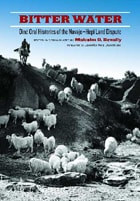
Bitter Water
Diné Oral Histories of the Navajo-Hopi Land DisputeEdited and Translated by Malcolm D. Benally; Foreword by Jennifer Nez Denetdale
University of Arizona Press, 2011
Bitter Water presents the narratives of four Diné women who have resisted removal but who have watched as their communities and lifeways have changed dramatically. The book, based on 25 hours of filmed personal testimony, features the women’s candid discussions of their efforts to carry on a traditional way of life in a contemporary world that includes relocation and partitioned lands; encroaching Western values and culture; and devastating mineral extraction and development in the Black Mesa region of Arizona. Though their accounts are framed by insightful writings by both Benally and Diné historian Jennifer Nez Denetdale, Benally lets the stories of the four women elders speak for themselves.
Scholars, media, and other outsiders have all told their versions of this story, but this is the first book that centers on the stories of women who have lived it—in their own words in Navajo as well as the English translation. The result is a living history of a contested cultural landscape and the unique worldview of women determined to maintain their traditions and lifeways, which are so intimately connected to the land. This book is more than a collection of stories, poetry, and prose. It is a chronicle of resistance as spoken from the hearts of those who have lived it.
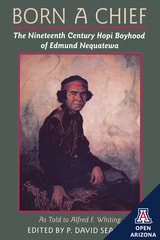
Born a Chief
The Nineteenth Century Hopi Boyhood of Edmund Nequatewa, as told to Alfred F. WhitingEdmund Nequatewa
University of Arizona Press, 1993
"This story was fascinating. . . . One worth the telling and one which will stay with the reader."—American Desert Magazine
"Recommended."—Choice
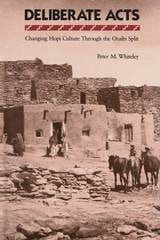
Deliberate Acts
Changing Hopi Culture Through the Oraibi SplitPeter M. Whiteley
University of Arizona Press, 1988
Drawing on oral accounts from Hopi consultants and on contemporary documents, Peter M. Whiteley argues that the split was in fact the result of a conspiracy among Hopi politico-religious leaders from both the “hostile” and “friendly” factions, a revolution to overturn the allegedly corrupt Oraibi religious order. A crucial element of Whiteley’s thesis is that, contrary to established theory, Hopi society was not egalitarian but was controlled by a ruling elite, the pavansinom, who clandestinely planned such events as the destruction of Awatovi because of its reacceptance of Franciscan priests.
Through an analysis of Bacavi social structure, Whiteley demonstrates how one fragment of a well-established society went about creating a new social order after the old one drastically fragmented. His detailed portrait of the history and social organization of a Hopi village represents an unusually rich resource for students of Hopi culture and history.

Footprints of Hopi History
Hopihiniwtiput Kukveni'atEdited by Leigh J. Kuwanwisiwma, T. J. Ferguson, and Chip Colwell
University of Arizona Press, 2018
The fourteen chapters in Footprints of Hopi History: Hopihiniwtiput Kukveni’at focus on these Hopi footprints as they are understood through a variety of research techniques, including archaeology, ethnography, documentary history, plant genetics, and educational outreach. The editors and contributors offer fresh and innovative perspectives on Hopi archaeology and history, and demonstrate how one tribe has significantly advanced knowledge about its past through collaboration with archaeologists and cultural anthropologists.
The book features managerial uses of research, cultural landscape theory, use of GIS in research, archaeological interpretations of social identity and immigration, analysis of corn genetics, heritage education of youth, and research of oral traditions and documentary history. Footprints of Hopi History highlights the Hopi tribe’s leadership in sustained efforts to create bridges between tribal goals and anthropology, forging a path for others to follow.
Contributors
E. Charles Adams
Wesley Bernardini
Joëlle Clark
Chip Colwell
T. J. Ferguson
Dennis Gilpin
Kelley Hays-Gilpin
George Gumerman IV
Saul L. Hedquist
Maren P. Hopkins
Stewart B. Koyiyumptewa
Leigh J. Kuwanwisiwma
Lee Wayne Lomayestewa
Patrick D. Lyons
Shirley Powell
Gregson Schachner
Thomas E. Sheridan
Mark D. Varien
Laurie D. Webster
Peter M. Whiteley
Michael Yeatts
Homol'ovi II
Archaeology of an Ancestral Hopi Village, ArizonaEdited by E. Charles Adams and Kelley Ann Hays
University of Arizona Press, 1991

Homol'ovi
An Ancient Hopi Settlement ClusterE. Charles Adams
University of Arizona Press, 2002
Charles Adams has directed fifteen years of research at these sites for the Arizona State Museum, including excavations in five of the seven primary Homol'ovi villages and in other villages predating them. Through this research he concludes that the founders of these settlements were Hopis who sought to protect their territory from migrating groups elsewhere in the Pueblo world. This book summarizes that research and broadens our understanding of the relationship of Homol'ovi to ancient and modern Hopi people.
Each Homol'ovi village had a unique history of establishment, growth, sociopolitical organization, length of occupation, and abandonment; and although the villages shared much in the way of material culture, their size and configuration were tremendously varied. By comparing Homol'ovi research to information from projects on other settlements in the area, Adams has been able to reconstruct a provocative history of the Homol'ovi cluster that includes relationships among the individual villages and their relationships to nearby clusters. He shows that social organization within villages is apparent by the number and variety of ritual structures, while political organization among villages is indicated by the need for cooperation to share water for irrigation and by the exchange of such materials as pottery, obsidian, and ground stone.
Adams advances several important theories about why Homol'ovi was founded where and when it was, who its founders were, and the importance of cotton in making Homol'ovi an important center of trade in the 1300s. He also considers why Pueblo settlements suddenly became so large, addressing theoretical issues pertaining to multiple settlements and the rise of enormous villages containing more than 1,000 rooms.
Homol'ovi is a rich work of synthesis and interpretation that will be important for anyone with an interest in Southwest archaeology, Arizona history, or Hopi culture. By considering the settlement trajectory of an entire cluster of sites, it will also prove valuable to archaeologists worldwide.

Hopi Cookery
Juanita Tiger Kavena
University of Arizona Press, 1980
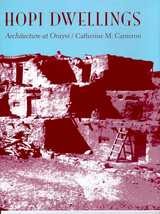
Hopi Dwellings
Architectural Change at OrayviCatherine M. Cameron
University of Arizona Press, 1999
Her study is unique in its use of historic photographs to document and understand abandonment processes and apply that knowledge to prehistoric sites. Photos taken by tourists, missionaries, and early anthropologists during the late nineteenth century portray original structures, while later photos show how Orayvi buildings changed over a period of almost eighty years. Census data relating to house size and household configuration shed additional light on social change in the pueblo.
Examining change at Orayvi afforded an opportunity to study the architectural effects of an event that must have happened many times in the past--the partial abandonment of a pueblo--by tracing the effects of sudden population decline on puebloan architecture. Cameron's work provides clues to how and why villages were abandoned and re-established repeatedly in the prehistoric Southwest as it offers a unique window on the relationship between Pueblo houses and the living people who occupied them.
Hopi Oral Tradition and the Archaeology of Identity
Wesley Bernardini
University of Arizona Press, 2005
Wesley Bernardini now draws on an unconventional source, Hopi traditional knowledge, to show how hypotheses that are developed from oral tradition can stimulate new and productive ways to think about the archaeological record. Focusing on insights that oral tradition has to offer about general processes of prehistoric migration and identity formation, he describes how each Hopi clan acquired its particular identity from the experiences it accumulated on its unique migration pathway. This pattern of “serial migration” by small social groups often saw the formation of villages by clans that briefly came together and then moved off again independently, producing considerable social diversity both within and among villages.
Using Anderson Mesa and Homol’ovi as case studies, Bernardini presents architectural and demographic data suggesting that the fourteenth century occupation of these regions was characterized by population flux and diversity consistent with the serial migration model. He offers an analysis of rock art motifs—focusing on those used as clan symbols—to evaluate the diversity of group identities, then presents a compositional analysis of Jeddito Yellow Ware pottery to evaluate the diversity of these groups’ eventual migration destinations.
Evidence supporting serial migration greatly complicates existing notions of links between ancient and modern social groups, with important implications for the implementation of the Native American Graves Protection and Repatriation Act. Bernardini’s work clearly demonstrates that studies of cultural affiliation must take into account the fluid nature of population movements and identity in the prehistoric landscape. It takes a decisive step toward better understanding the major demographic change that occurred on the Colorado Plateau from 1275 to 1400 and presents a strategy for improving the reconstruction of cultural identity in the past.
Hopis and the Counterculture
Traditionalism, Appropriation, and the Birth of a Social FieldBrian D. Haley
University of Arizona Press, 2024
Exploring the new social field that developed to spread these ideas, Hopis and the Counterculture meticulously traces the trajectories of figures such as Ammon Hennacy, Craig Carpenter, Frank Waters, and the Firesign Theatre, among others. Drawing on insights into the interplay between primitivism, radicalism, stereotyping, and identity, Haley expands on concepts from scholars such as Roy Harvey Pearce’s notion of “isolated radicals” and Jonathan Friedman’s observations regarding the ascendancy of primitivism amid global crises. Haley scrutinizes the roles played by non-Hopi actors and the timing behind the widespread popularization of Hopi religious practices.

Husk of Time
The Photographs of Victor MasayesvaVictor Masayesva, Jr.; Introduction by Beverly R. Singer
University of Arizona Press, 2006

Moquis and Kastiilam
Hopis, Spaniards, and the Trauma of History, Volume I, 1540–1679Edited by Thomas E. Sheridan, Stewart B. Koyiyumptewa, Anton Daughters, Dale S. Brenneman, T. J. Ferguson, Leigh Kuwanwisiwma, and Lee Wayne Lomayestewa
University of Arizona Press, 2015
The editors argue that the Spanish record is incomplete, and only the Hopi perspective can balance the story. The Spanish documentary record (and by extension the documentary record of any European or Euro-American colonial power) is biased and distorted, according to the editors, who assert there are enormous silences about Hopi responses to Spanish missionization and colonization. The only hope of correcting those weaknesses is to record and analyze Hopi oral traditions, which have been passed down from generation to generation, and give voice to Hopi values and Hopi social memories of what was a traumatic period in their past.
Spanish abuses during missionization—which the editors address specifically and directly as the sexual exploitation of Hopi women, suppression of Hopi ceremonies, and forced labor of Hopis—drove Hopis to the breaking point, inspiring a Hopi revitalization that led them to participate in the Pueblo Revolt. Those abuses, the revolt, and the resistance that followed remain as open wounds in Hopi society today.

Moquis and Kastiilam
Hopis, Spaniards, and the Trauma of History, Volume II, 1680–1781Edited by Thomas E. Sheridan, Stewart B. Koyiyumptewa, Anton Daughters, Dale S. Brenneman, T. J. Ferguson, Leigh Kuwanwisiwma, and Lee Wayne Lomayestewa
University of Arizona Press, 2020
The second in a two-volume series, Moquis and Kastiilam, Volume II, 1680–1781 continues the story of the encounter between the Hopis, who the Spaniards called Moquis, and the Spaniards, who the Hopis called Kastiilam, from the Pueblo Revolt in 1680 through the Spanish expeditions in search of a land route to Alta California until about 1781. By comparing and contrasting Spanish documents with Hopi oral traditions, the editors present a balanced presentation of a shared past. Translations of sixteenth-, seventeenth-, and eighteenth-century documents written by Spanish explorers, colonial officials, and Franciscan missionaries tell the perspectives of the European visitors, and oral traditions recounted by Hopi elders reveal the Indigenous experience.
The editors argue that only the Hopi perspective can balance the story recounted in the Spanish documentary record, which is biased, distorted, and incomplete (as is the documentary record of any European or Euro-American colonial power). The only hope of correcting those weaknesses and the enormous silences about the Hopi responses to Spanish missionization and colonization is to record and analyze Hopi oral traditions, which have been passed down from generation to generation since 1540, and to give voice to Hopi values and social memories of what was a traumatic period in their past.
Volume I documented Spanish abuses during missionization, which the editors address specifically and directly as the sexual exploitation of Hopi women, suppression of Hopi ceremonies, and forced labor of Hopi men and women. These abuses drove Hopis to the breaking point, inspiring a Hopi revitalization that led them to participate in the Pueblo Revolt and to rebuff all subsequent efforts to reestablish Franciscan missions and Spanish control. Volume II portrays the Hopi struggle to remain independent at its most effective—a mixture of diplomacy, negotiation, evasion, and armed resistance. Nonetheless, the abuses of Franciscan missionaries, the bloodshed of the Pueblo Revolt, and the subsequent destruction of the Hopi community of Awat’ovi on Antelope Mesa remain historical traumas that still wound Hopi society today.

Pages from Hopi History
Harry C. James
University of Arizona Press, 1974
"It is personal yet precise, emotional and involved, yet objective and factual. . . . Readers who know something of Hopi history will be fascinated by the new insights and interpretations presented by James."—Arizona and the West
"The author has been an active supporter of Hopi interests for some fifty years and this book is as much a testimony to his unflagging personal devotion to a small and neglected tribe as it is a history of the Hopis' determination to maintain their identity and self-respect."—Journal of Arizona History
"Harry James writes with sympathy and restraint about a proud people who have suffered unjustly in the past, and who today are seeking an identity. He brings into sharp focus the dreams for tomorrow of the Hopi tribe. Let these dreams be shared by others before it is too late."—The American West
"An amazing and gripping account of a very great and intelligent people, concentrating on fact rather than the fantastic legends that have grown up around this unique culture."—The Masterkey
"The Hopi are indeed a most interesting people, and this authentic account of their way of life is a valuable contribution to our knowledge of the Indian tribes of Arizona."—The Book Exchange
"For an excellent account of the history of the Hopi, the Southwest, typical government intervention into tribal affairs and the lives of the people . . . a must for any library."—Whispering Winds
Spider Woman Stories
G. M. Mullett
University of Arizona Press, 1979
"This is a fine introduction to Hopi mythology and values. It recreates an authentic poetic spirit and makes the reader eager to read more Hopi tales." —New Mexico Humanities Review
The Hopi Indians of Old Oraibi
Change and ContinuityMischa Titiev
University of Michigan Press, 1972

The Maze
A Desert JourneyLucy Rees
University of Arizona Press, 1996
Western Pueblo Identities
Regional Interaction, Migration, and TransformationAndrew I. Duff
University of Arizona Press, 2002
Using comparative data from the Upper Little Colorado and Zuni regions, Duff demonstrates differences in patterns of interaction within and between regions with different population densities. He then links these differences to such factors as occupational history, immigrant populations, the negotiation of social identities, and the emergence of new ritual systems. Following abandonments in the Four Corners area in the late 1200s, immigrants with different historical backgrounds occupied many Western Pueblo regions—in contrast to the Hopi and Zuni regions, which had more stable populations and deeper historical roots.
Duff uses chemical analyses of ceramics to document exchange among several communities within these regions, showing that people in less densely settled regions were actively recruited by residents of the Hopi and Zuni regions to join their settlements. By the time of the arrival of the Spaniards, two distinct social and territorial groups—the Hopi and Zuni peoples—had emerged from this scattering of communities. Duff's new interpretations, along with new data on ceramic exchange patterns, suggest that interaction is a better way to measure identity than more commonly used criteria. His work offers new perspectives on the role of ritual in social organization and on identity formation in Pueblo IV society and is rich in implications for the study of other sedentary, middle-range societies.

When Is a Kiva?
And Other Questions About Southwestern ArchaeologyWatson Smith; Edited by Raymond H. Thompson
University of Arizona Press, 1990
Contents:
The Vitality of the Hopi Way: Mural Decorations from Ancient Hopi Kivas
Pit House and Kiva Pitfalls: When Is a Kiva?
D-Shaped Features: The Kiva at Site 4
The Kiva Beneath the Altar: Room 788
"Ethnology Itself Carried Back": Extent of Ethnographic Studies Among the Pueblos
Birds of a Feather: Feathers
Pots on the Kiva Wall: Ceremonial Bowls
The Potsherd Paradigm: Analysis of Hooks, Scrolls, and Keys
A School for Cracked Pots: Schools, Pots, and Potters; The Jeddito School