Results by title
5 books match the query 'Horowitz, Daniel'

A Jewish Feminine Mystique?
Jewish Women in Postwar AmericaEdited by Hasia R. Diner, Shira Kohn, and Rachel Kranson
Rutgers University Press, 2010
As workers with or without pay, social justice activists, community builders, entertainers, and businesswomen, most Jewish women championed responsibilities outside their homes. Jewishness played a role in shaping their choices, shattering Friedan's assumptions about how middle-class women lived in the postwar years. Focusing on ordinary Jewish women as well as prominent figures such as Judy Holliday, Jennie Grossinger, and Herman Wouk's fictional Marjorie Morningstar, leading scholars explore the wide canvas upon which American Jewish women made their mark after the Second World War.

Bear With Me
A Cultural History of Famous Bears in AmericaDaniel Horowitz
Duke University Press, 2025
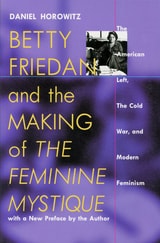
Betty Friedan and the Making of "The Feminine Mystique"
The American Left, the Cold War, and Modern FeminismDaniel Horowitz
University of Massachusetts Press, 1998
Ever since the 1963 publication of her landmark book, The Feminine Mystique, Betty Friedan has insisted that her commitment to women's rights grew out of her experiences as an alienated suburban housewife. Yet as Daniel Horowitz persuasively demonstrates in this illuminating and provocative biography, the roots of Friedan's feminism run much deeper than she has led us to believe. Drawing on an impressive body of new research—including Friedan's own papers—Horowitz traces the development of Friedan's feminist outlook from her childhood in Peoria, Illinois, through her wartime years at Smith College and Berkeley, to her decade-long career as a writer for two of the period's most radical labor journals, the Federated Press and the United Electrical Workers' UE News. He further shows that even after she married and began to raise a family, Friedan continued during the 1950s to write and work on behalf of a wide range of progressive social causes. By resituating Friedan within a broader cultural context, and by offering a fresh reading of The Feminine Mystique against that background, Horowitz not only overturns conventional ideas about “second wave” feminism but also reveals long submerged links to its past.
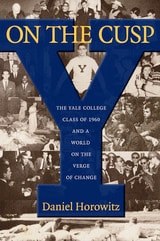
On the Cusp
The Yale College Class of 1960 and a World on the Verge of ChangeDaniel Horowitz
University of Massachusetts Press, 2015
How did the 1950s become “The Sixties”? This is the question at the heart of Daniel Horowitz's On the Cusp. Part personal memoir, part collective biography, and part cultural history, the book illuminates the dynamics of social and political change through the experiences of a small, and admittedly privileged, generational cohort.
A Jewish “townie” from New Haven when he entered Yale College in fall 1956, Horowitz reconstructs the undergraduate career of the class of 1960 and follows its story into the next decade. He begins by looking at curricular and extracurricular life on the all-male campus, then ranges beyond the confines of Yale to larger contexts, including the local drama of urban renewal, the lingering shadow of McCarthyism, and decolonization movements around the world. He ponders the role of the university in protecting the prerogatives of class while fostering social mobility, and examines the growing significance of race and gender in American politics and culture, spurred by a convergence of the personal and the political. Along the way he traces the political evolution of his classmates, left and right, as Cold War imperatives lose force and public attention shifts to the civil rights movement and the war in Vietnam.
Throughout Horowitz draws on a broad range of sources, including personal interviews, writings by classmates, reunion books, issues of the Yale Daily News, and other undergraduate publications, as well as his own letters and college papers. The end product is a work consistent with much of Horowitz's previously published scholarship on postwar America, further exposing the undercurrent of discontent and dissent that ran just beneath the surface of the so-called Cold War consensus.

The Anxieties of Affluence
Critiques of American Consumer Culture, 1939-1979Daniel Horowitz
University of Massachusetts Press, 2004
This book charts the reactions of prominent American writers to the unprecedented prosperity of the decades following World War II. It begins with an examination of Lewis Mumford's wartime call for “democratic” consumption and concludes with an analysis of the origins of President Jimmy Carter's “malaise” speech of 1979. Between these bookends, Daniel Horowitz documents a broad range of competing views, each in its own way reflective of a deep-seated ambivalence toward consumer culture.