Results by title
3 books match the query 'Horrocks, Thomas A.'
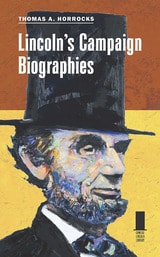
Lincoln's Campaign Biographies
Thomas A. Horrocks
Southern Illinois University Press, 2014
During the 1860 and 1864 presidential campaigns, Abraham Lincoln was the subject of over twenty campaign biographies. In this innovative study, Thomas A. Horrocks examines the role that these publications played in shaping an image of Lincoln that would resonate with voters and explores the vision of Lincoln that the biographies crafted, the changes in this vision over the course of four years, and the impact of these works on the outcome of the elections.
Horrocks investigates Lincoln’s campaign biographies within the context of the critical relationship between print and politics in nineteenth-century America and compares the works about Lincoln with other presidential campaign biographies of the era. Horrocks shows that more than most politicians of his day, Lincoln deeply appreciated and understood the influence and the power of the printed word.
The 1860 campaign biographies introduced to America “Honest Abe, the Rail Splitter,” a trustworthy, rugged candidate who appealed to rural Americans. When Lincoln ran for reelection in 1864, the second round of campaign biographies complemented this earlier portrait of Lincoln with a new, paternal figure, “Father Abraham,” more appropriate for Americans enduring a bloody civil war. Closing with a consideration of the influence of these publications on Lincoln’s election and reelection, Lincoln’s Campaign Biographies provides a new perspective for those seeking a better understanding of the sixteenth president and two of the most critical elections in American history.
Popular Print and Popular Medicine
Almanacs and Health Advice in Early AmericaThomas A. Horrocks
University of Massachusetts Press, 2008
In this innovative study of the relationship between popular print and popular attitudes toward the body, health, and disease in antebellum America, Thomas A. Horrocks focuses our attention on a publication long neglected by scholars—the almanac.
Approaching his subject as both a historian of the book and a historian of medicine, Horrocks contends that the almanac, the most popular secular publication in America from the late eighteenth century to the first quarter of the nineteenth, both shaped and was shaped by early Americans' beliefs and practices pertaining to health and medicine. Analyzing the astrological, therapeutic, and regimen advice offered in American almanacs over two centuries, and comparing it with similar advice offered in other genres of popular print of the period, Horrocks effectively demonstrates that the almanac was a leading source of health information in America prior to the Civil War. He contends that the almanac was an integral component of a complicated, fragmented, semi-vernacular health literature of the period, and that the genre played a leading role in disseminating astrological health advice as well as shaping contemporary and future perceptions of astrology.
In terms of therapeutic and regimen advice, Horrocks asserts that the almanac performed a complementary role, confirming and reinforcing traditional beliefs and practices. By analyzing the almanac as a cultural artifact that represents a time, a place, and a certain set of assumptions and beliefs, he demonstrates that the genre can provide a lens through which scholars may examine early American attitudes and practices concerning their health in particular and American popular culture in general.
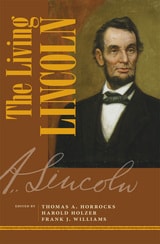
The Living Lincoln
Edited by Thomas A. Horrocks, Harold Holzer, and Frank J. Williams
Southern Illinois University Press, 2011
In an opening section focusing largely on Lincoln's formative years, insightful explorations into his early self-education and the era before his presidency come from editors Frank J. Williams and Harold Holzer, respectively. Readers will also glimpse a Lincoln rarely discerned in books: calculating politician, revealed in Matthew Pinsker's illuminating essay, and shrewd military strategist, as demonstrated by Craig L. Symonds. Stimulating discussions from Edna Greene Medford, John Stauffer, and Michael Vorenberg tell of Lincoln's friendship with Frederick Douglass, his gradualism on abolition, and his evolving thoughts on race and the Constitution to round out part two. Part three features reflections on his martyrdom and memory, including a counterfactual history from Gerald J. Prokopowicz that imagines a hypothetical second term for the president, emphasizing the differences between Lincoln and his successor, Andrew Johnson. Barry Schwartz's contribution presents original research that yields fresh insight into Lincoln's evolving legacy in the South, while Richard Wightman Fox dissects Lincoln's 1865 visit to Richmond, and Orville Vernon Burton surveys and analyzes recent Lincoln scholarship.
This thought-provoking new anthology, introduced at a major bicentennial symposium at Harvard University, offers a wide range of ideas and interpretations by some of the best-known and most widely respected historians of our time. The Living Lincoln is essential reading for those seeking a better understanding of this nation's greatest president and how his actions resonate today.