Results by title
18 books match the query 'Relativity'
A Relatively Painless Guide to Special Relativity
Dave Goldberg
University of Chicago Press, 2023
Special relativity challenges one’s physical intuition of space, time, matter, and energy in a way that few other topics in physics do. Yet the subject is often treated as an extra in undergraduate courses—something to be picked up in a few random lectures and presented as a combination of geometric and logical puzzles (seemingly with the premise of getting the novice student to concede that Einstein was a genius and that the universe is weird). But special relativity is absolutely fundamental to modern physics. It is the canvas on which electromagnetism, particle physics, field theory, and ultimately general relativity are based. For physics students, developing a relativistic intuition isn’t just a luxury: it’s a requirement.
Physicist and popular author Dave Goldberg provides a rigorous but conversational introduction to fill this void in spacetime education. Employing the standard calculus a sophomore or junior university student in science, engineering, or computer science will have encountered, Goldberg connects relativity to a student’s work ahead, acquainting them with topics like tensors, the development of new physical theories, and how relativity directly relates to other disciplines. But more than this, Goldberg welcomes lifelong learners who may have encountered special relativity in popular accounts, but are seeking a mathematical challenge to understand an elegant physical theory.

An Equation That Changed the World
Newton, Einstein, and the Theory of RelativityHarald Fritzsch
University of Chicago Press, 1994
"Fritzsch could not give the modern reader a more memorable introduction to the personalities and science of Isaac Newton and Albert Einstein unless somehow he could find the keys to H. G. Wells' time machine. . . . Many readers will applaud Fritzsch for this lively but profoundly insightful book." —Booklist, starred review
"[Fritzsch] has dreamed up a dialogue between the two great physicists, helped along by a fictional modern physicist. . . . The conversation builds up to an explanation of E=mc2, and on the way illuminates the important points where Newtonian and Einsteinian theory diverge." —David Lindley, New York Times Book Review
Black Holes and Relativistic Stars
Edited by Robert M. Wald
University of Chicago Press, 1998
Volume contributors: Valeria Ferrari, John L. Friedman, James B. Hartle, Stephen W. Hawking, Gary T. Horowitz, Werner Israel, Roger Penrose, Martin J. Rees, Rafael D. Sorkin, Saul A. Teukolsky, Kip S. Thorne, and Robert M. Wald.
Cracking the Einstein Code
Relativity and the Birth of Black Hole PhysicsFulvio Melia
University of Chicago Press, 2009
Albert Einstein’s theory of general relativity describes the effect of gravitation on the shape of space and the flow of time. But for more than four decades after its publication, the theory remained largely a curiosity for scientists; however accurate it seemed, Einstein’s mathematical code—represented by six interlocking equations—was one of the most difficult to crack in all of science. That is, until a twenty-nine-year-old Cambridge graduate solved the great riddle in 1963. Roy Kerr’s solution emerged coincidentally with the discovery of black holes that same year and provided fertile testing ground—at long last—for general relativity. Today, scientists routinely cite the Kerr solution, but even among specialists, few know the story of how Kerr cracked Einstein’s code.
Fulvio Melia here offers an eyewitness account of the events leading up to Kerr’s great discovery. Cracking the Einstein Code vividly describes how luminaries such as Karl Schwarzschild, David Hilbert, and Emmy Noether set the stage for the Kerr solution; how Kerr came to make his breakthrough; and how scientists such as Roger Penrose, Kip Thorne, and Stephen Hawking used the accomplishment to refine and expand modern astronomy and physics. Today more than 300 million supermassive black holes are suspected of anchoring their host galaxies across the cosmos, and the Kerr solution is what astronomers and astrophysicists use to describe much of their behavior.
By unmasking the history behind the search for a real world solution to Einstein’s field equations, Melia offers a first-hand account of an important but untold story. Sometimes dramatic, often exhilarating, but always attuned to the human element, Cracking the Einstein Code is ultimately a showcase of how important science gets done.
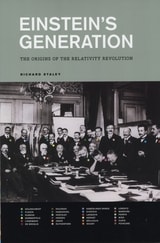
Einstein's Generation
The Origins of the Relativity RevolutionRichard Staley
University of Chicago Press, 2009
Why do we celebrate Einstein’s era above all other epochs in the history of physics? Much of the history of physics at the beginning of the twentieth century has been written with a sharp focus on a few key figures and a handful of notable events. Einstein’s Generation offers a distinctive new approach to the origins of modern physics by exploring both the material culture that stimulated relativity and the reaction of Einstein’s colleagues to his pioneering work.
Richard Staley weaves together the diverse strands of experimental and theoretical physics, commercial instrument making, and the sociology of physics around 1900 to present the collective efforts of a group whose work helped set the stage for Einstein’s revolutionary theories and the transition from classical to modern physics that followed. Collecting papers, talks, catalogues, conferences, and correspondence, Staley juxtaposes scientists’ views of relativity at the time to modern accounts of its history. Einstein’s Generation tells the story of a group of individuals which produced some of the most significant advances of the twentieth century; and challenges our celebration of Einstein’s era above all others.
Energy Forms
Allegory and Science in the Era of Classical ThermodynamicsBruce Clarke
University of Michigan Press, 2001
The book begins with an overview of the interconnections between allegory in literature and allegory in science, then analyzes the interaction between energy and entropy and their personification in the literature of the times. Energy Forms draws on the writing of well-known literary and scientific authors including H. G. Wells, Camille Flammarion, Charles Howard Hinton and D. H. Lawrence, among others. The focus then shifts to the broad cultural tension between thermodynamic malaise and electromagnetic aspiration. Energy Forms uncovers the works of important but overlooked authors in the fields of science and literature and will appeal especially to those who are intrigued by interdisciplinary studies.
Bruce Clarke is Professor of English,Texas Tech University. He is the author of Dora Marsden and Early Modernism: Gender, Individualism, Science; Allegories of Writing: The Subject of Metamorphosis; and editor of The Body and the Text: Comparative Essays in Literature and Medicine.
General Relativity
Robert. M. Wald
University of Chicago Press, 1984
Robert M. Wald's book has been a staple of physics teaching for decades. It offers straightforward, rigorous analyses of current understandings of all the central questions and problems of the field, giving each the complexity it requires while making every effort to keep the whole accessible to a student who is embarking on the study of this subject for the first time.
General Relativity from A to B
Robert Geroch
University of Chicago Press, 1981
"An imaginative and convincing new presentation of Einstein's theory of general relativity. . . . The treatment is masterful, continual emphasis being placed on careful discussion and motivation, with the aim of showing how physicists think and develop their ideas."—Choice
History and Theory after the Fall
An Essay on InterpretationFred Weinstein
University of Chicago Press, 1990
In the wake of this collapse or "fall," the rival claims of fiction, psychoanalysis, sociology, anthropology, and history have created the dilemma of radical relativism, the prospect of multiple interpretations of any complex historical event. The basic strategy of social theory and the social sciences—the search for underlying unities—proves so inherently contradictory and has provided so little in the way of reliable knowledge of social and historical relationships that to many critics it seems no longer worth pursuing.
Weinstein enters the debate by rejecting any search for underlying structural unities, dynamic or social, through which historians have attempted to find continuity with the past. He looks instead to ideological processes, to the construction of successive and changing versions of reality that mediate between the power of fantasy on the one side and the power of the social world on the other. He argues further that the need to use ideological constructs in this way accounts for the heterogeneous and changing content of social movements and for the persistent need people have always had for authoritative leaders, even in democratized societies. He suggests that people have historically been able to take a step away from leaders only by substituting the possession of objects such as property or money. This book is a breakthrough in poststructuralist theory that is sure to stimulate considerable discussion, especially about the shape of the social sciences and the future of historical interpretation.
Quantum Field Theory in Curved Spacetime and Black Hole Thermodynamics
Robert M. Wald
University of Chicago Press, 1994
In this book, Robert Wald provides a coherent, pedagogical introduction to the formulation of quantum field theory in curved spacetime. He begins with a treatment of the ordinary one-dimensional quantum harmonic oscillator, progresses through the construction of quantum field theory in flat spacetime to possible constructions of quantum field theory in curved spacetime, and, ultimately, to an algebraic formulation of the theory. In his presentation, Wald disentangles essential features of the theory from inessential ones (such as a particle interpretation) and clarifies relationships between various approaches to the formulation of the theory. He also provides a comprehensive, up-to-date account of the Unruh effect, the Hawking effect, and some of its ramifications. In particular, the subject of black hole thermodynamics, which remains an active area of research, is treated in depth.
This book will be accessible to students and researchers who have had introductory courses in general relativity and quantum field theory, and will be of interest to scientists in general relativity and related fields.

Reclaiming Truth
Contribution to a Critique of Cultural RelativismChristopher Norris
Duke University Press, 1996
Norris presents his case in a series of closely argued chapters that take issue with the relativist position. He attempts to rehabilitate the value of truth in philosophy of science by restoring a lost distinction between concept and metaphor and argues that theoretical discourse, so far from being an inconsequential activity, has very real consequences, particularly in ethics and politics. This debate has become skewed, he suggests, through the widespread and typically postmodern idea that truth-claims must always go along with a presumptive or authoritarian bid to silence opposing views. On the contrary, there is nothing as dogmatic—or as silencing—as a relativism that acknowledges no shared truth conditions for valid or responsible discourse. Norris also offers a timely reassessment of several thinkers—Althusser and Derrida among them—whose reception history has been distorted by the vagaries of short-term intellectual fashion.
Reclaiming Truth will be welcomed by readers concerned with the uses and abuses of theory at a time when such questions are in urgent need of sustained and serious debate.
Science and Relativism
Some Key Controversies in the Philosophy of ScienceLarry Laudan
University of Chicago Press, 1990
Sensus Communis
Vico, Rhetoric, and the Limits of RelativismJohn D. Schaeffer
Duke University Press, 1990
In extended commentaries on Gadamer, the Gadamer/Habermas debate, and Derrida, Schaeffer shows that Vico offers the possibility of analyzing social phenomena and constellations of power from within the humanist rhetorical tradition. Vico’s achievements have powerful implications for relating ethics and hermeneutics to the world of concrete social practice, particularly in an age in which the electronic media have replaced print as the primary means of communication and in which a “secondary orality” (a cast of mind similar to that of nonliterate peoples) is appearing within our literate civilization.
Spacetime And Geometry
The Alfred Schild LecturesEdited by Richard A. Matzner and L. C. Shepley
University of Texas Press, 1982
These reports, at the forefront of relativity theory when they were written, in particular the geometrical aspects of spacetime theory, were the result of the Alfred Schild Memorial Lecture Series presented at the University of Texas at Austin beginning in 1977. Each article is a self-contained summary of an important area of contemporary gravitational physics, while the book as a whole provides an overview of a wide variety of the problems of general relativity and gravitation.
The Specter of Relativism
Truth, Dialogue, and Phronesis in Philosophical HermeneuticsLawrence Schmidt
Northwestern University Press, 1995

Theoretical Principles in Astrophysics and Relativity
Norman R. Lebovitz, William H. Reid, and Peter O. Vandervoort
University of Chicago Press, 1981
"The book as a whole should be a gift from every research supervisor to every new graduate student in theoretical astronomy."—D. W. Sciama, Science
Topics in the Foundations of General Relativity and Newtonian Gravitation Theory
David B. Malament
University of Chicago Press, 2012
Victorian Relativity
Radical Thought and Scientific DiscoveryChristopher Herbert
University of Chicago Press, 2001
Christopher Herbert shows that the idea of relativity produced revolutionary changes in one field after another in the nineteenth century. Surveying a long line of thinkers including Herbert Spencer, Charles Darwin, Alexander Bain, W. K. Clifford, W. S. Jevons, Karl Pearson, James Frazer, and Einstein himself, Victorian Relativity argues that the early relativity movement was bound closely to motives of political and cultural reform and, in particular, to radical critiques of the ideology of authoritarianism. Recuperating relativity from those who treat it as synonymous with nihilism, Herbert portrays it as the basis of some of our crucial intellectual and ethical traditions.