Results by title
31 books match the query 'Hospitals'
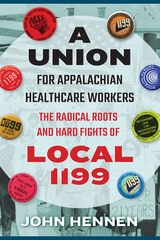
A Union for Appalachian Healthcare Workers
The Radical Roots and Hard Fights of Local 1199John Hennen
West Virginia University Press, 2021
The union of hospital workers usually referred to as the 1199 sits at the intersection of three of the most important topics in US history: organized labor, health care, and civil rights. John Hennen’s book explores the union’s history in Appalachia, a region that is generally associated with extractive industries but has seen health care grow as a share of the overall economy.
With a multiracial, largely female, and notably militant membership, 1199 was at labor’s vanguard in the 1970s, and Hennen traces its efforts in hospitals, nursing homes, and healthcare centers in West Virginia, eastern Kentucky, and Appalachian Ohio. He places these stories of mainly low-wage women workers within the framework of shake-ups in the late industrial and early postindustrial United States, relying in part on the words of Local 1199 workers and organizers themselves. Both a sophisticated account of an overlooked aspect of Appalachia’s labor history and a key piece of context for Americans’ current concern with the status of “essential workers,” Hennen’s book is a timely contribution to the fields of history and Appalachian studies and to the study of social movements.

Africanizing Oncology
Creativity, Crisis, and Cancer in UgandaMarissa Mika
Ohio University Press, 2021
Articulations
The Body and Illness in PoetryJon Mukand
University of Iowa Press, 1994
In 1987 poet and physician Jon Mukand published Sutured Words, a volume of contemporary poems to help patients, their families and friends, and all health care professionals embrace the complexity of healing, illness, and death. Robert Coles called the collection “a wonderful source of inspiration and instruction for any of us who are trying to figure out what our work means”; Norman Cousins was impressed by the “discernment and high quality of the selections.” Now, in Articulations, Mukand adds more than a hundred new poems to the strongest poems from Sutured Words to give us a lyrical, enlightened understanding of the human dimensions of suffering and illness
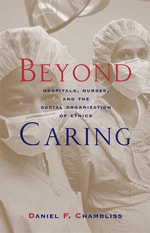
Beyond Caring
Hospitals, Nurses, and the Social Organization of EthicsDaniel F. Chambliss
University of Chicago Press, 1996
Vividly documenting the real world of the contemporary hospital, its nurses, and their moral and ethical crises, Dan Chambliss offers a sobering revelation of the forces shaping moral decisions in our hospitals.
Based on more than ten years' field research, Beyond Caring is filled with eyewitness accounts and personal stories demonstrating how nurses turn the awesome into the routine. It shows how patients, many weak and helpless, too often become objects of the bureaucratic machinery of the health care system and how ethics decisions, once the dilemmas of troubled individuals, become the setting for political turf battles between occupational interest groups. The result is a compelling combination of realism and a powerful theoretical argument about moral life in large organizations.
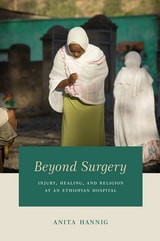
Beyond Surgery
Injury, Healing, and Religion at an Ethiopian HospitalAnita Hannig
University of Chicago Press, 2017
Through her in-depth ethnography of two repair and rehabilitation centers operating in Ethiopia, Hannig takes the reader deep into a world inside hospital walls, where women recount stories of loss and belonging, shame and delight. As she chronicles the lived experiences of fistula patients in clinical treatment, Hannig explores the danger of labeling “culture” the culprit, showing how this common argument ignores the larger problem of insufficient medical access in rural Africa. Beyond Surgery portrays the complex social outcomes of surgery in an effort to deepen our understanding of medical missions in Africa, expose cultural biases, and clear the path toward more effective ways of delivering care to those who need it most.
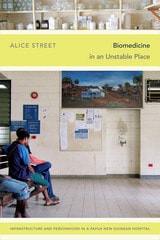
Biomedicine in an Unstable Place
Infrastructure and Personhood in a Papua New Guinean HospitalAlice Street
Duke University Press, 2014
In the hospital's clinics, biomedical practitioners struggle amid severe resource shortages to make the diseased body visible and knowable to the clinical gaze. That struggle is entangled with attempts by doctors, nurses, and patients to make themselves visible to external others—to kin, clinical experts, global scientists, politicians, and international development workers—as socially recognizable and valuable persons. Here hospital infrastructures emerge as relational technologies that are fundamentally fragile but also offer crucial opportunities for making people visible and knowable in new, unpredictable, and powerful ways.
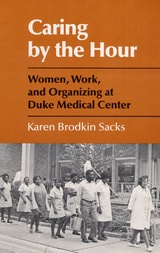
Caring by the Hour
Women, Work, and Organizing at Duke Medical CenterKaren Brodkin Sacks
University of Illinois Press, 1988
In addition to an analysis of the dynamics of women's activism, Caring by the Hour provides a comparative study of Duke Medical Center's treatment of both black and white female workers. Sacks links patterns of racial segregation in clerical jobs to the relationship between race, working conditions, and unequal opportunities for black and white women, and to their differing work cultures and patterns of public militance. She also discusses recent changes in service, clerical, and professional work and their effects on white and black women, placing them in the context of national changes in health funding and policies.
Challenging Operations
Medical Reform and Resistance in SurgeryKatherine C. Kellogg
University of Chicago Press, 2011
In 2003, in the face of errors and accidents caused by medical and surgical trainees, the American Council of Graduate Medical Education mandated a reduction in resident work hours to eighty per week. Over the course of two and a half years spent observing residents and staff surgeons trying to implement this new regulation, Katherine C. Kellogg discovered that resistance to it was both strong and successful—in fact, two of the three hospitals she studied failed to make the change. Challenging Operations takes up the apparent paradox of medical professionals resisting reforms designed to help them and their patients. Through vivid anecdotes, interviews, and incisive observation and analysis, Kellogg shows the complex ways that institutional reforms spark resistance when they challenge long-standing beliefs, roles, and systems of authority.
At a time when numerous policies have been enacted to address the nation’s soaring medical costs, uneven access to care, and shortage of primary-care physicians, Challenging Operations sheds new light on the difficulty of implementing reforms and offers concrete recommendations for effectively meeting that challenge.

Chris Gets Ear Tubes
Betty Pace
Gallaudet University Press, 1987
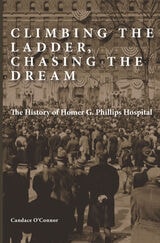
Climbing the Ladder, Chasing the Dream
The History of Homer G. Phillips HospitalCandace O’Connor
University of Missouri Press, 2022
When the beautiful, up-to-date hospital opened, it attracted more black residents than any other such program in the United States. Patients also flocked to the hospital, as did nursing students who found there excellent training, ready employment, and a boost into the middle class. For decades, the hospital thrived; by the 1950s, three-quarters of African-American babies in St. Louis were born at Homer G.
But the 1960s and 1970s brought less need for all-black hospitals, as faculty, residents, and patients were increasingly welcome in the many newly integrated institutions. Ever-tightening city budgets meant less money for the hospital, and in 1979, despite protests from the African-American community, HGPH closed. Years later, the venerated, long-vacant building came to life again as the Homer G. Phillips Senior Living Community.
Candace O’Connor draws upon contemporary newspaper articles, institutional records, and dozens of interviews with former staff members to create the first, full history of the Homer G. Phillips Hospital. She also brings new facts and insights into the life and mysterious murder (still an unsolved case) of the hospital’s namesake, a pioneering Black attorney and civil rights activist who led the effort to build the sorely needed medical facility in the Ville neighborhood.

Cordelia Harvey
Civil War AngelBob Kann
Wisconsin Historical Society Press, 2011
Cordelia Harvey: Civil War Angel includes sidebars on medical care, early nursing, and military prisons. A timeline, glossary of terms, and suggestions for activities and discussion round out this spirited narrative.
Guide to Electrical Installations in Medical Locations
The Institution of Engineering and Technology Harris
The Institution of Engineering and Technology, 2017
Health in Ruins
The Capitalist Destruction of Medical Care at a Colombian Maternity HospitalCésar Ernesto Abadía-Barrero
Duke University Press, 2022

Hosts, Hospitals and Hospitalities
Narratives of (in)hospitality in literature, culture and the artsEdited by Susana Araújo, Catarina Nunes de Almeida, and Santiago Pérez Isasi
University College London, 2026
This book analyzes narratives of hospitality (and inhospitality) through recent crises like climate change and mass displacement.
Current historical and political issues, such as the refugee crisis and climate emergency, are deeply intertwined with notions, images, and narratives of (in)hospitality. Departing from seminal works, such as those by Kant and Derrida, on this topic, the chapters in this volume examine how new postcolonial, gender, environmental, and medical perspectives reshape current approaches to hospitality in literature, culture, and the arts.
Through a comparison of case studies in multiple national settings, Hosts, Hospitals and Hospitalities shows how the concept of hospitality shapes the way in which we relate with “the Other” in diverse—and ever-evolving—cultural, political, social, and environmental contexts. By examining the issue of hospitality from a post-pandemic standpoint, which revised the roles of our private and public spaces in the aftermath of COVID-19, by dwelling on novel issues of climate emergency, and by focusing on current developments in terms of migration and displacement, this book adds new light and significant theoretical and methodological perspectives to previous debates about hospitality.
Lifelines
The Traffic of TraumaHarris Solomon
Duke University Press, 2022

Mergers of Teaching Hospitals in Boston, New York, and Northern California
John A. Kastor
University of Michigan Press, 2003
If a teaching hospital loses funding, what is the next option?
Mergers of Teaching Hospitals in Boston, New York, and Northern California investigates the recent mergers of six of the nation's most respected teaching hospitals. The author explains the reasons why these institutions decided to change their governance and the factors that have allowed two of them to continue to operate while forcing the third to dissolve after only 23 months of operation.
The case studies contained within this book rely on an impressive amount of research. Notably, instead of citing only published articles and books, the author includes information from numerous, extensive personal interviews with key participants in the various mergers. With this research the author not only presents to the reader a picture of why these mergers came about, but also investigates how the organizations have fared since joining together. The mergers are analyzed and compared in order to identify various methods of merger formation as well as ways in which other newly formed hospitals might accomplish a variety of important goals.
Offering a spectacular account of some of the mergers that occurred in the health care field at the close of the twentieth century, these stories provide insight into academia's relationship with teaching hospitals and the challenges involved in bringing prestigious and powerful medical institutions together. The institutions discussed are Partners, the corporation which includes the Massachusetts General Hospital and the Brigham and Women's Hospital, New York-Presbyterian Hospital, the union of the New York and Presbyterian hospitals in New York City, and the UCSF Stanford, the merged teaching hospitals of the University of California, San Francisco and Stanford. This book will particularly appeal to professionals and academics interested in medicine, business, and organizational studies.

Nathan Straus
From Macy's Magnate to International HumanitarianAndrew Fisher
Rutgers University Press, 2026
Nathan Straus (1848–1931) encompassed worlds. He rose from his Jewish German immigrant family’s ruin in Civil War Georgia to become co-owner of Macy’s and Abraham & Straus department stores. He helped build American Zionism and cofounded the American Jewish Congress movement. His public service led to a nomination for New York City mayor.
This, the first comprehensive biography of Straus, details each of these lives but argues that his most historic achievements lay elsewhere—in philanthropy. Inspired by both his Jewish values and no-nonsense pragmatism, Straus designed, funded, and oversaw four Progressive philanthropic initiatives. The greatest—his demonstration and advocacy campaigns for milk pasteurization—saved the lives of countless thousands of infants in New York City and, ultimately, across much of America and western Europe. Straus also founded America’s first TB preventorium for at-risk children: a model for the forty-five more that followed. Partnering with Hadassah, he brought American public health innovations to Mandate Palestine. He provided vast relief for New York City’s jobless in the severe 1890s depression. In all, Straus’s humanitarianism won the acclaim of American presidents and world leaders and the gratitude of millions. We can learn from him today.
Newer Dimensions of Patient Care
Improving Staff Motivation and CompetenceEsther Lucille Brown
Russell Sage Foundation, 1962
Newer Dimensions of Patient Care
The Use of the Physical and Social Environment for Therapeutic PurposesEsther Lucille Brown
Russell Sage Foundation, 1961

Paging God
Religion in the Halls of MedicineWendy Cadge
University of Chicago Press, 2012

Patterns of Time in Hospital Life
A Sociological PerspectiveEviatar Zerubavel
University of Chicago Press, 1979
Patterns of Time will be valued for its several distinctive achievements. Foremost among these is a demonstration of the importance of "temporality" as a topic in its own right. Because measurements of time are a commonplace of social life, sociologists have tended to ignore the significance of temporality as a feature of social organizations. Zerubavel's work is a corrective to this neglect. In addition, the author's imaginative integration of ethnographic description and theoretical analysis bridges the gap between contrasting methods that has characterized much recent sociological and anthropological work. Finally, because of the author's selection of the hospital setting, sociologists of medicine and the professions will find his study useful for its rich and well-observed ethnography, as well as its novel analytical approach.

Physicians and Hospitals
The Great Partnership at the CrossroadsDuncan Yaggy and Patricia Hodgson, eds.
Duke University Press, 1985
Saving Sickly Children
The Tuberculosis Preventorium in American Life, 1909-1970Connolly, Cynthia A
Rutgers University Press, 2008
In this book, Cynthia A. Connolly provides a provocative analysis of public health and family welfare through the lens of the tuberculosis preventorium. This unique facility was intended to prevent TB in indigent children from families labeled irresponsible or at risk for developing the disease. Yet, it also held deeply rooted assumptions about class, race, and ethnicity. Connolly goes further to explain how the child-saving themes embedded in the preventorium movement continue to shape children's health care delivery and family policy in the United States.

Structures of Indifference
An Indigenous Life and Death in a Canadian CityMary Jane Logan McCallum
University of Manitoba Press, 2018
The Changing Hospital Industry
Comparing Not-for-Profit and For-Profit InstitutionsEdited by David M. Cutler
University of Chicago Press, 1999
This timely volume provides a factual basis for discussing for-profit versus not-for-profit ownership of hospitals and gives a first look at the evidence about new and important issues in the hospital industry. The Changing Hospital Industry: Comparing Not-for-Profit and For-Profit Institutions will have significant implications for public-policy reforms in this vital industry and will be of great interest to scholars in the fields of health economics, public finance, hospital organization, and management; and to health services researchers.
The Making and Meaning of Hospital Policy in the United States and Canada
Terry Boychuk
University of Michigan Press, 1999
The Work of Hospitals
Global Medicine in Local CulturesWilliam C. Olsen
Rutgers University Press, 2022
Upheaval in the Quiet Zone
1199/SEIU and the Politics of Healthcare UnionismLeon Fink and Brian Greenberg
University of Illinois Press, 2008

Weaving Work & Motherhood
Anita Garey
Temple University Press, 1999
A sociologist and work and family expert, Garey situates her research in the health service industry. Interviewing a racially and ethnically diverse group of women hospital workers -- clerical workers, janitorial workers, nurses, and nurse's aids -- Garey analyzes what it means to be at once a mother who is employed and a worker with children. Within the limits of the resources available to them, women integrate their identities as workers and their identities as mothers by valuing their relation to work while simultaneously preserving cultural norms about what it means to be a good mother. Some of these women work non-day shifts in order to have the right blocks of time at home, including, for example, a registered nurse who explains how working the night shift enables her to see her children off to school, greet them when they return, and attend school events in the way she feels "good mothers" should -- even if she finds little time for sleep.
Moving beyond studies of women, work, and family in terms of structural incompatibilities, Garey challenges images of the exclusively "work-oriented" or exclusively "family-oriented" mother. As women talk about their lives, Garey focuses on the meanings of motherhood and of work that underlie their strategies for integrating employment and motherhood. She replaces notions of how women "balance" work and family with a better understanding of how women integrate, negotiate, and weave together their identities as both workers and mothers.
Breaking new ground in the study of work and family, Weaving Work and Motherhood offers new insights for those interested in sociology, gender and women's studies, social policy, child care, social welfare, and health care.
Well Satisfied with My Position
The Civil War Journal of Spencer BonsallEdited by Michael A. Flannery and Katherine H. Oomens
Southern Illinois University Press, 2007
Well Satisfied with My Position offers a first-person account of army life during the Civil War’s Peninsula Campaign and Battle of Fredericksburg. Spencer Bonsall, who joined the 81st Pennsylvania Infantry as a hospital steward, kept a journal from March 1862 until March 1863, when he abruptly ceased writing. Editors Michael A. Flannery and Katherine H. Oomens place his experiences in the context of the field of Civil War medicine and continue his story in an epilogue.
Trained as a druggist when he was in his early twenties, Bonsall traveled the world, spent eight years on a tea plantation in India, and settled in Philadelphia, where he worked in the city surveyor’s office. But in March 1862, when he was in his mid-forties, the lure of serving his country on the battlefield led Bonsall to join the 81st Pennsylvania Infantry as a hospital steward.
Bonsall enjoyed his life with the Union army at first, comparing bivouacking in the woods to merely picnicking on a grand scale. “We are about as jolly a set of old bachelors as can be found in Virginia,” Bonsall wrote. But his first taste of the aftermath of battle at Fair Oaks and the Seven Days’ Battles in Virginia changed his mind about the joys of soldiering—though he never lost his zeal for the Union cause.
Bonsall details the camp life of a soldier from firsthand experience, outlines the engagements of the 81st, and traces the Battle of Fredericksburg and the Peninsula Campaign. He records facts not available elsewhere about camp conditions, attitudes toward Union generals and Confederate soldiers, and troop movements.
From the end of June to late October 1862, Bonsall’s illness kept him from writing in his journal. He picked up the record again in December 1862, just before the Battle of Fredericksburg, Virginia, in which the Union suffered a staggering 10,200 casualties and the 81st Pennsylvania lost more than half its men. He vividly describes the bloody aftermath. Bonsall’s horse was shot out from underneath him at the battle of Gettysburg, injuring him seriously and ending his military career. Although he was listed as “sick in hospital” on the regiment’s muster rolls, he was labeled a deserter in the U.S. Army records. Indeed, after recovery from his injuries, Bonsall walked away from the army to resume life in Philadelphia with his wife and child.
Published for the first time, Bonsall’s journal offers an unusually personal glimpse into the circumstances and motives of a man physically ruined by the war. Seventeen illustrations, including some drawn by Bonsall himself, help bring this narrative to life.
Willing and Unable
Doctors' Constraints in Abortion CareLori R. Freedman
Vanderbilt University Press, 2010
Structural barriers to the mainstream practice of abortion effectively institutionalize the buck-passing of abortion patients to abortion clinics. As the author notes, "Public-health-minded HMOs and physician practices could significantly change the world of abortion care if they stopped outsourcing it."
Drawing from forty in-depth interviews, the book presents a challenge to a commonly held assumption that physicians decide whether or not to provide abortion based on personal ideology. Physician narratives demonstrate how their choices around learning, doing, and even having abortions themselves disrupt the pro-choice/pro-life moral and political binary.