Results by title
3 books match the query 'Huckell, Bruce B.'
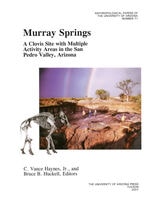
Murray Springs
A Clovis Site with Multiple Activity Areas in the San Pedro Valley, ArizonaEdited by C. Vance Haynes, Jr., and Bruce B. Huckell
University of Arizona Press, 2007
The Murray Springs Site in the upper San Pedro River Valley of southeast Arizona is one of the most significant Clovis sites ever found. It contained a multiple bison kill, a mammoth kill, and possibly a horse kill in a deeply stratified sedimentary context. Scattered across the buried occupation surface with the bones of late Pleistocene animals were several thousand stone tools and waste flakes from their manufacture and repair. Because of the unique occurrence of an algal black mat that buried the Clovis-age surface immediately after abandonment, the distributional integrity of the artifacts and debitage clusters is exceptional for Paleoindian sites. Excavation of the Clovis hunters’ camp 50 to 150 meters south of the kills revealed artifactual evidence typical of hunting camp activity, including hide working and weapons repair. Impact flakes conjoining with Clovis points clearly tied the camp to the bison kill. The unique nature of the site and this comprehensive study of the excavated material constitute one of the most important contributions to our knowledge of Paleoindian hunters in the New World.
[more]
Of Marshes and Maize
Preceramic Agricultural Settlement in the Cienega Valley, Southeastern ArizonaBruce B. Huckell
University of Arizona Press, 1995
While it was once believed that agriculture and pottery developed concurrently in prehistoric societies, modern research has concluded that agriculture preceded pottery making, since a sedentary life with greater food production led to both the need and time to create storage containers. Bruce Huckell has been at the forefront of a movement in Arizona archaeology that has greatly modified our understanding of the transition from the Archaic to the agricultural periods in the Southwest. Work done by Huckell and others at Matty Canyon has produced the most detailed account available of a Late Archaic village and has been extremely influential in suggesting that the cultivation of maize predated the appearance of pottery. Of Marshes and Maize presents archaeological information obtained from small-scale investigations at two deeply buried preceramic sites in the Cienega Creek Basin. Its report on excavations at the Donaldson Site and at Los Ojitos offers a thorough description of archaeological features and artifacts, floral and faunal remains, and their geological and chronological contexts. From this data, the author concludes that a major shift toward a sedentary lifeway dependent on maize agriculture had already occurred by Late Archaic times (c. 500 to 800 B.C.), demonstrating that previous research on late preceramic sites in this region has provided an inadequate picture of the period. This monograph represents the first full presentation in the literature of an important set of data that is well-known among researchers but has thus far not been easily accessible. It is a classic example of the use of fragmentary evidence in well-dated contexts to introduce new ideas, and will stand not only as an important record of the evidence but also as the primary reference for this significant new interpretation of the late Archaic and the introduction of agriculture into the Southwest.
[more]
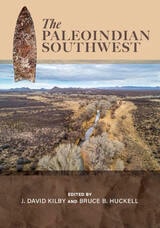
The Paleoindian Southwest
Edited by J. David Kilby and Bruce B. Huckell
University of Utah Press, 2025
A panoramic view of research on the first peoples of the Southwest
The North American Southwest looms large in American archaeology, well known for the agricultural societies that dominated its austere landscape in later times. However, the traces of its earliest occupants, Native American ancestors who shared the ancient landscape with mammoth and giant bison toward the end of the last Ice Age, remain more obscure.
The Paleoindian Southwest provides the first comprehensive overview focused on the earliest human occupants of the Southwest, exploring past investigations, the current state of research, and directions for future discovery. Experts in the field examine individual archaeological sites—some classic and some newly discovered—as well as broader patterns of human behavior across varied regions of both the United States and Mexico. Chapter authors present new and unexpected discoveries, ranging from a gomphothere kill to fossil footprints, pushing the boundaries of the Paleoindian period and investigating nontraditional archaeological data. This collection is a critical resource and landmark volume for those interested in Southwest prehistory, Paleoindian archaeology, and Ice Age human ecology.
[more]