Results by title
5 books match the query 'Human beings in art'
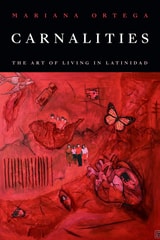
Carnalities
The Art of Living in LatinidadMariana Ortega
Duke University Press, 2025
In Carnalities, Mariana Ortega presents a phenomenological study of aesthetics grounded in the work of primarily Latinx artists. She introduces the idea of carnal aesthetics informed by carnalities, creative practices shaped by the self’s affective attunement to the material, cultural, historical, communal, and spiritual. For Ortega, carnal aesthetics offers a way to think about the affective and bodily experiences of racialized selves. Drawing on Gloria Anzaldúa, Chela Sandoval, José Esteban Muñoz, Alia Al-Saji, Helen Ngo, Maurice Merleau-Ponty, Roland Barthes, and others, Ortega examines photographic works on Latinx subjects. She analyzes the photography of Laura Aguilar, Verónica Gabriela Cárdenas, and Susan Meiselas, among others, theorizing photography as a carnal, affective medium that is crucial for processes of self-formation, resistance, and mourning in Latinx life. She ends with an intimate reading of photography through a reflection of her own crossing from Nicaragua to the United States in 1979. Motivated by her experience of loss and exile, Ortega argues for the importance of carnal aesthetics in destabilizing and transforming normative, colonial, and decolonial subjects, imaginaries, and structures.
[more]
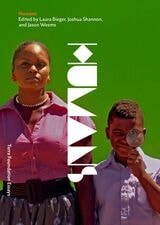
Humans
Edited by Laura Bieger, Joshua Shannon, and Jason Weems
Terra Foundation for American Art, 2021
Surveys the representations and constructions of the human being in American art.
Humans are organisms, but “the human being” is a term referring to a complicated, self-contradictory, and historically evolving set of concepts and practices. Humans explores competing versions, constructs, and ideas of the human being that have figured prominently in the arts of the United States. These essays consider a range of artworks from the colonial period to the present, examining how they have reflected, shaped, and modeled ideas of the human in American culture and politics. The book addresses to what extent artworks have conferred more humanity on some human beings than others, how art has shaped ideas about the relationships between humans and other beings and things, and in what ways different artistic constructions of the human being evolved, clashed, and intermingled over the course of American history. Humans both tells the history of a concept foundational to US civilization and proposes new means for its urgently needed rethinking.
Humans are organisms, but “the human being” is a term referring to a complicated, self-contradictory, and historically evolving set of concepts and practices. Humans explores competing versions, constructs, and ideas of the human being that have figured prominently in the arts of the United States. These essays consider a range of artworks from the colonial period to the present, examining how they have reflected, shaped, and modeled ideas of the human in American culture and politics. The book addresses to what extent artworks have conferred more humanity on some human beings than others, how art has shaped ideas about the relationships between humans and other beings and things, and in what ways different artistic constructions of the human being evolved, clashed, and intermingled over the course of American history. Humans both tells the history of a concept foundational to US civilization and proposes new means for its urgently needed rethinking.
[more]
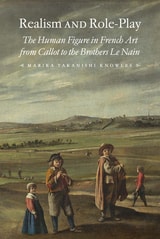
Realism and Role-Play
The Human Figure in French Art from Callot to the Brothers Le NainMarika Takanishi Knowles
University of Delaware Press, 2011
After the heroic nudes of the Renaissance and depictions of the tortured bodies of Christian saints, early seventeenth-century French artists turned their attention to their fellow humans, to nobles and beggars seen on the streets of Paris, to courtesans standing at their windows, to vendors advertising their wares, to peasants standing before their landlords. Fascinated by the intricate politics of the encounter between two human beings, artists such as Jacques Callot, Daniel Rabel, Abraham Bosse, Claude Vignon, Georges de la Tour, Jean de Saint-Igny, the Brothers Le Nain, Pierre Brébiette, Jean I Le Blond, and Charles David represented the human figure as a performer acting out a social role. The resulting figures were everyday types whose representations in series of prints, painted galleries, and illustrated books created a repertoire of such contemporary roles. Realism and Role-Play draws on literature, social history, and affect theory in order to understand the way that figuration performed social positions.
Published by University of Delaware Press. Distributed worldwide by Rutgers University Press.
Published by University of Delaware Press. Distributed worldwide by Rutgers University Press.
[more]

The Complete Writings and Selected Correspondence of John Dickinson
Volume 2Jane E. Calvert
University of Delaware Press, 2021
John Dickinson’s entry into public life in Delaware and Pennsylvania is a highlight of the ninety-eight documents written over four years printed in Volume Two of The Complete Writings and Selected Correspondence of John Dickinson. The volume opens with Dickinson’s legal notes as he established himself as one of the most prominent and learned lawyers in colonial British North America. His cases dealt with, among other issues, interpretation of wills, disputes over land, sailors suing for wages, a fine on a Quaker who refused military service, and a notorious murder in a prominent Philadelphia family. It concludes with Dickinson offering thoughtful advice to a young man who was considering the arduous work in becoming a lawyer. “I think,” he wrote, “those must be infinitely the most happy, whose fatigues are softend by a conscious Benevolence of mind wishing & endeavouring to [pro]mote the Happiness of others as well as their own.”
Dickinson’s hard work on behalf of his clients brought him success in other areas of his public life. In October 1759, he was elected to his first public position as a representative for Kent County, Del., the following year he was elevated to the position of speaker, and in 1762, he became a representative for Philadelphia County, Pa. As a legislator in two colonies, learning his craft as a global war unfolded, he contributed to bills on military and defense, Indian relations, infrastructure improvements and city management, and served on various committees. The death of George II occasioned debates over laws and judges, in which Dickinson participated. This era concludes with Dickinson playing a central role in managing the unfolding Paxton Riots, in which frontiersmen massacred peaceful Indians and threatened the Quaker leadership of Pennsylvania.
In private, Dickinson lost the two most prominent male figures in his life in 1760, his father, Samuel, and soon thereafter, his mentor, colleague, and friend, John Moland. In honor of Moland, Dickinson published a poem and became a proxy head to Moland’s large family. Though his extant correspondence during this period is small, he exchanged letters with Mary Cadwalader Dickinson, Israel Pemberton, William Allason, George Read, Thomas McKean, and others. Perhaps most significant, he wrote a lengthy, unpublished essay on the flag-of-truce trade and also maintained commonplace books as he considered his place within the British Empire, opening up the next phase in Dickinson’s life as a leader of the resistance against Britain.
Published by the University of Delaware Press. Distributed worldwide by Rutgers University Press.
[more]
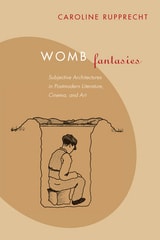
Womb Fantasies
Subjective Architectures in Postmodern Literature, Cinema, and ArtCaroline Rupprecht
Northwestern University Press, 2013
Womb Fantasies examines the womb, an invisible and mysterious space invested with allegorical significance, as a metaphorical space in postwar cinematic and literary texts grappling with the trauma of post-holocaust, postmodern existence. In addition, it examines the representation of visible spaces in the texts in terms of their attribution with womb-like qualities. The framing of the study historically within the postwar era begins with a discussion of Eero Saarinen’s Womb Chair in the context of the Cold War’s need for safety in light of the threat of nuclear destruction, and ranges over films such as Marguerite Duras’ and Alan Resnais’ film Hiroshima mon amour and Duras’ novel The Vice-Consul, exploring the ways that such cultural texts fantasize the womb as a response to trauma, defined as the compulsive need to return to the site of loss, a place envisioned as both a secure space and a prison. The womb fantasy is linked to the desire to recreate an identity that is new and original but ahistorical.
[more]