Results by title
10 books match the query 'Human sacrifice'
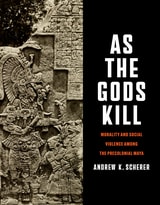
As the Gods Kill
Morality and Social Violence among the Precolonial MayaAndrew K. Scherer
University of Texas Press, 2025
An exploration of war, violence, and sacrifice in precolonial Maya culture and its importance in religious practices.
As the Gods Kill delivers new insights into warfare, weaponry, violence, and human sacrifice among the ancient Maya. While attending to the particularity of a singular historical context, anthropologist and archaeologist Andrew Scherer also suggests that Maya practices have something to tell us about human propensities toward violence more broadly.
Focusing on moral frameworks surrounding deliberate injury and killing, Scherer examines Maya justifications of violence—in particular the obligations to one another, to ancestors, and to the gods that made violence not only permissible but necessary. The analysis isolates key themes underpinning the morality of violence—including justice, vengeance, payment, and costumbre (ritual)—and explores the ethics of violent agents, including warriors, ritual specialists, and the gods. Finally, Scherer addresses motivations for warfare, including the acquisition of spoils, tribute, captives, and slaves. An interdisciplinary case study of morality in an ancient society, As the Gods Kill synthesizes scholarship on an important dimension of precolonial American culture while taking stock of its implications for the social sciences at large.
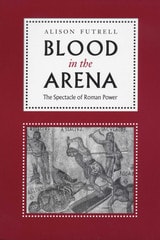
Blood in the Arena
The Spectacle of Roman PowerBy Alison Futrell
University of Texas Press, 1997
From the center of Imperial Rome to the farthest reaches of ancient Britain, Gaul, and Spain, amphitheaters marked the landscape of the Western Roman Empire. Built to bring Roman institutions and the spectacle of Roman power to conquered peoples, many still remain as witnesses to the extent and control of the empire.
In this book, Alison Futrell explores the arena as a key social and political institution for binding Rome and its provinces. She begins with the origins of the gladiatorial contest and shows how it came to play an important role in restructuring Roman authority in the later Republic. She then traces the spread of amphitheaters across the Western Empire as a means of transmitting and maintaining Roman culture and control in the provinces.
Futrell also examines the larger implications of the arena as a venue for the ritualized mass slaughter of human beings, showing how the gladiatorial contest took on both religious and political overtones. This wide-ranging study, which draws insights from archaeology and anthropology, as well as Classics, broadens our understanding of the gladiatorial contest and its place within the highly politicized cult practice of the Roman Empire.
Latin American Indigenous Warfare and Ritual Violence
Edited by Richard J. Chacon and Rubén G. Mendoza
University of Arizona Press, 2007
All of the chapters advance our knowledge of the causes, extent, and consequences of indigenous violence—including ritualized violence—in Latin America. Each major historical/cultural group in Latin America is addressed by at least one contributor. Incorporating the results of dozens of years of research, this volume documents evidence of warfare, violent conflict, and human sacrifice from the fifteenth century to the twentieth, including incidents that occurred before European contact. Together the chapters present a convincing argument that warfare and ritual violence have been woven into the fabric of life in Latin America since remote antiquity.
For the first time, expert subject-area work on indigenous violence—archaeological, osteological, ethnographic, historical, and forensic—has been assembled in one volume. Much of this work has heretofore been dispersed across various countries and languages. With its collection into one English-language volume, all future writers—regardless of their discipline or point of view—will have a source to consult for further research.
CONTENTS
Acknowledgments
Introduction
Richard J. Chacon and Rubén G. Mendoza
1. Status Rivalry and Warfare in the Development and Collapse of Classic Maya Civilization
Matt O’Mansky and Arthur A. Demarest
2. Aztec Militarism and Blood Sacrifice: The Archaeology and Ideology of Ritual Violence
Rubén G. Mendoza
3. Territorial Expansion and Primary State Formation in Oaxaca, Mexico
Charles S. Spencer
4. Images of Violence in Mesoamerican Mural Art
Donald McVicker
5. Circum-Caribbean Chiefly Warfare
Elsa M. Redmond
6. Conflict and Conquest in Pre-Hispanic Andean South America: Archaeological Evidence from Northern Coastal Peru
John W. Verano
7. The Inti Raymi Festival among the Cotacachi and Otavalo of Highland Ecuador: Blood for the Earth
Richard J. Chacon, Yamilette Chacon, and Angel Guandinango
8. Upper Amazonian Warfare
Stephen Beckerman and James Yost
9. Complexity and Causality in Tupinambá Warfare
William Balée
10. Hunter-Gatherers’ Aboriginal Warfare in Western Chaco
Marcela Mendoza
11. The Struggle for Social Life in Fuego-Patagonia
Alfredo Prieto and Rodrigo Cárdenas
12. Ethical Considerations and Conclusions Regarding Indigenous Warfare and Ritual Violence in Latin America
Richard J. Chacon and Rubén G. Mendoza
References
About the Contributors
Index
Mesoamerican Ritual Economy
Archaeological and Ethnological PerspectivesE. Christian Wells
University Press of Colorado, 2007
Exploring the intersection of spirituality and materiality, Mesoamerican Ritual Economy will be of interest to all scholars studying how worldview and belief motivate economic behavior. The authors consider a diverse set of Mesoamerican cultural patterns in order to investigate the ways in which ritual and economic practices influenced each other in the operation of communities, small-scale societies, and state-level polities. Contributors include: Sarah B. Barber, Frances F. Berdan, Karla L. Davis-Salazar, Barbara W. Fash, William L. Fash, Antonia E. Foias, Arthur A. Joyce, Brigitte Kovacevich, Ben A. Nelson, Enrique Rodríguez-Alegría, Katherine A. Spielmann, John M. Watanabe, E. Christian Wells.
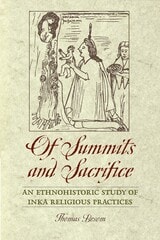
Of Summits and Sacrifice
An Ethnohistoric Study of Inka Religious PracticesBy Thomas Besom
University of Texas Press, 2009
In perhaps as few as one hundred years, the Inka Empire became the largest state ever formed by a native people anywhere in the Americas, dominating the western coast of South America by the early sixteenth century. Because the Inkas had no system of writing, it was left to Spanish and semi-indigenous authors to record the details of the religious rituals that the Inkas believed were vital for consolidating their conquests. Synthesizing these arresting accounts that span three centuries, Thomas Besom presents a wealth of descriptive data on the Inka practices of human sacrifice and mountain worship, supplemented by archaeological evidence.
Of Summits and Sacrifice offers insight into the symbolic connections between landscape and life that underlay Inka religious beliefs. In vivid prose, Besom links significant details, ranging from the reasons for cyclical sacrificial rites to the varieties of mountain deities, producing a uniquely powerful cultural history.
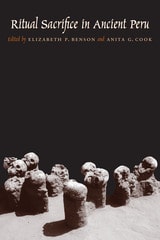
Ritual Sacrifice in Ancient Peru
Edited by Elizabeth P. Benson and Anita G. Cook
University of Texas Press, 2001
Propitiating the supernatural forces that could grant bountiful crops or wipe out whole villages through natural disasters was a sacred duty in ancient Peruvian societies, as in many premodern cultures. Ritual sacrifices were considered necessary for this propitiation and for maintaining a proper reciprocal relationship between humans and the supernatural world.
The essays in this book examine the archaeological evidence for ancient Peruvian sacrificial offerings of human beings, animals, and objects, as well as the cultural contexts in which the offerings occurred, from around 2500 B.C. until Inca times just before the Spanish Conquest. Major contributions come from the recent archaeological fieldwork of Steve Bourget, Anita Cook, and Alana Cordy-Collins, as well as from John Verano's laboratory work on skeletal material from recent excavations. Mary Frame, who is a weaver as well as a scholar, offers rich new interpretations of Paracas burial garments, and Donald Proulx presents a fresh view of the nature of Nasca warfare. Elizabeth Benson's essay provides a summary of sacrificial practices.
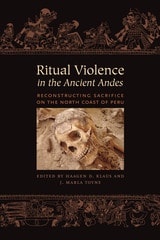
Ritual Violence in the Ancient Andes
Reconstructing Sacrifice on the North Coast of PeruEdited by Haagen D. Klaus and J. Marla Toyne
University of Texas Press, 2016
Traditions of sacrifice exist in almost every human culture and often embody a society’s most meaningful religious and symbolic acts. Ritual violence was particularly varied and enduring in the prehistoric South American Andes, where human lives, animals, and material objects were sacrificed in secular rites or as offerings to the divine. Spectacular discoveries of sacrificial sites containing the victims of violent rituals have drawn ever-increasing attention to ritual sacrifice within Andean archaeology. Responding to this interest, this volume provides the first regional overview of ritual killing on the pre-Hispanic north coast of Peru, where distinct forms and diverse trajectories of ritual violence developed during the final 1,800 years of prehistory.
Presenting original research that blends empirical approaches, iconographic interpretations, and contextual analyses, the contributors address four linked themes—the historical development and regional variation of north coast sacrifice from the early first millennium AD to the European conquest; a continuum of ritual violence that spans people, animals, and objects; the broader ritual world of sacrifice, including rites both before and after violent offering; and the use of diverse scientific tools, archaeological information, and theoretical interpretations to study sacrifice. This research proposes a wide range of new questions that will shape the research agenda in the coming decades, while fostering a nuanced, scientific, and humanized approach to the archaeology of ritual violence that is applicable to archaeological contexts around the world.
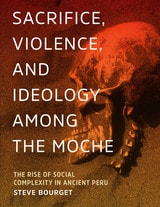
Sacrifice, Violence, and Ideology Among the Moche
The Rise of Social Complexity in Ancient PeruBy Steve Bourget
University of Texas Press, 2016
In a special precinct dedicated to ritual sacrifice at Huaca de la Luna on the north coast of Peru, about seventy-five men were killed and dismembered, their remains and body parts then carefully rearranged and left on the ground with numerous offerings. The discovery of this large sacrificial site—one of the most important sites of this type in the Americas—raises fundamental questions. Why was human sacrifice so central to Moche ideology and religion? And why is sacrifice so intimately related to the notions of warfare and capture?
In this pioneering book, Steve Bourget marshals all the currently available information from the archaeology and visual culture of Huaca de la Luna as he seeks to understand the centrality of human sacrifice in Moche ideology and, more broadly, the role(s) of violence in the development of social complexity. He begins by providing a fully documented account of the archaeological contexts, demonstrating how closely interrelated these contexts are to the rest of Moche material culture, including its iconography, the regalia of its elite, and its monumental architecture. Bourget then probes the possible meanings of ritual violence and human sacrifice and their intimate connections with concepts of divinity, ancestry, and foreignness. He builds a convincing case that the iconography of ritual violence and the practice of human sacrifice at all the principal Moche ceremonial centers were the main devices used in the establishment and development of the Moche state.
Social Violence in the Prehispanic American Southwest
Edited by Deborah L. Nichols and Patricia L. Crown
University of Arizona Press, 2008
CONTENTS
1. Introduction
Patricia Crown and Deborah Nichols
2. Dismembering the Trope: Imagining Cannibalism in the Ancient Pueblo World
Randall H. McGuire and Ruth Van Dyke
3. An Outbreak of Violence and Raiding in the Central Mesa Verde Region in the 12th Century AD
Brian R. Billman
4. Chaco Horrificus?
Wendy Bustard
5. Inscribed in the Body, Written in Bones: The Consequences of Social Violence at La Plata
Debra L. Martin, Nancy Akins, Bradley Crenshaw, and Pamela K. Stone
6. Veneration or Violence: A Study of Variations in Patterns of Human Bone Modification at La Quemada
Ventura R. Pérez, Ben A. Nelson, and Debra L. Martin
7. Witches, Practice, and the Context of Pueblo Cannibalism
William H. Walker
8. Explanation vs. Sensation: The Discourse of Cannibalism at Awat’ovi
Peter Whiteley
9. Devouring Ourselves
George J. Armelagos
References Cited
About the Contributors
Index
Sweeping the Way
Divine Transformation in the Aztec Festival of OchpaniztliCatherine DiCesare
University Press of Colorado, 2022