Results by title
2 books match the query 'Human trafficking victims'
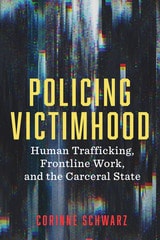
Policing Victimhood
Human Trafficking, Frontline Work, and the Carceral StateCorinne Schwarz
Rutgers University Press, 2023
Since the turn of the twentieth century, human trafficking has animated public discourses, policy debates, and moral panics in the United States. Though some nuances of these conversations have shifted, the role of the criminal legal system (police officers, investigators, lawyers, and connected service providers) in anti-trafficking interventions has remained firmly in place. Policing Victimhood explores how frontline workers in direct contact with vulnerable, exploited, and trafficked persons—however those groups are defined at personal, organizational, or legal levels—defer to the tools of the carceral state and ideologies of punishment when navigating their clients’ needs.
In Policing Victimhood, Corinne Schwarz interviewed with service providers in the Midwestern US, a region that, though colloquially understood as “flyover country,” regularly positions itself as a leader in state-level anti-trafficking policies and collaborative networks. These frontline workers’ perceptions and narratives are informed by their interpersonal, day-to-day encounters with exploited or trafficked persons. Their insights underscore how anti-trafficking policies are put into practice and influenced by specific ideologies and stereotypes. Extending the reach of street-level bureaucracy theory to anti-trafficking initiatives, Schwarz demonstrates how frontline workers are uniquely positioned to perpetuate or radically counter punitive anti-trafficking efforts.
Taking a cue from anti-carceral feminist critiques and critical trafficking studies, Schwarz argues that ongoing anti-trafficking efforts in the US expand the punitive arm of the state without addressing the role of systemic oppression in perpetuating violence. The violence inherent to the carceral state—and required for its continued expansion—is the same violence that perpetuates the exploitation of human trafficking. In order to solve the “problem” of human trafficking, advocates, activists, and scholars must divest from systems that center punishment and radically reinvest their efforts in dismantling the structural violence that perpetuates social exclusion and vulnerability, what she calls the “-isms” and “-phobias” that harm some at the expense of others’ empowerment. Policing Victimhood encourages readers to imagine a world without carceral violence in any of its forms.
[more]

The Banality of Good
The UN's Global Fight against Human TraffickingLieba Faier
Duke University Press, 2024
In The Banality of Good, Lieba Faier examines why contemporary efforts to curb human trafficking have fallen so spectacularly short of their stated goals despite well-funded campaigns by the United Nations and its member-state governments. Focusing on Japan’s efforts to enact the UN’s counter-trafficking protocol and assist Filipina migrants working in Japan’s sex industry, Faier draws from interviews with NGO caseworkers and government officials to demonstrate how these efforts disregard the needs and perspectives of those they are designed to help. She finds that these campaigns tend to privilege bureaucracies and institutional compliance, resulting in the compromised quality of life, repatriation, and even criminalization of human trafficking survivors. Faier expands on Hannah Arendt’s idea of the “banality of evil” by coining the titular “banality of good” to describe the reality of the UN’s fight against human trafficking. Detailing the protocols that have been put in place and evaluating their enactment, Faier reveals how the continued failure of humanitarian institutions to address structural inequities and colonial history ultimately reinforces the violent status quo they claim to be working to change.
[more]