Results by title
13 books match the query 'Human-animal relationships in literature'
Animal Rites
American Culture, the Discourse of Species, and Posthumanist TheoryCary Wolfe
University of Chicago Press, 2002
Animal Stories
Narrating across Species LinesSusan McHugh
University of Minnesota Press, 2010
McHugh’s investigations into fictions of people relying on animals in civic and professional life—most obviously those of service animal users and female professional horse riders—showcase distinctly modern and human–animal forms of intersubjectivity. But increasingly graphic violence directed at these figures indicates their ambivalent significance to changing configurations of species.
Reading these developments with narrative adaptations of traditional companion species relations during this period— queer pet memoirs and farm animal fictions—McHugh clarifies the intercorporeal intimacies—the perforations of species boundaries now proliferating in genetic and genomic science—and embeds the representation of animals within biopolitical frameworks.
How Not to Make a Human
Pets, Feral Children, Worms, Sky Burial, OystersKarl Steel
University of Minnesota Press, 2019
From pet keeping to sky burials, a posthuman and ecocritical interrogation of and challenge to human particularity in medieval texts
Mainstream medieval thought, like much of mainstream modern thought, habitually argued that because humans alone had language, reason, and immortal souls, all other life was simply theirs for the taking. But outside this scholarly consensus teemed a host of other ways to imagine the shared worlds of humans and nonhumans. How Not to Make a Human engages with these nonsystematic practices and thought to challenge both human particularity and the notion that agency, free will, and rationality are the defining characteristics of being human.
Recuperating the Middle Ages as a lost opportunity for decentering humanity, Karl Steel provides a posthuman and ecocritical interrogation of a wide range of medieval texts. Exploring such diverse topics as medieval pet keeping, stories of feral and isolated children, the ecological implications of funeral practices, and the “bare life” of oysters from a variety of disanthropic perspectives, Steel furnishes contemporary posthumanists with overlooked cultural models to challenge human and other supremacies at their roots.
By collecting beliefs and practices outside the mainstream of medieval thought, How Not to Make a Human connects contemporary concerns with ecology, animal life, and rethinkings of what it means to be human to uncanny materials that emphasize matters of death, violence, edibility, and vulnerability.
Imperfect Creatures
Vermin, Literature, and the Sciences of Life, 1600-1740Lucinda Cole
University of Michigan Press, 2016
As Cole illustrates, human health and demographic problems—notably those of feeding populations periodically stricken by hunger, disease, and famine—were tied to larger questions about food supplies, property laws, national identity, and the theological imperatives that underwrote humankind’s claim to dominion over the animal kingdom. In this context, Cole’s study indicates, so-called “vermin” occupied liminal spaces between subject and object, nature and animal, animal and the devil, the devil and disease—even reason and madness. This verminous discourse formed a foundational category used to carve out humankind’s relationship to an unpredictable, irrational natural world, but it evolved into a form for thinking about not merely animals but anything that threatened the health of the body politic—humans, animals, and even thoughts.
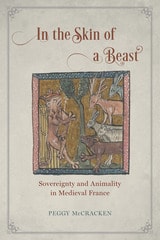
In the Skin of a Beast
Sovereignty and Animality in Medieval FrancePeggy McCracken
University of Chicago Press, 2017
Peggy McCracken discusses a range of literary texts and images from medieval France, including romances in which animal skins appear in symbolic displays of power, fictional explorations of the wolf’s desire for human domestication, and tales of women and snakes converging in a representation of territorial claims and noble status. These works reveal that the qualities traditionally used to define sovereignty—lineage and gender among them—are in fact mobile and contingent. In medieval literary texts, as McCracken demonstrates, human dominion over animals is a disputed model for sovereign relations among people: it justifies exploitation even as it mandates protection and care, and it depends on reiterations of human-animal difference that paradoxically expose the tenuous nature of human exceptionalism.
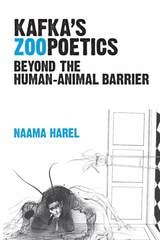
Kafka's Zoopoetics
Beyond the Human-Animal BarrierNaama Harel
University of Michigan Press, 2020
Nonhuman figures are ubiquitous in the work of Franz Kafka, from his early stories down to his very last one. Despite their prominence throughout his oeuvre, Kafka’s animal representations have been considered first and foremost as mere allegories of intrahuman matters. In recent years, the allegorization of Kafka’s animals has been poetically dismissed by Kafka’s commentators and politically rejected by posthumanist scholars. Such critique, however, has yet to inspire either an overarching or an interdiscursive account. This book aims to fill this lacuna. Positing animal stories as a distinct and significant corpus within Kafka’s entire poetics, and closely examining them in dialogue with both literary and posthumanist analysis, Kafka’s Zoopoetics critically revisits animality, interspecies relations, and the very human-animal contradistinction in the writings of Franz Kafka.
Kafka’s animals typically stand at the threshold between humanity and animality, fusing together human and nonhuman features. Among his liminal creatures we find a human transformed into vermin (in “The Metamorphosis”), an ape turned into a human being (in “A Report to an Academy”), talking jackals (in “Jackals and Arabs”), a philosophical dog (in “Researches of a Dog”), a contemplative mole-like creature (in “The Burrow”), and indiscernible beings (in “Josefine, the Singer or the Mouse People”). Depicting species boundaries as mutable and obscure, Kafka creates a fluid human-animal space, which can be described as “humanimal.” The constitution of a humanimal space radically undermines the stark barrier between human and other animals, dictated by the anthropocentric paradigm. Through denying animalistic elements in humans, and disavowing the agency of nonhuman animals, excluding them from social life, and neutralizing compassion for them, this barrier has been designed to regularize both humanity and animality. The contextualization of Kafka's animals within posthumanist theory engenders a post-anthropocentric arena, which is simultaneously both imagined and very real.
Minor Creatures
Persons, Animals, and the Victorian NovelIvan Kreilkamp
University of Chicago Press, 2018
Romantic Beasts
Pervasion, Eccentricity, ExhibitionMichael Demson
Bucknell University Press, 2025
Published by Bucknell University Press. Distributed worldwide by Rutgers University Press.
The Accommodated Animal
Cosmopolity in Shakespearean LocalesLaurie Shannon
University of Chicago Press, 2013
The Animal Claim
Sensibility and the Creaturely VoiceTobias Menely
University of Chicago Press, 2015
In the Restoration and eighteenth century, philosophers emphasized the role of sympathy in collective life and began regarding the passionate expression humans share with animals, rather than the spoken or written word, as the elemental medium of community. Menely shows how poetry came to represent this creaturely voice and, by virtue of this advocacy, facilitated the development of a viable discourse of animal rights in the emerging public sphere. Placing sensibility in dialogue with classical and early-modern antecedents as well as contemporary animal studies, The Animal Claim uncovers crucial connections between eighteenth-century poetry; theories of communication; and post-absolutist, rights-based politics.
The Secret Life of Things
Animals, Objects, and It-Narratives in Eighteenth-Century EnglandMark Blackwell
Bucknell University Press, 2023
Published by Bucknell University Press.
Distributed worldwide by Rutgers University Press.
Victorian Dogs, Victorian Men
Affect and Animals in Nineteenth-Century Literature and CultureKeridiana W. Chez
The Ohio State University Press, 2017
Chez traces the evolution of the human-dog relationship as it developed parallel to an increasingly imperialist national discourse. The dog began as the affective mediator of the family, then addressed the emotional needs of its individual members, and finally evolved into both “man’s best friend” and worst enemy. By the last decades of the nineteenth century, the porous human-animal boundary served to produce the “humane” man: a liberal subject enabled to engage in aggressive imperial projects. Reading the work of Charles Dickens, George Eliot, Margaret Marshall Saunders, Bram Stoker, and Jack London, Victorian Dogs, Victorian Men charts the mobilization of affect through transatlantic narratives, demonstrating the deep interconnections between animals, affect, and gender.
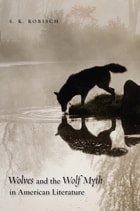
Wolves and the Wolf Myth in American Literature
S.K. Robisch
University of Nevada Press, 2009
The wolf is one of the most widely distributed canid species, historically ranging throughout most of the Northern Hemisphere. For millennia, it has also been one of the most pervasive images in human mythology, art, and psychology. Wolves and the Wolf Myth in American Literature examines the wolf’s importance as a figure in literature from the perspectives of both the animal’s physical reality and the ways in which writers imagine and portray it. Author S. K. Robisch examines more than two hundred texts written in North America about wolves or including them as central figures. From this foundation, he demonstrates the wolf’s role as an archetype in the collective unconscious, its importance in our national culture, and its ecological value. Robisch takes a multidisciplinary approach to his study, employing a broad range of sources: myths and legends from around the world; symbology; classic and popular literature; films; the work of scientists in a number of disciplines; human psychology; and field work conducted by himself and others. By combining the fundamentals of scientific study with close readings of wide-ranging literary texts, Robisch astutely analyzes the correlation between actual, living wolves and their representation on the page and in the human mind. He also considers the relationship between literary art and the natural world, and argues for a new approach to literary study, an ecocriticism that moves beyond anthropocentrism to examine the complicated relationship between humans and nature.