Results by title
17 books match the query 'Human-plant relationships'
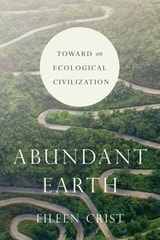
Abundant Earth
Toward an Ecological CivilizationEileen Crist
University of Chicago Press, 2019
Crist argues that to do so would require a two-pronged approach. Scaling down calls upon us to lower the global human population while working within a human-rights framework, to deindustrialize food production, and to localize economies and contract global trade. Pulling back calls upon us to free, restore, reconnect, and rewild vast terrestrial and marine ecosystems. However, the pervasive worldview of human supremacy—the conviction that humans are superior to all other life-forms and entitled to use these life-forms and their habitats—normalizes and promotes humanity’s ongoing expansion, undermining our ability to enact these linked strategies and preempt the mounting suffering and dislocation of both humans and nonhumans.
Abundant Earth urges us to confront the reality that humanity will not advance by entrenching its domination over the biosphere. On the contrary, we will stagnate in the identity of nature-colonizer and decline into conflict as we vie for natural resources. Instead, we must chart another course, choosing to live in fellowship within the vibrant ecologies of our wild and domestic cohorts, and enfolding human inhabitation within the rich expanse of a biodiverse, living planet.
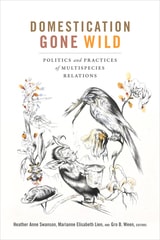
Domestication Gone Wild
Politics and Practices of Multispecies RelationsHeather Anne Swanson, Gro B. Ween, and Marianne E. Lien, editors
Duke University Press, 2018
Contributors. Inger Anneberg, Natasha Fijn, Rune Flikke, Frida Hastrup, Marianne Elisabeth Lien, Knut G. Nustad, Sara Asu Schroer, Heather Anne Swanson, Anna Lowenhaupt Tsing, Mette Vaarst, Gro B. Ween, Jon Henrik Ziegler Remme
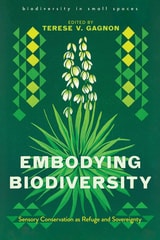
Embodying Biodiversity
Sensory Conservation as Refuge and SovereigntyTerese V. Gagnon
University of Arizona Press, 2024
Harnessing a myriad of methodologies and research spanning multiple continents, this volume delves into the power of everyday forms of biodiversity conservation, motivated by sensory and embodied engagement with plants. Through an array of interdisciplinary contributions, the authors argue that the vast majority of biodiversity conservation worldwide is carried out not by large-scale, hierarchical initiatives but by ordinary people who cultivate sensory-motivated, place-based bonds with plants.
Acknowledging the monumental role of everyday champions in tending biodiversity, the contributors write that this caretaking is crucial to countering ecological harm and global injustice stemming from colonial violence and racial capitalism.
Contributors
Mike Anastario
Ally Ang
Antonia Barreau
Julián Caviedes
Chen Chen
Evelyn Flores
Terese V. Gagnon
José Tomás Ibarra
Fred L. Joiner
Gary Nabhan
Virginia D. Nazarea
Shannon A. Novak
Valentina Peveri
Emily Ramsey
Yasuaki Sato
Justin Simpson
David E. Sutton

Estado Vegetal
Performance and Plant-ThinkingGiovanni Aloi
University of Minnesota Press, 2023
Interdisciplinary essays on Manuela Infante’s award-winning play explore the relationship between critical plant studies and performance art in the Anthropocene
Since its first staging in 2016, Estado Vegetal, Manuela Infante’s riveting piece of experimental performance art, has expanded philosophical thinking into a fully-fledged artistic inquiry of nonanthropocentric being. Through Infante’s polyvocal monologue, acted with impetus by Marcela Salinas, plants are charged with an agency capable of uprooting culturally grounded conceptions of the world in the face of incommensurable trauma and loss.
This first book dedicated to Infante’s plant-focused performance features eight essays by scholars, poets, and artists whose practices draw from research fields as disparate as new materialism, anthropogenic feminism, queer studies, and speculative realism. Including an interview with Infante, the full playscript, and stills from the performance, Estado Vegetal: Performance and Plant-Thinking reveals the roles that plants in art can play in productively reconfiguring human–nonhuman relations within current anthropogenic perspectives.
Infante’s performance is a perfect case study and reference point for anyone interested in exploring the complexities of plant-thinking through alternative and experimental avenues. Furthermore, this book is at once a critical plant studies primer and an artistic problematization of the philosophical questions that have been central to the latest multidisciplinary discussions on plant-being.
Contributors: Maaike Bleeker, Utrecht U; Lucy Cotter, Portland State U; Prudence Gibson, UNSW Sydney; Michael Marder, U of the Basque Country; Dawn Sanders, U of Gothenburg; Catriona Sandilands, York U; Sibila Sotomayor Van Rysseghem, colectivo LASTESIS; Mandy-Suzanne Wong.

Green Nature/Human Nature
THE MEANING OF PLANTS IN OUR LIVESCharles A. Lewis
University of Illinois Press, 1996
Why do gardeners delight in the germination and growth of a seed? Why are our spirits lifted by flowers, our feelings of tension allayed by a walk in a forest or park? What other positive influences can green nature
bring to humanity?
In Green Nature/Human Nature Charles A. Lewis describes the psychological, sociological, and physiological responses of people to vegetation in cities and forests, as well as in horticultural therapy programs in hospitals, geriatric institutions, physical rehabilitation centers, drug rehabilitation programs, and correctional institutions. He presents an evolutionary basis for the human attraction to plants. People-plant interactions are presented from two perspectives: participatory, in which the individual is involved in planting and maintaining the vegetation, and observational, in which the individual bears no responsibility for establishing or maintaining the vegetation.
In what amounts to a straightforward catalog of well-documented and tangible benefits, Lewis brings the latest and best research into plant/human interaction to bear on questions of how green nature is intertwined with the human psyche and how that interaction can lead to enhanced well-being and an appreciation of the human dimension in environmental concerns.
Lewis's work will be essential reading for anyone interested in plants
and how they affect people.
A volume in the series The Environment and the Human Condition
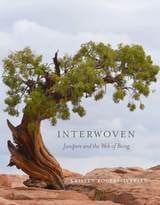
Interwoven
Junipers and the Web of BeingKristen Rogers-Iversen
University of Utah Press, 2017
Throughout prehistory and history, junipers have influenced ecosystems, cultures, mythologies, economics, politics, and environmental controversies. In terms of their effects on human lives the juniper may be the most significant tree in the interior West. Interwoven explores these interconnecting aspects of junipers. Ghost beads, biotic communities, gin, tree masticators, Puebloan diapers, charcoal, folklore, historic explorers, spiral grain, tree life cycles, spirituality, packrat middens, climate changes, wildfire, ranching, wilderness, and land management policies are among the many different threads the book follows. These and other topics shed light on a fascinating organism, but the book is more than a compilation of facts. At once a scientific, experiential, historical, and metaphorical walk among junipers and their interrelationships, Interwoven may change readers’ experiences with these trees and the natural world.
Finalist for the Utah State Historical Society Best Book Award.
Finalist for the 2019 ASLE Book Award for excellence in ecocriticism and environmental creative writing.
Named a “notable book” by the prize committee of the 2018 Sigurd F. Olson Nature Writing Award.
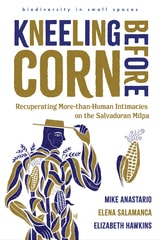
Kneeling Before Corn
Recuperating More-than-Human Intimacies on the Salvadoran MilpaMike Anastario, Elena Salamanca, and Elizabeth Hawkins
University of Arizona Press, 2024
Kneeling Before Corn focuses on the intimate relations that develop between plants and humans in the milpas of the northern rural region of El Salvador. It explores the ways in which more-than-human intimacies travel away from and return to the milpa through human networks.
Collective and multivocal, this work reflects independent lines of investigation and multiple conversations between co-authors—all of whom have lived in El Salvador for extended periods of time. Throughout the six chapters, the co-authors invite readers to consider more-than-human intimacies by rethinking, experimenting with, and developing new ways of documenting, analyzing, and knowing the intimacies that form between humans and the plants that they cultivate, conserve, long for, and eat. This book offers an innovative account of rural El Salvador in the twenty-first century.
Making Kin not Population
Reconceiving GenerationsEdited by Adele Clarke and Donna Haraway
Prickly Paradigm Press, 2018
Making Kin Not Population ends the silence on these issues with essays from leading anti-racist, ecologically-concerned, feminist scholars. Though not always in accord, these contributors provide bold analyses of complex issues of intimacy and kinship, from reproductive justice to environmental justice, and from human and nonhuman genocides to new practices for making families and kin. This timely work offers vital proposals for forging innovative personal and public connections in the contemporary world.
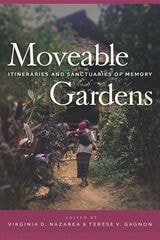
Moveable Gardens
Itineraries and Sanctuaries of MemoryEdited by Virginia D. Nazarea and Terese V. Gagnon
University of Arizona Press, 2021
Moveable Gardens highlights itineraries and sanctuaries in an era of massive dislocation, addressing concerns about finding comforting and familiar refuges in the Anthropocene. The worlds of marginalized individuals who live in impoverished rural communities, many Indigenous peoples, and refugees are constantly under threat of fracturing. Yet, in every case, there is resilience and regeneration as these individuals re-create their worlds through the foods, traditions, and plants they carry with them into their new realities.
This volume offers a new understanding of the performances and routines of sociality in the face of daunting market forces and perilous climate transformations. These traditions sustained our ancestors, and they may suffice to secure a more meaningful, diverse future. By delving into the nature of nostalgia, burrowing into memory and knowledge, and embracing the specific wonders of each deeply rooted or newly displaced community, endlessly valuable ways of being and understanding can be preserved.
Contributors: Guntra A. Aistara, Aida Curtis, Terese V. Gagnon, John Hartigan Jr., Tracey Heatherington, Taylor Hosmer, Hayden S. Kantor, Melanie Narciso, Virginia D. Nazarea, Emily F. Ramsey, Krishnendu Ray, David Sutton, James R. Veteto, Marc N. Williams
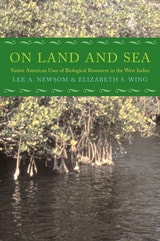
On Land and Sea
Native American Uses of Biological Resources in the West IndiesLee A. Newsom and Elizabeth S. Wing
University of Alabama Press, 2003
During the vast stretches of early geologic time, the islands of the Caribbean archipelago separated from continental land masses, rose and sank many times, merged with and broke from other land masses, and then by the mid-Cenozoic period settled into the current pattern known today. By the time Native Americans arrived, the islands had developed complex, stable ecosystems. The actions these first colonists took on the landscape—timber clearing, cultivation, animal hunting and domestication, fishing and exploitation of reef species—affected fragile land and sea biotic communities in both beneficial and harmful ways.
On Land and Sea examines the condition of biosystems on Caribbean islands at the time of colonization, human interactions with those systems through time, and the current state of biological resources in the West Indies. Drawing on a massive data set collected from long-term archaeological research, the study reconstructs past lifeways on these small tropical islands. The work presents a wide range of information, including types of fuel and construction timber used by inhabitants, cooking techniques for various shellfish, availability and use of medicinal and ritual plants, the effects on native plants and animals of cultivation and domestication, and diet and nutrition of native populations.
The islands of the Caribbean basin continue to be actively excavated and studied in the quest to understand the earliest human inhabitants of the New World. This comprehensive work will ground current and future studies and will be valuable to archaeologists, anthropologists, botanists, ecologists, Caribbeanists, Latin American historians, and anyone studying similar island environments.
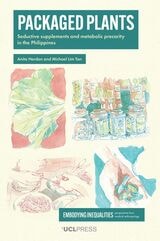
Packaged Plants
Seductive Supplements and Metabolic Precarity in the PhilippinesAnita Hardon and Michael Lim Tan
University College London, 2024
Through meticulous research and insightful analysis, Packaged Plants explores the intersectionality between health, economics, and environment in the Philippines, offering an absorbing ethnography and cultural history of how the production and consumption of plants for food and medicine have changed as well as how ultra-processed foods have become linked to health concerns, including cardiovascular disease, diabetes, and obesity.
Part one of the book presents a comprehensive analysis scrutinizing the colonial influences, urbanization, nutritional policies, research programs, and neoliberal marketing strategies in the Philippines that have proliferated packaged plant-based products as food and medicines. Part two interweaves contemporary urban political ecology frameworks with medical anthropological perspectives within Puerto Princesa and elucidates the precarious circumstances compelling individuals to invest in supplements.
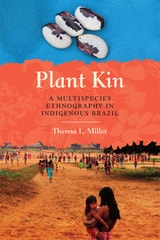
Plant Kin
A Multispecies Ethnography in Indigenous BrazilBy Theresa L. Miller
University of Texas Press, 2019
The Indigenous Canela inhabit a vibrant multispecies community of nearly 3,000 people and over 300 types of cultivated and wild plants living together in Maranhão State in the Brazilian Cerrado (savannah), a biome threatened with deforestation and climate change. In the face of these environmental threats, Canela women and men work to maintain riverbank and forest gardens and care for their growing crops, whom they consider to be, literally, children. This nurturing, loving relationship between people and plants—which offers a thought-provoking model for supporting multispecies survival and well-being throughout the world—is the focus of Plant Kin.
Theresa L. Miller shows how kinship develops between Canela people and plants through intimate, multi-sensory, and embodied relationships. Using an approach she calls “sensory ethnobotany,” Miller explores the Canela bio-sociocultural life-world, including Canela landscape aesthetics, ethnobotanical classification, mythical storytelling, historical and modern-day gardening practices, transmission of ecological knowledge through an education of affection for plant kin, shamanic engagements with plant friends and lovers, and myriad other human-nonhuman experiences. This multispecies ethnography reveals the transformations of Canela human-environment and human-plant engagements over the past two centuries and envisions possible futures for this Indigenous multispecies community as it reckons with the rapid environmental and climatic changes facing the Brazilian Cerrado as the Anthropocene epoch unfolds.
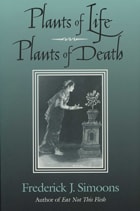
Plants of Life, Plants of Death
Frederick J. Simoons
University of Wisconsin Press, 1998
Pythagoras, the ancient Greek mathematician, did not himself eat fava beans in any form; in fact, he banned his followers from eating them. Cultural geographer Frederick Simoons disputes the contention that Pythagoras established that ban because he recognized the danger of favism, a disease that afflicts genetically-predisposed individuals who consume fava beans. Contradicting more deterministic explanations of history, Simoons argues that ritual considerations led to the Pythagorean ban.
In his fascinating and thorough new study, Simoons examines plants associated with ritual purity, fertility, prosperity, and life, on the one hand, or with ritual impurity, sickness, ill fate, and death, on the other. Plants of Life, Plants of Death offers a wealth of detail from not only history, ethnography, religious studies, classics, and folklore, but also from ethnobotany and medicine. Simoons surveys a vast geographical region extending from Europe through the Near East to India and China. He tells the story of India's giant sacred fig trees, the pipal and the banyan, and their changing role in ritual, religion, and as objects of pilgrimage from antiquity to the present day; the history of mandrake and ginseng, “man roots” whose uses from Europe to China have been shaped by the perception that they are human in form; and the story of garlic and onions as impure foods of bad odor in that same broad region.
Simoons also identifies and discusses physical characteristics of plants that have contributed to their contrasting ritual roles, and he emphasizes the point that the ritual roles of plants are also shaped by basic human concerns—desire for good health and prosperity, hopes for fertility and offspring, fear of violence, evil and death—that were as important in antiquity as they are today.
“It dazzles as a piece of scholarship.”—Daniel W. Gade, University of Vermont
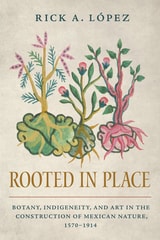
Rooted in Place
Botany, Indigeneity, and Art in the Construction of Mexican Nature, 1570–1914Rick A. López
University of Arizona Press, 2025
Prize for Best Book in Environmental Studies, Latin American Studies Association
Honorable mention for Best Book Prize in Visual Culture, Latin American Studies Association
Honorable mention for Best Book on Mexico, Latin American Studies Association
Since the first moment of conquest, colonizers and the colonized alike in Mexico confronted questions about what it meant to be from this place, what natural resources it offered, and who had the right to control those resources and on what basis.
Focusing on the ways people, environment, and policies have been affected by political boundaries, historian Rick A. López explores the historical connections between political identities and the natural world. López analyzes how scientific intellectuals laid claim to nature within Mexico, first on behalf of the Spanish Empire and then in the name of the republic, during three transformative moments: the Hernández expedition of the late sixteenth century; the Royal Botanical Expedition of the late eighteenth century; and the heyday of scientific societies such as the Sociedad Mexicana de Historia Natural of the late nineteenth century.
This work traces how scientific intellectuals studied and debated what it meant to know and claim the flora that sprang from Mexican soil—ranging from individual plants to forests and vegetated landscapes—and the importance they placed on indigeneity. It also points to the short- and long-term consequences of these efforts. López draws on archival and published sources produced from the sixteenth century through the start of the twentieth century and gives special attention to the use of visual images such as scientific illustrations and landscape art. López employs the term “visualization” in recognition of the degree to which officials, botanists, and draftsmen produced imagery and also how they and others viewed nature.
Rooted in Place reveals how scientific endeavors were not just about cataloging flora but were deeply intertwined with the construction of identity and the political landscape at three pivotal moments in Mexican history.
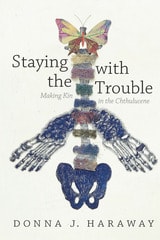
Staying with the Trouble
Making Kin in the ChthuluceneDonna J. Haraway
Duke University Press, 2016
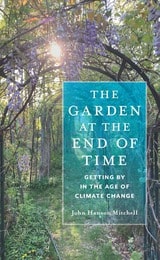
The Garden at the End of Time
Getting By in the Age of Climate ChangeJohn Hanson Mitchell
University of Massachusetts Press, 2025
John Hanson Mitchell has long written about his garden outside of Boston, and about the plants and animals with whom he shares this land. In 2022, the United Nations and others started reporting the true severity of the climate crisis as the Earth passed a point of no return. All across the globe it was the worst year on record for climate-related disasters, including extinctions, deadly floods, massive fires, and dramatic droughts, all of which have worsened since that year. Mitchell, like so many, felt overwhelmed. He looked to the story of Voltaire’s Candide, and settled on the famous aphorism from that book: “We must cultivate our garden.”
The Garden at the End of Time features Mitchell’s trademark blend of science, literature, and anecdote as he processes both the information he is reading from various sources and what it prompts him to do in his own small corner of the world. The story that unfolds is one of Mitchell diversifying his plantings; fighting what he sees as unnecessary local development; walking through and observing changes in the wild lands nearby; continuing to read the news from around the world; and meditating on other moments, real and imagined, when people sought refuge even as they did their part to improve a personally and collectively stressful situation.
Readers discover the impossibility of separating gardening from global warming, while also seeing the solace that exposure to plants can offer, in addition to their contribution to carbon consumption. With gravitas, kindness, and wit, Mitchell offers a model for maintaining a connection to nature even as it reels from manmade threats.
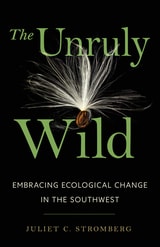
The Unruly Wild
Embracing Ecological Change in the SouthwestJuliet C. Stromberg
University of Arizona Press, 2026
Challenging the traditional invasion biology paradigm, Juliet C. Stromberg invites readers to reconsider the “alien invader” narrative and explore the beneficial roles that newly arrived plants can play in our ecosystems. Drawing from her extensive experience as a plant and restoration ecologist, Stromberg introduces a cast of plant characters that includes longtimers as well as newcomers.
Through compelling stories and scientific insights, Stromberg explains why some plants are thriving while others are in decline. Stromberg’s engaging narrative, enriched with personal anecdotes and detailed vignettes, encourages readers to pause, reflect, and deepen their relationship with the plant world. By promoting a more nuanced and respectful dialogue about our natural surroundings, this book offers valuable insights into biodiversity, climate resilience, and ecosystem restoration. This book is a call to embrace a more inclusive and adaptive approach to wild plants.