Results by title
3 books match the query 'Hung, Wu'
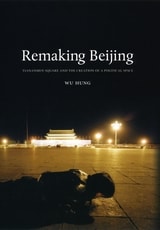
Remaking Beijing
Tiananmen Square and the Creation of a Political SpaceWu Hung
University of Chicago Press, 2005
In 1949, Beijing still retained nearly all of its time-honored character and magnificence. But when Chairman Mao rejected the proposal to build a new capital for the People's Republic of China and decided to stay in the ancient city, he initiated a long struggle to transform Beijing into a shining beacon of socialism. So began the remaking of the city into a modern metropolis rife with monuments, public squares, exhibition halls, and government offices.
Wu Hung grew up in Beijing and experienced much of the city's makeover firsthand. In this lavishly illustrated work, he offers a vivid, often personal account of the struggle over Beijing's reinvention, drawing particular attention to Tiananmen Square—the most sacred space in the People's Republic of China. Remaking Beijing considers the square's transformation from a restricted imperial domain into a public arena for political expression, from an epic symbol of socialism into a holy relic of the Maoist regime, and from an official and monumental complex into a site for unofficial and antigovernment demonstrations.
Wu Hung also explores how Tiananmen Square has become a touchstone for official art in modern China—as the site for Mao's monumental portrait, as the location of museums narrating revolutionary history, and as the grounds for extravagant National Day parades celebrating the revolutionary masses. He then shows how in recent years the square has inspired artists working without state sponsorship to create paintings, photographs, and even performances that reflect the spirit of the 1989 uprisings and pose a forceful challenge to official artworks and the sociopolitical system that supports them.
Remaking Beijing will reward anyone interested in modern Chinese history, society, and art, or, more generally, in how urban renewal becomes intertwined with cultural and national politics.
[more]

The Double Screen
Medium and Representation in Chinese PaintingWu Hung
University of Chicago Press, 1997
In the first exploration of Chinese paintings as both material products
and pictorial representations, The Double Screen shows how the
collaboration and tension between material form and image gives life to
a painting. A Chinese painting is often reduced to the image it bears;
its material form is dismissed; its intimate connection with social
activities and cultural conventions neglected.
A screen occupies a space and divides it, supplies an ideal surface for
painting, and has been a favorite pictorial image in Chinese art since
antiquity. Wu Hung undertakes a comprehensive analysis of the screen,
which can be an object, an art medium, a pictorial motif, or all three
at once. With its diverse roles, the screen has provided Chinese
painters with endless opportunities to reinvent their art.
The Double Screen provides a powerful non-Western perspective on
issues from portraiture and pictorial narrative to voyeurism,
masquerade, and political rhetoric. It will be invaluable to anyone
interested in the history of art and Asian studies.
[more]
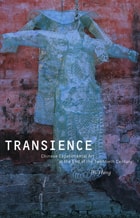
Transience
Chinese Experimental Art at the End of the Twentieth CenturyWu Hung
University of Chicago Press, 2006
In a groundbreaking approach to avant-garde Chinese art, the 1999 exhibition "Transience: Chinese Experimental Art at the End of the Twentieth Century" established a historical framework for current artistic production in China. Organized by the David and Alfred Smart Museum of Art at the University of Chicago, the show and its catalog highlighted the diverse responses of twenty-two artists to Chinas recent history and current social transformation.
These detailed essays on the artists and their works are now available in a revised edition of the exhibition catalog. Written by Wu Hung, a leading authority and the curator of the exhibit, Transience explores contemporary Chinese art through the themes of demystification, ruins, and transience, and represents an original perspective in the continuing discussion on Chinese experimental art.
These detailed essays on the artists and their works are now available in a revised edition of the exhibition catalog. Written by Wu Hung, a leading authority and the curator of the exhibit, Transience explores contemporary Chinese art through the themes of demystification, ruins, and transience, and represents an original perspective in the continuing discussion on Chinese experimental art.
[more]