Results by title
16 books match the query 'Hurston, Zora Neale'
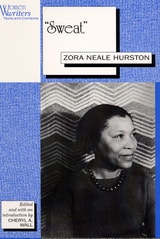
"Sweat"
Written by Zora Neale HurstonWall, Cheryl A
Rutgers University Press, 1997
Now frequently anthologized, Zora Neale Hurston's short story "Sweat" was first published in Firell, a legendary literary magazine of the Harlem Renaissance, whose sole issue appeared in November 1926. Among contributions by Gwendolyn Bennett, Countee Cullen, Langston Hughes, and Wallace Thurman, "Sweat" stood out both for its artistic accomplishment and its exploration of rural Southern black life. In "Sweat" Hurston claimed the voice that animates her mature fiction, notably the 1937 novel Their Eyes Were Watching God; the themes of marital conflict and the development of spiritual consciousness were introduced as well. "Sweat" exemplifies Hurston's lifelong concern with women's relation to language and the literary possibilities of black vernacular.
This casebook for the story includes an introduction by the editor, a chronology of the author's life, the authoritative text of "Sweat," and a second story, "The Gilded Six-Bits." Published in 1932, this second story was written after Hurston had spent years conducting fieldwork in the Southern United States. The volume also includes Hurston's groundbreaking 1934 essay, "Characteristics of Negro Expression," and excerpts from her autobiography, Dust Tracks on a Road. An article by folklorist Roger Abrahams provides additional cultural contexts for the story, as do selected blues and spirituals. Critical commentary comes from Alice Walker, who led the recovery of Hurston's work in the 1970s, Robert Hemenway, Henry Louis Gates, Gayl Jones, John Lowe, Kathryn Seidel, and Mary Helen Washington.
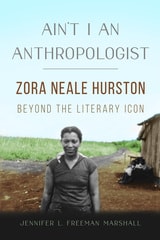
Ain't I an Anthropologist
Zora Neale Hurston Beyond the Literary IconJennifer L. Freeman Marshall
University of Illinois Press, 2023
Perceptive and original, Ain’t I an Anthropologist is an overdue reassessment of Zora Neale Hurston’s place in American cultural and intellectual life.
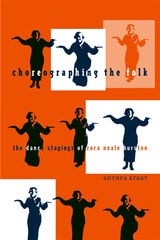
Choreographing the Folk
The Dance Stagings of Zora Neale HurstonAnthea Kraut
University of Minnesota Press, 2008
Recovers an important dimension of the work of the renowned African American artist
While Zora Neale Hurston and her 1937 novel Their Eyes Were Watching God have become widely celebrated, she was also a prolific stage director and choreographer. In the 1930s Hurston produced theatrical concerts that depicted a day in the life of a railroad work camp in Florida and featured a rousing Bahamian Fire Dance as the dramatic finale. In Choreographing the Folk, Anthea Kraut traces the significance and influence of Hurston’s little-known choreographic work.
Hurston’s concerts were concrete illustrations of the “real Negro art theatre” she was eager to establish, and they compellingly demonstrate how she used the arena of performance to advance a nuanced understanding of the black diaspora. Her version of the Fire Dance was staged in a variety of venues during the 1930s. In its multiple representations, Kraut asserts, the dance raised critical issues about ownership, artistry, and authenticity. Choreographing the Folk argues for the significance of Hurston’s choreography, and with perceptiveness, sensitivity, and originality, Kraut illuminates the important and often-contested place of black folk dance in American culture.
Clear-Cutting Eden
Ecology and the Pastoral in Southern LiteratureChristopher Rieger
University of Alabama Press, 2009
Examines how Southern literary depictions of the natural world were influenced by the historical, social, and ecological changes of the 1930s and 1940s
Rieger studies the ways that nature is conceived of and portrayed by four prominent Southern writers of the era: Erskine Caldwell, Marjorie Kinnan Rawlings, Zora Neale Hurston, and William Faulkner. Specifically, he argues that these writers created new versions of an old literary mode—the pastoral—in response to the destabilizing effects of the Great Depression, the rise of Southern modernism, and the mechanization of agricultural jobs.
Mass deforestation, soil erosion, urban development, and depleted soil fertility are issues that come to the fore in the works of these writers. In response, each author depicts a network model of nature, where humans are part of the natural world, rather than separate, over, or above it, as in the garden pastorals of the Old South, thus significantly revising the pastoral mode proffered by antebellum and Reconstruction-era writers.
Each writer, Rieger finds, infuses the pastoral mode with continuing relevance, creating new versions that fit his or her ideological positions on issues of race, class, and gender. Despite the ways these authors represent nature and humankind’s place in it, they all illustrate the idea that the natural environment is more than just a passive background against which the substance of life, or fiction, is played out.
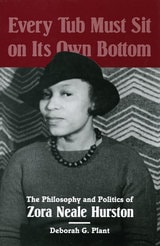
Every Tub Must Sit on Its Own Bottom
The Philosophy and Politics of Zora Neale HurstonDeborah G. Plant
University of Illinois Press, 1995
needed at this point in the evolving critical assessment of Hurston. It
is a paradigm for the study of individual African American women writers."
-- Alice Deck, University of Illinois at Urbana-Champaign
In a ground-breaking study
of Zora Neale Hurston, Deborah Plant takes issue with current notions
of Hurston as a feminist and earlier impressions of her as an intellectual
lightweight who disregarded serious issues of race in American culture.
Instead, Plant calls Hurston a "writer of resistance" who challenged
the politics of domination both in her life and in her work. One of the
great geniuses of the Harlem Renaissance, Hurston stands out as a strong
voice for African-American women. Her anthropological inquiries as well
as her evocative prose provide today's readers with a rich history of
African American folk culture, a folk culture through which Hurston expressed
her personal and political strategy of resistance and self-empowerment.
Through readings of Hurston's
fiction and autobiographical writings, Plant offers one of the first book-length
discussions of Hurston's personal philosophy of individualism and self-preservation.
From a discussion of Hurston's preacher father and influential mother,
whose guiding philosophy is reflected in the title of this book, to the
influence of Spinoza and Nietzsche, Plant puts into perspective the driving
forces behind Hurston's powerful prose.
This fresh look at one of
the most important writers of the twentieth century is sure to shape future
study of Hurston and her work.
Hitting A Straight Lick with a Crooked Stick
Race and Gender in the Work of Zora Neale HurstonSusan E Meisenhelder
University of Alabama Press, 2001
Masculinist Impulses
Toomer, Hurston, Black Writing, and ModernityNathan Grant
University of Missouri Press, 2004
Grant’s book provides close readings of Jean Toomer (Cane and Natalie Mann) and Zora Neale Hurston (Moses, Man of the Mountain, Seraph of the Suwanee, and Their Eyes Were Watching God), for whom the American South was a crucial locus of the African American experience. Toomer and Hurston were virtually alone among the Harlem Renaissance writers of prose who returned to the South for their literary materials. That return, however, allowed their rediscovery of key black masculine values and charted the northern route of those values in the twentieth century to their compromise and destruction.
Grant then moves on to three more recent writers—John Edgar Wideman, Gloria Naylor, and Toni Morrison—who expanded upon and transformed the themes of Toomer and Hurston. Like Toomer and Hurston, these later authors recognized the need for the political union of black men and women in the effort to realize the goals of equity and justice.
Masculinist Impulses discusses nineteenth- and twentieth-century black masculinity as both a feature and a casualty of modernism. Scholars and students of African American literature will find Grant’s nuanced and creative readings of these key literary texts invaluable.
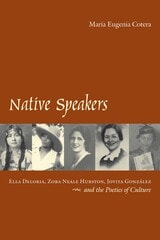
Native Speakers
Ella Deloria, Zora Neale Hurston, Jovita Gonzalez, and the Poetics of CultureBy María Eugenia Cotera
University of Texas Press, 2008
Gloria Anzaldua Book Prize, National Women's Studies Association, 2009
In the early twentieth century, three women of color helped shape a new world of ethnographic discovery. Ella Cara Deloria, a Sioux woman from South Dakota, Zora Neale Hurston, an African American woman from Florida, and Jovita González, a Mexican American woman from the Texas borderlands, achieved renown in the fields of folklore studies, anthropology, and ethnolinguistics during the 1920s and 1930s. While all three collaborated with leading male intellectuals in these disciplines to produce innovative ethnographic accounts of their own communities, they also turned away from ethnographic meaning making at key points in their careers and explored the realm of storytelling through vivid mixed-genre novels centered on the lives of women.
In this book, Cotera offers an intellectual history situated in the "borderlands" between conventional accounts of anthropology, women's history, and African American, Mexican American and Native American intellectual genealogies. At its core is also a meditation on what it means to draw three women—from disparate though nevertheless interconnected histories of marginalization—into conversation with one another. Can such a conversation reveal a shared history that has been erased due to institutional racism, sexism, and simple neglect? Is there a mode of comparative reading that can explore their points of connection even as it remains attentive to their differences? These are the questions at the core of this book, which offers not only a corrective history centered on the lives of women of color intellectuals, but also a methodology for comparative analysis shaped by their visions of the world.
The Politics of Black Joy
Zora Neale Hurston and Neo-AbolitionismLindsey Stewart
Northwestern University Press, 2021
Stewart develops Hurston’s contributions to political theory and philosophy of race by introducing the politics of joy as a refusal of neo-abolitionism, a political tradition that reduces southern Black life to tragedy or social death. To develop the politics of joy, Stewart draws upon Zora Neale Hurston’s essays, Beyoncé’s Lemonade, and figures across several disciplines including Frederick Douglass, W. E. B. Du Bois, Toni Morrison, Angela Davis, Saidiya Hartman, Imani Perry, Eddie Glaude, and Audra Simpson. The politics of joy offers insights that are crucial for forming needed new paths in our current moment. For those interested in examining popular conceptions of Black political agency at the intersection of geography, gender, class, and Black spirituality, The Politics of Black Joy is essential reading.
Underworld Work
Black Atlantic Religion Making in Jim Crow New OrleansAhmad Greene-Hayes
University of Chicago Press, 2025
When Zora Neale Hurston traveled to New Orleans, she encountered a religious underworld, a beautiful anarchy of spiritual life. In Underworld Work, Ahmad Greene-Hayes follows Hurston on a journey through the rich tapestry of Black religious expression from emancipation through Jim Crow. He looks within and beyond the church to recover the diverse leadership of migrants, healers, dissidents, and queer people who transformed their marginalized homes, bars, and street corners into sacred space.
Greene-Hayes shows how, while enclosed within an anti-black world, these outcasts embraced Africana esotericisms—ancestral veneration, faith healing, spiritualized sex work, and more—to conjure a connection to freer worlds past and yet to come. In recovering these spiritual innovations, Underworld Work celebrates the resilience and creativity of Africana religions.
Universes without Us
Posthuman Cosmologies in American LiteratureMatthew A. Taylor
University of Minnesota Press, 2013
During the nineteenth and early twentieth centuries, a wide variety of American writers proposed the existence of energies connecting human beings to cosmic processes. From varying points of view—scientific, philosophical, religious, and literary—they suggested that such energies would eventually result in the perfection of individual and collective bodies, assuming that assimilation into larger networks of being meant the expansion of humanity’s powers and potentialities—a belief that continues to inform much posthumanist theory today.
Universes without Us explores a lesser-known countertradition in American literature. As Matthew A. Taylor’s incisive readings reveal, the heterodox cosmologies of Edgar Allan Poe, Henry Adams, Charles Chesnutt, and Zora Neale Hurston reject the anthropocentric fantasy that sees the universe as a kind of reservoir of self-realization. For these authors, the world can be made neither “other” nor “mirror.” Instead, humans are enmeshed with “alien” processes that are both constitutive and destructive of “us.” By envisioning universes no longer our own, these cosmologies picture a form of interconnectedness that denies any human ability to master it.
Universes without Us demonstrates how the questions, possibilities, and dangers raised by the posthuman appeared nearly two centuries ago. Taylor finds in these works an untimely engagement with posthumanism, particularly in their imagining of universes in which humans are only one category of heterogeneous thing in a vast array of species, objects, and forces. He shows how posthumanist theory can illuminate American literary texts and how those texts might, in turn, prompt a reassessment of posthumanist theory. By understanding the posthuman as a materialist cosmology rather than a technological innovation, Taylor extends the range of thinkers who can be included in contemporary conversations about the posthuman.
We See with the Skin
On Zora Neale Hurston's MethodologyRoshanak Kheshti
Duke University Press, 2026
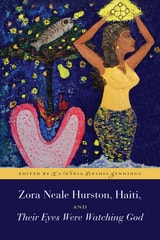
Zora Neale Hurston, Haiti, and Their Eyes Were Watching God
La Vinia Delois Jennings
Northwestern University Press, 2013
Zora Neale Hurston wrote her most famous novel, Their Eyes Were Watching God, while in Haiti on a trip funded by a Guggenheim fellowship to research the region’s transatlantic folk and religious culture; this work grounded what would become her ethnography Tell My Horse: Voodoo and Life in Haiti and Jamaica. The essays in Zora Neale Hurston, Haiti, and “Their Eyes Were Watching God” persuasively demonstrate that Hurston’s study of Haitian Voudoun informed the characterization, plotting, symbolism, and theme of her novel. Much in the way that Voudoun and its North American derivative Voodoo are syncretic religions, Hurston’s fiction enacts a syncretic, performative practice of reference, freely drawing upon Greco-Roman, Judeo-Christian, and Haitian Voudoun mythologies for its political, aesthetic, and philosophical underpinnings. Zora Neale Hurston, Haiti, and “Their Eyes Were Watching God” connects Hurston’s work more firmly to the cultural and religious flows of the African diaspora and to the literary practice by twentieth-century American writers of subscripting in their fictional texts symbols and beliefs drawn from West and Central African religions.
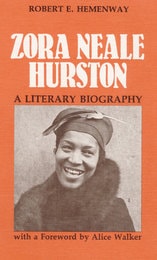
Zora Neale Hurston
A Literary BiographyRobert E. Hemenway. Foreword by Alice Walker
University of Illinois Press, 1977
The life and work of the iconic author and intellectual
Zora Neale Hurston transformed each hour of her life into something bubbling, exuberant, and brimming with joy. Robert Hemenway’s biography is a towering portrait of the novelist, folklorist, and anthropologist. Drawing on archival documents and interviews with people who knew her, Hemenway explores Hurston’s art and work, from her extraordinary novels and autobiography to a popular treatment of black folkways that revealed her deep commitment to the black folk tradition. He also provides a sensitive look at her two marriages; her relationships with Mrs. R. Osgood Mason, Franz Boas, and Langston Hughes; her time as a member of the black literati of the 1920s and 1930s; and the penniless final years leading to her death.
Sophisticated and original, Zora Neale Hurston tells the compelling story of a woman who reveled in a fully lived life dedicated to a lasting art and the preservation of a vital cultural heritage.
Zora Neale Hurston
And A History Of Southern LifeTiffany Ruby Patterson
Temple University Press, 2005
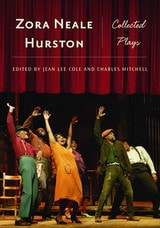
Zora Neale Hurston
Collected PlaysJean Lee Cole and Charles Mitchell
Rutgers University Press, 2008
Though she died penniless and forgotten, Zora Neale Hurston is now recognized as a major figure in African American literature. Best known for her 1937 novel Their Eyes Were Watching God, she also published numerous short stories and essays, three other novels, and two books on black folklore.
Even avid readers of Hurston’s prose, however, may be surprised to know that she was also a serious and ambitious playwright throughout her career. Although several of her plays were produced during her lifetime—and some to public acclaim—they have languished in obscurity for years. Even now, most critics and historians gloss over these texts, treating them as supplementary material for understanding her novels. Yet, Hurston’s dramatic works stand on their own merits and independently of her fiction.
Now, eleven of these forgotten dramatic writings are being published together for the first time in this carefully edited and annotated volume. Filled with lively characters, vibrant images of rural and city life, biblical and folk tales, voodoo, and, most importantly, the blues, readers will discover a “real Negro theater” that embraces all the richness of black life.