Results by title
11 books match the query 'Husserl'
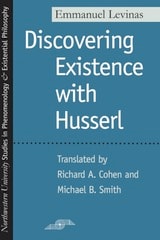
Discovering Existence with Husserl
Emmanuel Levinas
Northwestern University Press, 1997
In collecting almost all of Levinas's articles on Husserlian phenomenology, this volume gathers together a wealth of thoughtful exposition and interpretation by one of the most important European philosophers of the twentieth century. Levinas's thought is relevant to a broad variety of disciplines and concerns. This volume serves as a reliable introduction for the beginning student, as well as satisfying the expert's more demanding and critical desire for insight into the complexities of Levinas's thought.
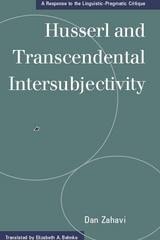
Husserl and Transcendental Intersubjectivity
A Response to the Linguistic-Pragmatic CritiqueDan Zahavi
Ohio University Press, 2001
Against this background the book compares his view with the approaches to intersubjectivity found in Heidegger, Sartre, and Merleau-Ponty, and it then attempts to establish to what extent the phenomenological approach can contribute to the current discussion of intersubjectivity. This is achieved through a systematic confrontation with the language-pragmatical positions of Apel and Habermas.
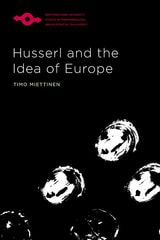
Husserl and the Idea of Europe
Timo Miettinen
Northwestern University Press, 2020
Husserl and the Idea of Europe argues that Edmund Husserl’s late reflections on Europe should not be read either as departures from his early transcendental phenomenology or as simple exercises of cultural criticism but rather as systematic phenomenological reflections on generativity and historicity. Timo Miettinen shows that Husserl’s deliberations on Europe contain his most compelling and radical interpretation of the intersubjective, communal, and historical dimensions of phenomenology.
Husserl and his generation worked in the aftermath of World War I, as Europe struggled to redefine itself, and he penned his late writings as the clouds of World War II gathered. Decades later, the fall of the Soviet Union again altered the continent’s identity and its political and economic divisions. Miettinen writes as a European involved in the question of Europe, and many of the recent authors and critics he addresses in this work—such as Michel Foucault, Jacques Derrida, and Giorgio Agamben—likewise deeply engaged with this new problem of European identity. The book illuminates the multifaceted problem of the idea of European rationality, and it defends novel conceptions of universalism and teleology as necessary components of radical philosophical reflection.
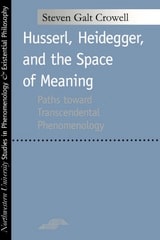
Husserl, Heidegger, and the Space of Meaning
Paths Toward Trancendental PhenomenologySteven Galt Crowell
Northwestern University Press, 2001
In a penetrating and lucid discussion of the enigmatic relationship between the work of Edmund Husserl and Martin Heidegger, Steven Galt Crowell proposes that the distinguishing feature of twentieth-century philosophy is not so much its emphasis on language as its concern with meaning. Arguing that transcendental phenomenology is indispensable to the philosophical explanation of the space of meaning, Crowell shows how a proper understanding of both Husserl and Heidegger reveals the distinctive contributions of each to that ongoing phenomenological project.
Husserl
An Analysis of His PhenomenologyPaul Ricoeur, Edward G. Ballard and Lester E. Embree; Foreword by David Carr
Northwestern University Press, 1967
Husserl
An Analysis of His PhenomenologyPaul Ricoeur, Edward G. Ballard and Lester E. Embree; Foreword by David Carr
Northwestern University Press, 2007
Phenomenology and Embodiment
Husserl and the Constitution of SubjectivityJoona Taipale
Northwestern University Press, 2014
Reduction and Givenness
Investigations of Husserl, Heidegger, and PhenomenologyJean-Luc Marion
Northwestern University Press, 1997
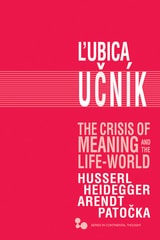
The Crisis of Meaning and the Life-World
Husserl, Heidegger, Arendt, PatockaLubica Ucník
Ohio University Press, 2016
In The Crisis of Meaning and the Life-World, Ľubica Učník examines the existential conflict that formed the focus of Edmund Husserl’s final work, which she argues is very much with us today: how to reconcile scientific rationality with the meaning of human existence. To investigate this conundrum, she places Husserl in dialogue with three of his most important successors: Martin Heidegger, Hannah Arendt, and Jan Patočka.
For Husserl, 1930s Europe was characterized by a growing irrationalism that threatened to undermine its legacy of rational inquiry. Technological advancement in the sciences, Husserl argued, had led science to forget its own foundations in the primary “life-world”: the world of lived experience. Renewing Husserl’s concerns in today’s context, Učník first provides an original and compelling reading of his oeuvre through the lens of the formalization of the sciences, then traces the unfolding of this problem through the work of Heidegger, Arendt, and Patočka.
Although many scholars have written on Arendt, none until now has connected her philosophical thought with that of Czech phenomenologist Jan Patočka. Učník provides invaluable access to the work of the latter, who remains understudied in the English language. She shows that together, these four thinkers offer new challenges to the way we approach key issues confronting us today, providing us with ways to reconsider truth, freedom, and human responsibility in the face of the postmodern critique of metanarratives and a growing philosophical interest in new forms of materialism.
The World Unclaimed
A Challenge to Heidegger’s Critique of HusserlLilian Alweiss
Ohio University Press, 2003
The World Unclaimed argues that Heidegger’s critique of modern epistemology in Being and Time is seriously flawed. Heidegger believes he has done away with epistemological problems concerning the external world by showing that the world is an existential structure of Dasein. However, the author argues that Heidegger fails to make good his claim that he has “rescued” the phenomenon of the world, which he believes the tradition of philosophy has bypassed. Heidegger fails not only to reclaim the world but also to acknowledge its loss. Alweiss thus calls into question Heidegger’s claim that ontology is more fundamental than epistemology.
The World Unclaimed develops its powerful critique of Being and Time by arguing for a return to Husserl. It draws on Husserl’s insight that it is the moving and sensing body that discloses how we are already familiar with the world. Kinaesthesia provides a key for understanding our relation to the world. The author thus suggests that thinkers in the vein of Husserl and Kant -who, for Heidegger, epitomize the tradition of modern philosophy by returning to a “worldless subject”- may provide us with the resources to reclaim the phenomenon of the world that Being and Time sets out to salvage.
Alweiss’s fresh and innovative study demonstrates that it is possible to overcome epistemological skepticism without ever losing sight of the phenomenon of the world. Moreover, Alweiss challenges us to reconsider the relation between Husserl and Heidegger by providing a forceful defense of Husserl’s critique of cognition.
Word and Object in Husserl, Frege, and Russell
The Roots of Twentieth-Century PhilosophyClaire Oritz Hill
Ohio University Press, 2001
In search of the origins of some of the most fundamental problems that have beset philosophers in English-speaking countries in the past century, Claire Ortiz Hill maintains that philosophers are treating symptoms of ills whose causes lie buried in history. Substantial linguistic hurdles have blocked access to Gottlob Frege's thought and even to Bertrand Russell's work to remedy the problems he found in it. Misleading translations of key concepts like intention, content, presentation, idea, meaning, concept, etc., severed analytic philosophy from its roots.
Hill argues that once linguistic and historical barriers are removed, Edmund Husserl's critical study of Frege's logic in his 1891 Philosophy of Arithmetic provides important insights into issues in philosophy now.
She supports her conclusions with analyses of Frege's, Husserl's, and Russell's works, including Principia Mathematica, and with linguistic analyses of the principal concepts of analytic philosophy. She re-establishes links that existed between English and Continental thought to show Husserl's expertise as a philosopher of mathematics and logic who had been Weierstrass's assistant and had long maintained ties with Cantor, Hilbert, and Zermelo.