Results by title
2 books match the query 'Hybridity (Social sciences)'
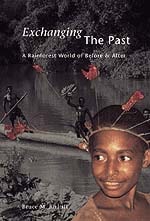
Exchanging the Past
A Rainforest World of Before and AfterBruce M. Knauft
University of Chicago Press, 2002
Twenty years ago, the Gebusi of the lowland Papua New Guinea rainforest had one of the highest homicide rates in the world. Bruce M. Knauft found then that the killings stemmed from violent scapegoating of suspected sorcerers. But by the time he returned in 1998, homicide rates had plummeted, and Gebusi had largely disavowed vengeance against sorcerers in favor of modern schools, discos, markets, and Christianity.
In this book, Knauft explores the Gebusi's encounter with modern institutions and highlights what their experience tells us more generally about the interaction between local peoples and global forces. As desire for material goods grew among Gebusi, Knauft shows that they became more accepting of and subordinated by Christian churches, community schools,and government officials in their attempt to benefit from them—a process Knauft terms "recessive agency." But the Gebusi also respond actively to modernity, creating new forms of feasting, performance, and music that meld traditional practices with Western ones, all of which Knauft documents in this fascinating study.
In this book, Knauft explores the Gebusi's encounter with modern institutions and highlights what their experience tells us more generally about the interaction between local peoples and global forces. As desire for material goods grew among Gebusi, Knauft shows that they became more accepting of and subordinated by Christian churches, community schools,and government officials in their attempt to benefit from them—a process Knauft terms "recessive agency." But the Gebusi also respond actively to modernity, creating new forms of feasting, performance, and music that meld traditional practices with Western ones, all of which Knauft documents in this fascinating study.
[more]
Hybridity
The Cultural Logic Of GlobalizationMarwan Kraidy
Temple University Press, 2005
The intermingling of people and media from different cultures is a communication-based phenomenon known as hybridity. Drawing on original research from Lebanon to Mexico and analyzing the use of the term in cultural and postcolonial studies (as well as the popular and business media), Marwan Kraidy offers readers a history of the idea and a set of prescriptions for its future use.Kraidy analyzes the use of the concept of cultural mixture from the first century A.D. to its present application in the academy and the commercial press. The book's case studies build an argument for understanding the importance of the dynamics of communication, uneven power relationships, and political economy as well as culture, in situations of hybridity. Kraidy suggests a new framework he developed to study cultural mixture—called critical transculturalism—which uses hybridity as its core concept, but in addition, provides a practical method for examining how media and communication work in international contexts.
[more]