Results by title
10 books match the query 'I'
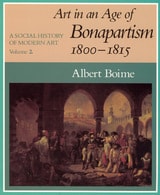
A Social History of Modern Art, Volume 2
Art in an Age of Bonapartism, 1800-1815Albert Boime
University of Chicago Press, 1990
Heavily illustrated, this volume is an invaluable social history of modern art during the Napoleonic era.
Stimulating and informative, this volume will become a valuable resource for faculty and undergraduates.—R. W. Liscombe, Choice
Elizabeth I
Autograph Compositions and Foreign Language OriginalsElizabeth I
University of Chicago Press, 2002
The originals selected for inclusion here are compositions that survive in Elizabeth's own handwriting, in English and in foreign languages, as well as her foreign language compositions preserved by other hands or in printed editions. Presented in transcriptions that reproduce the spelling and punctuation of their sixteenth-century sources, these texts convey many of the expressive and significant features of Elizabeth's writing. Through the transcriptions of texts in her own hand, readers can track the queen's language and compositional style-her choices of vocabulary and phrasing; her habits of capitalization, spelling, and punctuation; her often heavy revisions and redraftings; and her insertions of postscripts and second thoughts. The texts in foreign languages, meanwhile, will allow readers to prepare their own English translations from these original sources.
A unique resource for scholars of English literature and the Renaissance, this companion to the Collected Works offers much fuller and more detailed access to Elizabeth and her writings than can be obtained from the modern English versions alone.
Elizabeth I
Collected WorksElizabeth I
University of Chicago Press, 2000
"This collection shines a light onto the character and experience of one of the most interesting of monarchs. . . . We are likely never to get a closer or clearer look at her. An intriguing and intense portrait of a woman who figures so importantly in the birth of our modern world."—Publishers Weekly
"An admirable scholarly edition of the queen's literary output. . . . This anthology will excite scholars of Elizabethan history, but there is something here for all of us who revel in the English language."—John Cooper, Washington Times
"Substantial, scholarly, but accessible. . . . An invaluable work of reference."—Patrick Collinson, London Review of Books
"In a single extraordinary volume . . . Marcus and her coeditors have collected the Virgin Queen's letters, speeches, poems and prayers. . . . An impressive, heavily footnoted volume."—Library Journal
"This excellent anthology of [Elizabeth's] speeches, poems, prayers and letters demonstrates her virtuosity and afford the reader a penetrating insight into her 'wiles and understandings.'"—Anne Somerset, New Statesman
"Here then is the only trustworthy collection of the various genres of Elizabeth's writings. . . . A fine edition which will be indispensable to all those interested in Elizabeth I and her reign."—Susan Doran, History
"In the torrent of words about her, the queen's own words have been hard to find. . . . [This] volume is a major scholarly achievement that makes Elizabeth's mind much more accessible than before. . . . A veritable feast of material in different genres."—David Norbrook, The New Republic
Isabel Rules
Constructing Queenship, Wielding PowerBarbara F. Weissberger
University of Minnesota Press, 2003
A deconstruction of the strategies used to shape the image of a powerful woman ruler
As queen of Spain, Isabel I of Castile (known to history as Isabella the Catholic, 1474–1504) oversaw the creation of Europe’s first nation-state and laid the foundations for its emergence as the largest empire the West has ever known—nearly a century before the better-known and more widely studied Elizabeth I of England.
What we know of this remarkable ruler is typically gleaned from hagiographic texts that negate her power and accept her own propagandistic self-fashioning as legitimate heir, pious princess, devoted wife, and heaven-sent healer of the wounds inflicted on Spain’s body politic by impotent kings, seditious nobles, and such undesirable others as Jews, Muslims, and sodomites. Isabel Rules is the first book to examine the formation of the queen’s public image, focusing on strategies designed to cope with the ideological and cultural dissonance created by the combination of her gender and her profoundly patriarchal political program for unifying and purifying Spain.Barbara Weissberger identifies two primary and interrelated strategies among the supporters of the queen—often writing in her employ—and her critics. Her loyalists use Marian imagery to portray Isabel as a pious, chaste, and submissive queen consort to her husband Ferdinand, while her opponents imagine the queen as a voracious and lascivious whore whose illicit power threatens the virility of her male subjects and inverts the traditional gender hierarchy. Weissberger applies a materialist feminist perspective to a wide array of texts of the second half of the fifteenth century in order to uncover and study the masculine psychosexual anxiety created by Isabel’s anomalous power. She then demonstrates the persistence of the two sides of the propagandistic construction of the Catholic queen, reviewing modern treatments in Francoist schoolbooks and in the fiction of Juan Goytisolo, Alejo Carpentier, and Salman Rushdie.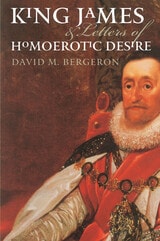
King James and Letters of Homoerotic Desire
David M. Bergeron
University of Iowa Press, 1999
What can we know of the private lives of early British sovereigns? Through the unusually large number of letters that survive from King James VI of Scotland/James I of England (1566-1625), we can know a great deal. Using original letters, primarily from the British Library and the National Library of Scotland, David Bergeron creatively argues that James' correspondence with certain men in his court constitutes a gospel of homoerotic desire. Bergeron grounds his provocative study on an examination of the tradition of letter writing during the Renaissance and draws a connection between homosexual desire and letter writing during that historical period.
King James, commissioner of the Bible translation that bears his name, corresponded with three principal male favorites—Esmé Stuart (Lennox), Robert Carr (Somerset), and George Villiers (Buckingham). Esmé Stuart, James' older French cousin, arrived in Scotland in 1579 and became an intimate adviser and friend to the adolescent king. Though Esmé was eventually forced into exile by Scottish nobles, his letters to James survive, as does James' hauntingly allegorical poem Phoenix. The king's close relationship with Carr began in 1607. James' letters to Carr reveal remarkable outbursts of sexual frustration and passion.
A large collection of letters exchanged between James and Buckingham in the 1620s provides the clearest evidence for James' homoerotic desires. During a protracted separation in 1623, letters between the two raced back and forth. These artful, self-conscious letters explore themes of absence, the pleasure of letters, and a preoccupation with the body. Familial and sexual terms become wonderfully intertwined, as when James greets Buckingham as "my sweet child and wife."
King James and Letters of Homoerotic Desire presents a modern-spelling edition of seventy-five letters exchanged between Buckingham and James. Across the centuries, commentators have condemned the letters as indecent or repulsive. Bergeron argues that on the contrary they reveal an inward desire of king and subject in a mutual exchange of love.
The Complete Works of Liudprand of Cremona (Medieval Texts in Translation)
Paolo Liudprand of Cremona
Catholic University of America Press, 2007
The Deeds of Count Roger of Calabria and Sicily and of His Brother Duke Robert Guisc
Kenneth Baxter Wolf
University of Michigan Press, 2005
Geoffrey Malaterra's Deeds of Count Roger is the most important extant account of the Norman conquest of Muslim Silicy (1061-91). This volume includes a translation of the Latin original as well as an introduction, notes, and maps.
The Deeds of Count Roger fills a gap in the primary literature pertaining to the earliest phase of Latin Christian expansion at the expense of Islam, since the Norman conquests in Sicily were more or less contemporary with the First Crusade and the beginnings of the Spanish Reconquista. The account also illustrates the complexity of medieval historical writing, with Malaterra on the one hand praising the Normans for their military achievements and on the other subtly criticising the "lust for domination" that inspired them.
Kenneth Baxter Wolf is Professor of History at Pomona College.
The Emperor's Clothes
A Personal Viewpoint of Politics and Administration in the Imperial Ethiopian Government, 1941-1974Gaitachew Bekele
Michigan State University Press, 1993
. . . An engaging personal account of a public service career n the period leading to the 1974 revolution. It ...persuades and provides real insight into the genuine noblesse oblige of the first generation of technocrats drawn from the social elite of the post- war period.
-James McCann, Boston University

The Petrine Revolution in Russian Architecture
James Cracraft
University of Chicago Press, 1988
The Subject of Elizabeth
Authority, Gender, and RepresentationLouis Montrose
University of Chicago Press, 2006
Montrose offers a masterful account of the texts, pictures, and performances in which the Queen was represented to her people, to her court, to foreign powers, and to Elizabeth herself. Retrieving this “Elizabethan imaginary” in all its richness and fascination, Montrose presents a sweeping new account of Elizabethan political culture. Along the way, he explores the representation of Elizabeth within the traditions of Tudor dynastic portraiture; explains the symbolic manipulation of Elizabeth’s body by both supporters and enemies of her regime; and considers how Elizabeth’s advancing age provided new occasions for misogynistic subversions of her royal charisma.
This book, the remarkable product of two decades of study by one of our most respected Renaissance scholars, will be welcomed by all historians, literary scholars, and art historians of the period.