Results by title
2 books match the query 'Identity at'

Power and Identity at the Margins of the Ancient Near East
Sara Mohr
University Press of Colorado, 2022
Power and Identity at the Margins of the Ancient Near East rethinks the dichotomy between antiquated terms such as “core” and “periphery,” explores lived realities in the margins of central authority, and centers those margins as places of resistance and power in their own right.
The borderlands of hegemonic entities within the Near East and Egypt pressed against each other, creating cities and societies with influence from several competing polities. The peoples, cities, and cultures that resulted present a unique lens by which to examine how states controlled and influenced the lives, political systems, and social hierarchies of these subjects (and vice versa). This volume addresses the distinct traditions and experiences of areas beyond the core; terminology used when discussing empire, core, periphery, borderlands, and frontiers; conceptualization of space; practices and consequences of warfare, captive-taking, and slavery; identity- and secondary state–formation; economy and society; ritual; diplomacy; and the negotiation of claims to power.
It is imperative that historians and social scientists understand the ways in which these cultures developed, spread, and interacted with others along frontier edges. Using an intersectional approach across disciplines, Power and Identity at the Margins of the Ancient Near East brings together professionals from archaeology, religious studies, history, sociology, and anthropology to make new contributions to the study of the frontier.
Contributors: Alexander Ahrens, Peter Dubovský, Avraham Faust, Daniel E. Fleming, Mahri Leonard-Fleckman, Alvise Matessi, Ellen Morris, Valeria Turriziani, Eric M. Trinka
[more]
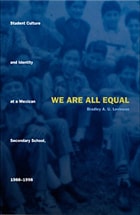
We Are All Equal
Student Culture and Identity at a Mexican Secondary School, 1988–1998Bradley A. U. Levinson
Duke University Press, 2001
We Are All Equal is the first full-length ethnography of a Mexican secondary school available in English. Bradley A. U. Levinson observes student life at a provincial Mexican junior high, often drawing on poignant and illuminating interviews, to study how the the school’s powerful emphasis on equality, solidarity, and group unity dissuades the formation of polarized peer groups and affects students’ eventual life trajectories.
Exploring how students develop a cultural “game of equality” that enables them to identify—across typical class and social boundaries—with their peers, the school, and the nation, Levinson considers such issues as the organizational and discursive resources that students draw on to maintain this culture. He also engages cultural studies, media studies, and globalization theory to examine the impact of television, music, and homelife on the students and thereby better comprehend—and problematize—the educational project of the state. Finding that an ethic of solidarity is sometimes used to condemn students defined as different or uncooperative and that little attention is paid to accommodating the varied backgrounds of the students—including their connection to indigenous, peasant, or working class identities—Levinson reveals that their “schooled identity” often collapses in the context of migration to the United States or economic crisis in Mexico. Finally, he extends his study to trace whether the cultural game is reinforced or eroded after graduation as well as its influence relative to the forces of family, traditional gender roles, church, and global youth culture.
We Are All Equal will be of particular interest to educators, sociologists, Latin Americanists, and anthropologists.
[more]