Results by title
433 books match the query 'Immigrants' and 42 start with a
A Century of Transnationalism
Immigrants and Their Homeland ConnectionsEdited by Nancy L. Green and Roger Waldinger
University of Illinois Press, 2016
A City At War
Milwaukee Labor During World War IIRichard L. Pifer
Wisconsin Historical Society Press, 2003

A Divided World
Hollywood Cinema and Emigré Directors in the Era of Roosevelt and Hitler, 1933-1948Nick Smedley
Intellect Books, 2011
The New Deal introduced sweeping social, political, and cultural change across the United States, which Hollywood embraced enthusiastically. Then, when the heady idealism of the 1930s was replaced by the paranoia of the postwar years, Hollywood became an easy target for the anticommunists. A Divided World examines some of the important programs of the New Deal and the subsequent response of the film community—especially in relation to social welfare, women’s rights, and international affairs. The book also provides an analysis of the major works of three European directors—Billy Wilder, Ernst Lubitsch, and Fritz Lang—compared and contrasted with the products of mainstream Hollywood. This is a new interpretation of an influential period in American film history and it is sure to generate further debate and scholarship.
A Journey Around Our America
A Memoir on Cycling, Immigration, and the Latinoization of the U.S.By Louis G. Mendoza
University of Texas Press, 2012
Immigration and the growing Latino population of the United States have become such contentious issues that it can be hard to have a civil conversation about how Latinoization is changing the face of America. So in the summer of 2007, Louis Mendoza set out to do just that. Starting from Santa Cruz, California, he bicycled 8,500 miles around the entire perimeter of the country, talking to people in large cities and small towns about their experiences either as immigrants or as residents who have welcomed—or not—Latino immigrants into their communities. He presented their enlightening, sometimes surprising, firsthand accounts in Conversations Across Our America: Talking About Immigration and the Latinoization of the United States.
Now, in A Journey Around Our America, Mendoza offers his own account of the visceral, emotional, intellectual, and spiritual dimensions of traveling the country in search of a deeper, broader understanding of what it means to be Latino in the United States in the twenty-first century. With a blend of first- and second-person narratives, blog entries, poetry, and excerpts from conversations he had along the way, Mendoza presents his own aspirations for and critique of social relations, political ruminations, personal experiences, and emotional vulnerability alongside the stories of people from all walks of life, including students, activists, manual laborers, and intellectuals. His conversations and his experiences as a Latino on the road reveal the multilayered complexity of Latino life today as no academic study or newspaper report ever could.

A Life in Music from the Soviet Union to Canada
Memoirs of a Madrigal Ensemble SingerAlexander Tumanov
University of North Texas Press, 2019
A Midwestern Mosaic
Immigration and Political Socialization in Rural AmericaJ. Celeste Lay
Temple University Press, 2012
Drawn by low-skilled work and the safety and security of rural life, increasing numbers of families from Latin America and Southeast Asia have migrated to the American heartland. In the path-breaking book A Midwestern Mosaic, J. Celeste Lay examines the effects of political socialization on native white youth growing up in small towns.
Lay studies five Iowa towns to investigate how the political attitudes and inclinations of native adolescents change as a result of rapid ethnic diversification. Using surveys and interviews, she discovers that native adolescents adapt very well to foreign-born citizens, and that over time, gaps diminish between diverse populations and youth in all-white/Anglo towns in regard to tolerance, political knowledge, efficacy, and school participation.
A Midwestern Mosaic looks at the next generation to show how exposure to ethnic and cultural diversity during formative years can shape political behavior and will influence politics in the future.
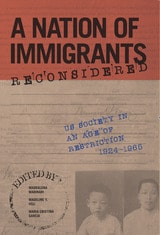
A Nation of Immigrants Reconsidered
US Society in an Age of Restriction, 1924-1965Maddalena Marinari, Madeline Hsu, Maria Garcia
University of Illinois Press, 2019
Contributors: Eiichiro Azuma, David Cook-Martín, David FitzGerald, Monique Laney, Heather Lee, Kathleen López, Laura Madokoro, Ronald L. Mize, Arissa H. Oh, Ana Elizabeth Rosas, Lorrin Thomas, Ruth Ellen Wasem, and Elliott Young
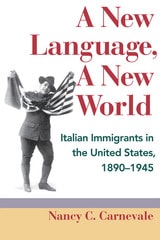
A New Language, A New World
Italian Immigrants in the United States, 1890-1945Nancy C. Carnevale
University of Illinois Press, 2012
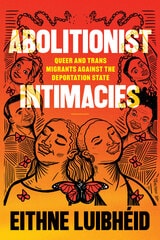
Abolitionist Intimacies
Queer and Trans Migrants against the Deportation StateEithne Luibheid
Duke University Press, 2025
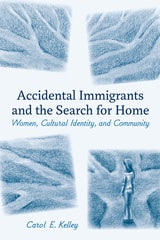
Accidental Immigrants and the Search for Home
Women, Cultural Identity, and CommunityCarol E. Kelley
Temple University Press, 2013
The intimate stories of these "accidental" immigrants broaden conventional notions of home. From a Maori woman who moves to Norway to the daughter of an Iranian diplomat now living in France, Kelley weaves together these stories of the personal and emotional effects of immigration with interdisciplinary discussions drawn from anthropology and psychology. Ultimately, she reveals how the lifelong process of immigration affects each woman's sense of identity and belonging and contributes to better understanding today's globalized society.
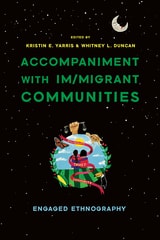
Accompaniment with Im/migrant Communities
Engaged EthnographyKristin E. Yarris and Whitney L. Duncan
University of Arizona Press, 2024
This collection brings together the experiences and voices of anthropologists whose engaged work with im/migrant communities pushes the boundaries of ethnography toward a feminist, care-based, decolonial mode of ethnographic engagement called “accompaniment.”
Accompaniment as anthropological research and praxis troubles the boundaries of researcher-participant, scholar-activist, and academic-community to explicitly address issues of power, inequality, and the broader social purpose of the work. More than two dozen contributors show how accompaniment is not merely a mode of knowledge production but an ethical commitment that calls researchers to action in solidarity with those whose lives we seek to understand. The volume stands as a collective conversation about possibilities for caring and decolonial forms of ethnographic engagement with im/migrant communities.
This volume is ideal for scholars, students, immigrant activists, instructors, and those interested in social justice work.
Contributors
Carolina Alonso Bejarano
Anna Aziza Grewe
Alaska Burdette
Whitney L. Duncan
Carlos Escalante Villagran
Christina M. Getrich
Tobin Hansen
Lauren Heidbrink
Dan Heiman
Josiah Heyman
Sarah Horton
Nolan Kline
Alana M. W. LeBrón
Lupe López
William D. Lopez
Aida López Huinil
Mirian A. Mijangos García
Nicole L. Novak
Mariela Nuñez-Janes
Ana Ortez-Rivera
Juan Edwin Pacay Mendoza
Salvador Brandon Pacay Mendoza
María Engracia Robles Robles
Delmis Umanzor
Erika Vargas Reyes
Kristin E. Yarris
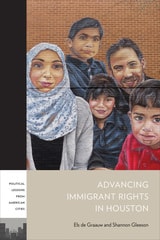
Advancing Immigrant Rights in Houston
Els de Graauw and Shannon Gleeson
Temple University Press, 2024
In Advancing Immigrant Rights in Houston, Els de Graauw and Shannon Gleeson recount how local and multi-level contexts shape the creation, contestation, and implementation of immigrant rights policies and practices in the city. They examine the development of a city immigrant affairs office, interactions between local law enforcement and federal immigration enforcement officials, local public-private partnerships around federal immigration benefits, and collaborations between labor, immigrant rights, faith, and business leaders to combat wage theft.
The case study of Houston provides a bellwether for how other U.S. cities will deal with their growing immigrant populations and underscores the importance of public-private collaborations to advance immigrant rights.
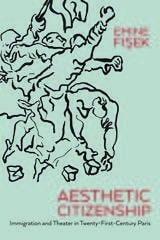
Aesthetic Citizenship
Immigration and Theater in Twenty-First-Century ParisEmine Fisek
Northwestern University Press, 2017
From neighborhood associations and humanitarian alliances to arts organizations both large and small, Fisek traces how theater has emerged as a practice with the perceived capacity to address questions regarding immigrant rights, integration, and experience. In Aesthetic Citizenship, she explores how the stage, one of France’s most evocative cultural spaces, has come to play a role in contemporary questions about immigration, citizenship and national identity. Yet Fişek’s insightful research also illuminates Paris’s broader historical, political, and cultural through-lines that continue to shape the relationship between theater and migration in France.
By focusing on how French public discourses on immigration are not only rendered meaningful but also inhabited and modified in the context of activist and arts practice, Aesthetic Citizenship seeks to answer the fundamental question: is theater a representational act or can it also be a transformative one?
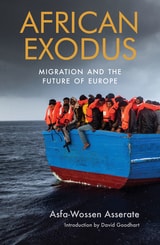
African Exodus
Migration and the Future of EuropeAsfa-Wossen Asserate
Haus Publishing, 2018
Asfa-Wossen Asserate argues here that building higher fences or finding more effective methods of integration will only, in the long term, perpetuate rather than solve the problems associated with these large numbers of displaced refugees. We need to realize that we are only treating the symptoms of an oncoming catastrophe and that, if we are to respond to mass migration, we will ultimately have to understand its causes. African Exodus places its emphasis firmly on the causes of the refugee crisis, which are to be found not least in Europe itself, and charts ways in which we might deal with it effectively in the long term.
In the course of this analysis, Asserate asks why our view of Africa—a troubled continent, but rich in so many ways—is so distorted. How can we combat the corrupt, authoritarian regimes that stymie progress and development? Why are millions fleeing to Europe? How is the EU complicit in the migration crisis? And finally, in practical terms: what can be done, and what prospects does the future hold?
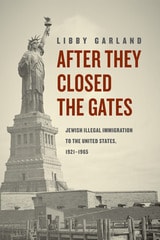
After They Closed the Gates
Jewish Illegal Immigration to the United States, 1921-1965Libby Garland
University of Chicago Press, 2014
In After They Closed the Gates, Libby Garland tells the untold stories of the Jewish migrants and smugglers involved in that underworld, showing how such stories contributed to growing national anxieties about illegal immigration. Garland also helps us understand how Jews were linked to, and then unlinked from, the specter of illegal immigration. By tracing this complex history, Garland offers compelling insights into the contingent nature of citizenship, belonging, and Americanness.
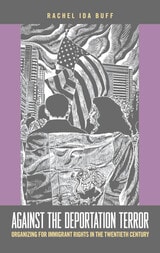
Against the Deportation Terror
Organizing for Immigrant Rights in the Twentieth CenturyRachel Ida Buff
Temple University Press, 2017
Despite being characterized as a “nation of immigrants,” the United States has seen a long history of immigrant rights struggles. In her timely book Against the Deportation Terror, Rachel Ida Buff uncovers this multiracial history. She traces the story of the American Committee for the Protection of the Foreign Born (ACPFB) from its origins in the 1930s through repression during the early Cold War, to engagement with “new” Latinx and Caribbean immigrants in the 1970s and early 1980s.
Functioning as a hub connecting diverse foreign-born communities and racial justice advocates, the ACPFB responded to various, ongoing crises of what they called “the deportation terror.” Advocates worked against repression, discrimination, detention, and expulsion in migrant communities across the nation at the same time as they supported reform of federal immigration policy. Prevailing in some cases and suffering defeats in others, the story of the ACPFB is characterized by persistence in multiracial organizing even during periods of protracted repression.
By tracing the work of the ACPFB and its allies over half a century, Against the Deportation Terror provides important historical precedent for contemporary immigrant rights organizing. Its lessons continue to resonate today.
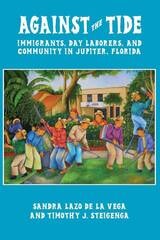
Against the Tide
Immigrants, Day Laborers, and Community in Jupiter, FloridaSandra Lazo de la Vega and Timothy J. Steigenga
University of Wisconsin Press, 2013
At the beginning of the twenty-first century, Jupiter was in the throes of immigration debates. A decade earlier, this small town had experienced an influx of migrants from Mexico and Guatemala. Immigrants seeking work gathered daily on one of the city’s main streets, creating an ad-hoc, open-air labor market that generated complaints and health and human safety concerns. What began as a local debate rapidly escalated as Jupiter’s situation was thrust into the media spotlight and attracted the attention of state and national anti-immigrant groups. But then something unexpected happened: immigrants, neighborhood residents, university faculty and students, and town representatives joined together to mediate community tensions and successfully moved the informal labor market to the new El Sol Neighborhood Resource Center.
Timothy J. Steigenga, who helped found the center, and Lazo de la Vega, who organized students in support of its mission, describe how El Sol engaged the residents of Jupiter in a two-way process of immigrant integration and helped build trust on both sides. By examining one city’s search for a positive public policy solution, Against the Tide offers valuable practical lessons for other communities confronting similar challenges.
Alien
Reflections on Being an ImmigrantSandro Galea
University of Chicago Press, 2026
A personal treatise from distinguished social scientist Sandro Galea on the indelible effects of being an immigrant—and what it means for the greater good.
“I am one of the lucky ones,” writes Sandro Galea. Galea left home in Malta at fourteen with his parents and sister as the island was rocked by political turmoil. The family made their way to Canada and Galea, in turn, eventually made his way to the United States. This is the story of Galea’s long, surreal journey of forging a life in a series of new and unfamiliar places.
With spare and deeply affecting prose, Alien is a poignant exploration of what it means to build a life across borders—and why it’s important for all of us. Galea’s intimate and personal story frames the experience of being an immigrant in terms of its indelible lessons on adaptation, identity, belonging, and shared generosity. Galea also captures at once the joys and the uncertainties that define the process of uprooting one life to begin another abroad. His is a reflection on empathy, on precarity, and on the effect of immigrating, in which one becomes keenly aware of how quickly life—and the world—can change.
Blending philosophical inquiry and personal story, Alien bridges the gap between storytelling and scholarship and, in doing so, gifts us an essential aperture on the world not everyone experiences—and the value of having those who do.
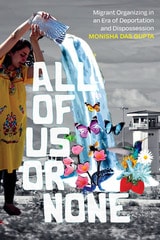
All of Us or None
Migrant Organizing in an Era of Deportation and DispossessionMonisha Das Gupta
Duke University Press, 2024
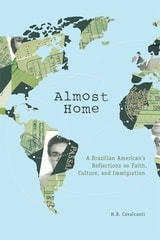
Almost Home
A Brazilian American's Reflections on Faith, Culture, and ImmigrationH. B. Cavalcanti
University of Wisconsin Press, 2012
Due to both his family background and the prevalence of U.S. media in Latin America, Cavalcanti already felt immersed in U.S. culture before arriving in Kentucky in 1981 to complete graduate studies. At that time, opportunities for advancement in the United States exceeded those in Brazil, and in an era of military dictatorships throughout much of Latin America, Cavalcanti sought in the United States a nation of laws. In this memoir, he reflects on the dynamics of acculturation, immigrant parenting, interactions with native-born U.S. citizens, and the costs involved in rejecting his country of birth for an adopted nation. He also touches on many of the factors that contribute to migration in both the “sending” and “receiving” countries and explores the contemporary phenomenon of accelerated immigration.
With its blend of personal anecdotes and scholarly information, Almost Home addresses both individual and policy-related issues to provide a moving portrait of the impact of migration on those who, like Cavalcanti, confront both the wonder and the disorientation inherent in the immigrant experience.

Aloha Compadre
Latinxs in Hawai'iRudy P. Guevarra
Rutgers University Press, 2023
Aloha Compadre: Latinxs in Hawaiʻi is the first book to examine the collective history and contemporary experiences of the Latinx population of Hawaiʻi. This study reveals that contrary to popular discourse, Latinx migration to Hawaiʻi is not a recent event. In the national memory of the United States, for example, the Latinx population of Hawaiʻi is often portrayed as recent arrivals and not as long-term historical communities with a presence that precedes the formation of statehood itself. Historically speaking, Latinxs have been voyaging to the Hawaiian Islands for over one hundred and ninety years. From the early 1830s to the present, they continue to help shape Hawaiʻi’s history, yet their contributions are often overlooked. Latinxs have been a part of the cultural landscape of Hawaiʻi prior to annexation, territorial status, and statehood in 1959. Aloha Compadre also explores the expanding boundaries of Latinx migration beyond the western hemisphere and into Oceania.
Always an Academic Immigrant
A Collective MemoirDafna Lemish
Rutgers University Press, 2025
Always an Academic Immigrant is a collective memoir that gives voice to eighty-one academics who immigrated from thirty-seven countries for a career in an institution of higher education, in either the United States or one of ten other countries. Through in-depth interviews and observations from her own experiences as an immigrant scholar, Dafna Lemish shares the highs and the lows that academic immigrants feel as they search for both a country and an institution they can call home. She discovers the formative events that led these scholars to pursue careers outside their native lands and details the challenges they faced adapting to unspoken expectations in their new countries and workplaces. Ultimately, this book reveals the strategies that immigrant professors use to bridge their native and adoptive cultures while highlighting the vital contributions they have made to academia as scholars, teachers, and leaders.
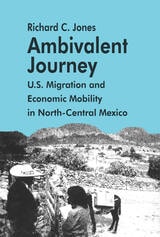
Ambivalent Journey
U.S. Migration and Economic Mobility in North-Central MexicoRichard C. Jones
University of Arizona Press, 1995
Jones's study focuses on the ways in which U.S. migration affects the lives of families in these two subregions. Migrants from Zacatecas have traditionally come from rural areas and have gone to California and Illinois. Migrants from Coahuila, on the other hand, usually come from urban areas and have almost exclusively preferred locations in nearby Texas. The different motivations of both groups for migrating, and the different economic and social effects upon their home areas realized by migrating, form the core of this book. The comparison also lends the book its uniqueness, since no other study has made such an in-depth comparison of two areas.
Jones addresses the basic dichotomy of structuralists (who maintain that dependency and disinvestment are the rule for families and communities in sending areas) and functionalists (who believe that autonomy and reinvestment are the case of migrants and their families in home regions). Jones finds that much of the primary literature is based on uneven and largely outdated data that leans heavily on two sending states, Jalisco and Michoacan. His fresh analysis shows that communities and regions of Mexico, rather than families only, account for differing migration patterns and differing social and economic results of these patterns.
Jones's study will be of value not only to scholars and practitioners working in the field of Mexican migration, but also, for its innovative methodology, to anthropologists, sociologists, political scientists, and historians whose interests include human migration patterns in any part of the world
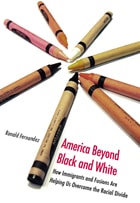
America Beyond Black and White
How Immigrants and Fusions Are Helping Us Overcome the Racial DivideRonald Fernandez
University of Michigan Press, 2007
“This book is both powerful and important. Powerful for the testimony it provides from Americans of many different (and even mixed races) about their experiences. And important because there is a racial revolution underway that will upend race as we know it during the twenty-first century.”
—John Kenneth White, Catholic University of America
America Beyond Black and White is a call for a new way of imagining race in America. For the first time in U.S. history, the black-white dichotomy that has historically defined race and ethnicity is being challenged, not by a small minority, but by the fastest-growing and arguably most vocal segment of the increasingly diverse American population—Mexicans, Chinese, Japanese, Koreans, Indians, Arabs, and many more—who are breaking down and recreating the very definitions of race.
Drawing on interviews with hundreds of Americans who don’t fit conventional black/white categories, the author invites us to empathize with these “doubles” and to understand why they may represent our best chance to throw off the strictures of the black/white dichotomy.
The revolution is already underway, as newcomers and mixed-race “fusions” refuse to engage in the prevailing Anglo- Protestant culture. Americans face two choices: understand why these individuals think as they do, or face a future that continues to define us by what divides us rather than by what unites us.
America's Newcomers and the Dynamics of Diversity
Frank D. Bean
Russell Sage Foundation, 2003

America, the Dream of My Life
Selections from the Federal Writers' Project's New Jersey Ethnic SurveyCohen, David Steven
Rutgers University Press, 1990
American Diaspora
Poetry of DisplacementVirgil Suarez
University of Iowa Press, 2001
Diaspora constitutes a powerful descriptor for the modern condition of the contemporary poet, the spokesperson for the psyche of America. The poems in American Diaspora: Poetry of Displacement focus on the struggles and pleasures of creating a home-physical and mental-out of displacement, exile, migration, and alienation.
To fully explore the concept of diaspora, the editors have broadened the scope of their definition to include not only the physical act of moving and immigration but also the spiritual and emotional dislocations that can occur-as for Emily Dickinson and other poets-even in a life spent entirely in one location.
v
American Dreaming, Global Realities
Rethinking U.S. Immigration HistoryEdited by Donna R. Gabaccia and Vicki L. Ruiz
University of Illinois Press, 2006
An introduction to the best from the new directions in U.S. immigration history
Representing a selection of the finest new research on immigration, American Dreaming, Global Realities explores the ways in which immigrant lives and those of their children are shaped by transnational bonds, globalization, family ties, and personal choice, and the ways in which they engender a sense of belonging and a sense of themselves as “Americans.”
American Dreaming, Global Realities considers a plurality of very specific historical, economic, regional, familial, and cultural contexts. This history reveals resistance and accommodation, both persistent older traditions and Americanization, plus the creation of new cultural forms blending old and new. The twenty-two interdisciplinary essays included in this collection explore the intricate overlapping of race, class, and gender on ethnic identity and on American citizenship.
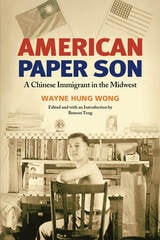
American Paper Son
A Chinese Immigrant in the MidwestWayne Hung Wong
University of Illinois Press, 2005
In the early and mid-twentieth century, Chinese migrants evaded draconian anti-immigrant laws by entering the US under false papers that identified them as the sons of people who had returned to China to marry. Wayne Hung Wong tells the story of his life after emigrating to Wichita, Kansas, as a thirteen-year-old paper son. After working in his father’s restaurant as a teen, Wong served in an all-Chinese Air Force unit stationed in China during World War II. His account traces the impact of race and segregation on his service experience and follows his postwar life from finding a wife in Taishan through his involvement in the government’s amnesty program for Chinese immigrants and career in real estate. Throughout, Wong describes the realities of life as part of a small Chinese American community in a midwestern town.
Vivid and rich with poignant insights, American Paper Son explores twentieth-century Asian American history through one person’s experiences.

Amá, Your Story Is Mine
Walking Out of the Shadows of AbuseBy Ercenia "Alice" Cedeño
University of Texas Press, 2007
In the preface to her memoir, Ercenia "Alice" Cedeño recalls the secrecy and turmoil that marked her youth: "I spent most of my growing years mad at my mother and wanting her to change to fit in with the rest of the world," she writes. "When my sisters and I wanted her to visit our friends' mothers, she would say, 'Why do people need to know other peoples' lives?' Looking back, I wonder if she was really saying, 'I don't want them to know our business.' There was so much to hide."
Now bringing those hidden memories to light, Amá, Your Story Is Mine traces the hardship, violence, deceit, and defiance that shaped the identity of two generations of women in Alice's family. Born in the mountains of northern Mexico, Alice's mother married at age 14 into a family rife with passion that often turned to anger. After losing several infant children to disease, the young couple crossed into the United States seeking a better life.
Unfolding in a series of powerful vignettes, Amá, Your Story Is Mine describes in captivating detail a daring matriarch who found herself having to protect her children from their own father while facing the challenges of cultural discrimination. By turns wry and tender, Alice's recollections offer a rare memoir that fully encompasses the Latina experience in the United States.
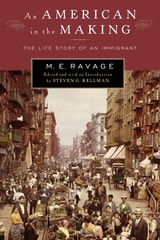
An American in the Making
The Life Story of an ImmigrantKellman, Steven G
Rutgers University Press, 2009
Steven G. Kellman brings Ravage's story to life again in this new edition, providing a brief biography and introduction that place the memoir within historical and literary contexts. An American in the Making contributes to a broader understanding of the global notion of "America" and remains timely, especially in an era when massive immigration, now from Latin America and Asia, challenges ideas of national identity.

An Amulet of Greek Earth
Generations of Immigrant Folk CultureHelen Papanikolas
Ohio University Press, 2002
The boys and men who left their Greek valley and mountain villages in the early 1900s for America came with amulets their mothers had made for them. Some were miniature sacks attached to a necklace; more often they were merely a square of fabric enclosing the values of their lives: a piece of a holy book or a sliver of the True Cross representing their belief in Greek Orthodoxy; a thyme leaf denoting their wild terrain; a blue bead to ward off the Evil Eye; and a pinch of Greek earth.
In her evocative and meticulously researched book An Amulet of Greek Earth, author Helen Papanikolas explains and examines the vibrant culture these immigrants brought with them to the new world. The Romiosini culture, as it was called, provided the foundation for their new lives and was oftentimes the cause of strife as they passed on their beliefs and traditions to successive generations of Greek Americans.
In the tradition of her fictional accounts of Greek immigrant life, Helen Papanikolas unearths the cultural beliefs and passions that compelled the Greek-American community to make its own way into the broader culture of America. Based on extensive study, personal interviews, and a lifetime of experience, An Amulet of Greek Earth is a revealing and informative chronicle of the immigrant’s experience in becoming an American.
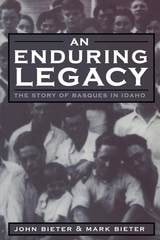
An Enduring Legacy
The Story Of Basques In IdahoMark Bieter
University of Nevada Press, 2003
In this volume, brothers Mark and John Bieter chronicle three generations of Basque presence in Idaho from 1890 to the present, resulting in an engaging story that begins with a few solitary sheepherders and follows their evolution into the prominent ethnic community of today.
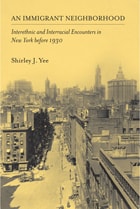
An Immigrant Neighborhood
Interethnic and Interracial Encounters in New York before 1930Shirley Yee
Temple University Press, 2011
Examining race and ethnic relations through an intersectional lens, Shirley Yee's An Immigrant Neighborhoodinvestigates the ways that race, class, and gender together shaped concepts of integration and assimilation as well as whiteness and citizenship in lower Manhattan during the late nineteenth and early twentieth-centuries.
In contrast to accounts of insulated neighborhoods and ethnic enclaves, Yee unearths the story of working class urban dwellers of various ethnic groups—Chinese, Jews, Italians, and Irish—routinely interacting in social and economic settings.
Yee's numerous, fascinating anecdotes—such as one about an Irishman who served as the only funeral director for Chinese for many years—recount the lived experiences of these neighborhoods, detailing friendships, business relationships, and sexual relationships that vividly counter the prevailing idea that different ethnic groups did not mix except in ways marked by violence and hostility.
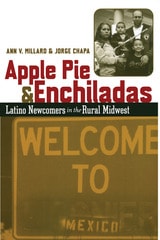
Apple Pie and Enchiladas
Latino Newcomers in the Rural MidwestBy Ann V. Millard and Jorge Chapa
University of Texas Press, 2004
The sudden influx of significant numbers of Latinos to the rural Midwest stems from the recruitment of workers by food processing plants and small factories springing up in rural areas. Mostly they work at back-breaking jobs that local residents are not willing to take because of the low wages and few benefits. The region has become the scene of dramatic change involving major issues facing our country—the intertwining of ethnic differences, prejudice, and poverty; the social impact of a low-wage workforce resulting from corporate transformations; and public policy questions dealing with economic development, taxation, and welfare payments.
In this thorough multidisciplinary study, the authors explore both sides of this ethnic divide and provide the first volume to focus comprehensively on Latinos in the region by linking demographic and qualitative analysis to describe what brings Latinos to the area and how they are being accommodated in their new communities. The fact is that many Midwestern communities would be losing population and facing a dearth of workers if not for Latino newcomers. This finding adds another layer of social and economic complexity to the region's changing place in the global economy. The authors look at how Latinos fit into an already fractured social landscape with tensions among townspeople, farmers, and others. The authors also reveal the optimism that lies in the opposition of many Anglos to ethnic prejudice and racism.
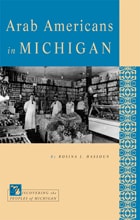
Arab Americans in Michigan
Rosina J. Hassoun
Michigan State University Press, 2003
The state of Michigan hosts one of the largest and most diverse Arab American populations in the United States. As the third largest ethnic population in the state, Arab Americans are an economically important and politically influential group. It also reflects the diversity of national origins, religions, education levels, socioeconomic levels, and degrees of acculturation. Despite their considerable presence, Arab Americans have always been a misunderstood ethnic population in Michigan, even before September 11, 2001 imposed a cloud of suspicion, fear, and uncertainty over their ethnic enclaves and the larger community. In Arab Americans in Michigan Rosina J. Hassoun outlines the origins, culture, religions, and values of a people whose influence has often exceeded their visibility in the state.

Arab-American Faces and Voices
The Origins of an Immigrant CommunityBy Elizabeth Boosahda
University of Texas Press, 2003
As Arab Americans seek to claim their communal identity and rightful place in American society at a time of heightened tension between the United States and the Middle East, an understanding look back at more than one hundred years of the Arab-American community is especially timely. In this book, Elizabeth Boosahda, a third-generation Arab American, draws on over two hundred personal interviews, as well as photographs and historical documents that are contemporaneous with the first generation of Arab Americans (Syrians, Lebanese, Palestinians), both Christians and Muslims, who immigrated to the Americas between 1880 and 1915, and their descendants.
Boosahda focuses on the Arab-American community in Worcester, Massachusetts, a major northeastern center for Arab immigration, and Worcester's links to and similarities with Arab-American communities throughout North and South America. Using the voices of Arab immigrants and their families, she explores their entire experience, from emigration at the turn of the twentieth century to the present-day lives of their descendants. This rich documentation sheds light on many aspects of Arab-American life, including the Arab entrepreneurial motivation and success, family life, education, religious and community organizations, and the role of women in initiating immigration and the economic success they achieved.
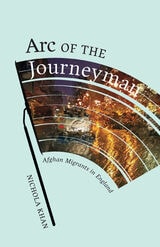
Arc of the Journeyman
Afghan Migrants in EnglandNichola Khan
University of Minnesota Press, 2021
A monumental account of one migrant community’s everyday lives, struggles, and aspirations
Forty years of continuous war and conflict have made Afghans the largest refugee group in the world. In this first full-scale ethnography of Afghan migrants in England, Nichola Khan examines the imprint of violence, displacement, kinship obligations, and mobility on the lives and work of Pashtun journeyman taxi drivers in Britain. Khan’s analysis is centered in the county of Sussex, site of Brighton’s orientalist Royal Pavilion and the former home of colonial propagandist Rudyard Kipling. Her nearly two decades of relationships and fieldwork have given Khan a deep understanding of the everyday lives of Afghan migrants, who face unrelenting pressures to remit money to their struggling relatives in Pakistan and Afghanistan, adhere to traditional values, and resettle the wives and children they have left behind.
This kaleidoscopic narrative is enriched by the migrants’ own stories and dreams, which take on extra significance among sleep-deprived taxi drivers. Khan chronicles the way these men rely on Pashto poems and aphorisms to make sense of what is strange or difficult to bear. She also attests to the pleasures of local family and friends who are less demanding than kin back home—sharing connection and moments of joy in dance, excursions, picnics, and humorous banter. Khan views these men’s lives through the lenses of movement—the arrival of friends and family, return visits to Pakistan, driving customers, even the journey to remit money overseas—and immobility, describing the migrants who experience “stuckness” caused by unresponsive bureaucracies, chronic insecurity, or struggles with depression and other mental health conditions.
Arc of the Journeyman is a deeply humane portrayal that expands and complicates current perceptions of Afghan migrants, offering a finely analyzed description of their lives and communities as a moving, contingent, and fully contemporary force.
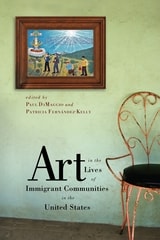
Art in the Lives of Immigrant Communities in the United States
DiMaggio, Paul
Rutgers University Press, 2010
As French as Everyone Else?
A Survey of French Citizens of Maghrebin, African, and Turkish OriginAuthored by Sylvain Brouard and Vincent Tiberj
Temple University Press, 2011
France is often depicted as the model of assimilationist or republican integration in the international literature on immigration. However, rarely have surveys drilled down to provide individual responses from a double representative sample. In As French as Everyone Else?, Sylvain Brouard and Vincent Tiberj provide a comprehensive assessment of the state of integration in France and challenge the usual crisis of integration by systematically comparing the "new French" immigrants, as well as their children and grandchildren born in France, with a sample of the French general population.
The authors' survey considers a wide range of topics, including religious affiliation and religiosity, political attitudes and political efficacy, value systems (including gender roles, work ethics, and anti-Semitism), patterns of integration, multiple identities and national belongings, and affirmative action. As the authors show, despite existing differences, immigrants of Maghrebin, African, and Turkish origin share a wide scope of commonality with other French citizens.
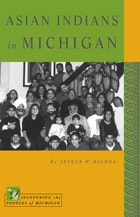
Asian Indians in Michigan
Arthur W. Helweg
Michigan State University Press, 2002
Since 1970, a growing number of Asian Indians have called Michigan home. Representative of the “new immigration,” Asian Indians come from a democratic country, are well-educated, and come from middle- and upper-class families. Unlike older immigrant groups, Asian Indians do not form urban ethnic enclaves or found their own communities to meet the challenges of living in a new society. As Arthur W. Helweg shows, Asian Indians contribute to the richness and diversity of Michigan’s culture through active participation in local institutions, while maintaining a strong ethnic identity rooted in India.
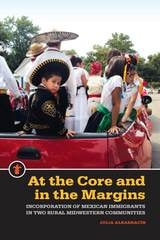
At the Core and in the Margins
Incorporation of Mexican Immigrants in Two Rural Midwestern CommunitiesJulia Albarracín
Michigan State University Press, 2016
Based on 260 surveys and 47 in-depth interviews, this study combines quantitative and qualitative research to explore the level and characteristics of immigrant incorporation in Beardstown and Monmouth. It assesses the advancement of immigrants in the immigration/ residency/citizenship process, the immigrants’ level of cultural integration (via language, their connectedness with other members of society, and their relationships with neighbors), the degree and characteristics of discrimination against immigrants in these two towns, and the extent to which immigrants participate in different social and political activities and trust government institutions.
Immigrants in new destinations are likely to be poorer, to be less educated, and to have weaker English-language skills than immigrants in traditional destinations. Studying how this population negotiates the obstacles to and opportunities for incorporation is crucial.