Results by title
5 books match the query 'Impressions'

As Others See Chicago
Impressions of Visitors, 1673-1933Bessie Louise Pierce
University of Chicago Press, 2004
First published in 1933 by the University of Chicago Press to mark the occasion of the Century of Progress Exhibition, As Others See Chicago consists of writings culled from over a thousand men and women who visited the city and commented on the best and worst it had to offer, from the skyscrapers to the stockyards. Originally compiled by Bessie Louise Pierce, the first major historian of Chicago, and featuring her own incisive commentary, the volume brings together the impressions of visitors to Chicago over two and a half centuries, from the early years of Westward Expansion to the height of the Great Depression. In addition to writings from better known personalities such as Rudyard Kipling and Waldo Frank, the book collects the opinions of missionaries, aristocrats, journalists, and politicians—observers who were perfectly placed to comment on the development of the city, its inhabitants, and well known events that would one day define Chicago history, such as the Great Fire of 1871 and the 1893 World's Fair.
Taking us back to a time when Chicago was "more astonishing than the wildest visions of the most vagrant imaginations," As Others See Chicago offers an enthralling portrait of an enduring American metropolis.
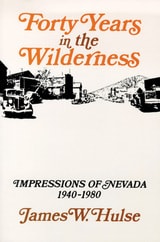
Forty Years In The Wilderness
Impressions Of Nevada, 1940-1980James W. Hulse
University of Nevada Press, 1986
A view of Nevada history by native Nevadan and historian Hulse that suggests prosperity be based on diverse businesses rather than on a gaming-financed economy.
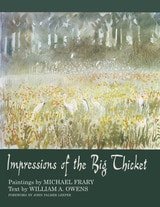
Impressions of the Big Thicket
Michael Frary
University of Texas Press, 1973
Before the establishment of the Big Thicket Nature Preserve, the Big Thicket of Texas became a symbol of nature's last stand against encroaching civilization. Here, in a mingling of ecological zones, come together plants, animals, and birds—many of them rare—the flora and fauna of north and south, east and west. Northern maples and beeches stand not too great a distance from cypresses and Southern magnolias. American hollies grow large and orchids bloom among Northern ferns. Mesquite and tumbleweed, plants of the Western desert, survive where the annual rainfall averages sixty inches. On a major flyway, the Big Thicket is a stopping place for many birds in passage as well as home to a wide variety. Beavers build their dams there, and an occasional coyote yips in the night.
Because of its great beauty and rich natural resources, use of the Big Thicket was the object of a forty-year struggle involving financiers, politicians, conservationists, and countless Thicket lovers. Each group viewed the Thicket from a different perspective and foresaw its future in different terms.
This book records the impressions of two Thicket lovers. Michael Frary's paintings and drawings of woods and water, of birds in flight and strange plants growing close to the moist earth are pictures of a place, a time, a mood caught today—and not the same if left until tomorrow. The qualities of gentleness and violence are constant, but often hidden—there to be brought out by human need or human greed.
William Owens writes of the people who have lived their lives in the Big Thicket, who have stirred its stillness with whoop and holler across the waters, who have taken in its stillness and explosive beauty until they themselves are made up of gentleness and violence.
Together the impressions show what the Big Thicket was and is. What it will be—that is the chief concern of the book.
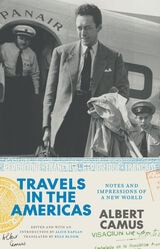
Travels in the Americas
Notes and Impressions of a New WorldAlbert Camus
University of Chicago Press, 2023
In March 1946, the young Albert Camus crossed from Le Havre to New York. Though he was virtually unknown to American audiences at the time, all that was about to change—The Stranger, his first book translated into English, would soon make him a literary star. By 1949, when he set out on a tour of South America, Camus was an international celebrity. Camus’s journals offer an intimate glimpse into his daily life during these eventful years and showcase his thinking at its most personal—a form of observational writing that the French call choses vues (things seen).
Camus’s journals from these travels record his impressions, frustrations, joys, and longings. Here are his unguarded first impressions of his surroundings and his encounters with publishers, critics, and members of the New York intelligentsia. Long unavailable in English, the journals have now been expertly retranslated by Ryan Bloom, with a new introduction by Alice Kaplan. Bloom’s translation captures the informal, sketch-like quality of Camus’s observations—by turns ironic, bitter, cutting, and melancholy—and the quick notes he must have taken after exhausting days of travel and lecturing. Bloom and Kaplan’s notes and annotations allow readers to walk beside the existentialist thinker as he experiences changes in his own life and the world around him, all in his inimitable style.

Visits with the Amish
Impressions of the Plain LifeLinda Egenes
University of Iowa Press, 2000
Who are the “plain people,” the men and women who till their fields with horse and plow, travel by horse and buggy, live without electricity and telephones, and practice “help thy neighbor” in daily life? Linda Egenes visited with her Old Order Amish neighbors in southeast Iowa for thirteen years before writing this informative and companionable introduction to their lifeways.
Drawn to their slower pace of life and their resistance to the lures of a consumer society, Egenes found a warm welcome among the Amish, and in return she has given us an equally warm perspective on Amish family life as she experienced it. The Amish value harmony in family life above all, and Egenes found an abundance of harmony as she savored homemade ice cream in a kitchen where the refrigerator ran on kerosene, learned to milk a two-bucket cow, helped cook dinner for nine in a summer kitchen, spent the day in a one-room schoolhouse, and sang “The Hymn of Praise” in its original German at Sunday service.
Whether quilting at a weekly sewing circle above the Stringtown Grocery, playing Dutch Blitz and Dare Base with schoolchildren, learning the intricacies of harness making, or mulching strawberries in a huge garden, Egenes was treated with the kindness, respect, and dignity that exemplify the strong community ties of the Amish. Her engaging account of her visits with the Amish, beautifully illustrated with woodcuts by Caldecott Medal winner Mary Azarian, reveals the serene and peaceful ways of a plain people whose lives are anything but plain.