Results by title
33 books match the query 'In mass media'

African Intellectuals and Decolonization
Nicholas M. Creary
Ohio University Press, 2012
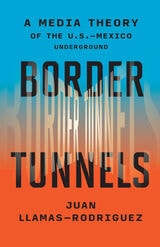
Border Tunnels
A Media Theory of the U.S.-Mexico UndergroundJuan Llamas-Rodriguez
University of Minnesota Press, 2023
A comparative media analysis of the representation of the U.S.–Mexico border
Border tunnels at the U.S.–Mexico border are ubiquitous in news, movies, and television, yet, because they remain hidden and inaccessible, the public can encounter them only through media. Analyzing the technologies, institutional politics, narrative tropes, and aesthetic decisions that go into showing border tunnels across multiple forms of media, Juan Llamas-Rodriguez argues that we cannot properly address border issues without attending to—and fully understanding—the fraught relationship between their representation and reality.
Llamas-Rodriguez reveals that every media text about border tunnels, whether meant for entertainment, cable news, video games, or speculative design, implicitly takes a position on the politics of the border. The examples laid out in Border Tunnels will teach readers how to look differently at the border as it is commonly presented in various forms of media, from ABC’s Nightline and CNN’s Anderson Cooper 360º to reality TV, propaganda videos, and even digital effects in Hollywood action films. Llamas-Rodriguez examines how creative decisions in the production, promotion, and distribution of these media texts either emphasize or downplay issues such as border security, racial dynamics of migration, and sustainability of the borderlands.
Focusing on tunnels to show how media representations can influence all kinds of audiences—even those physically near the border—Border Tunnels helps us make sense of this pressing social issue, ultimately advancing understanding of the U.S.–Mexico border in all of its complexity and precariousness.
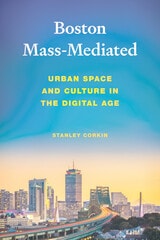
Boston Mass-Mediated
Urban Space and Culture in the Digital AgeStanley Corkin
University of Massachusetts Press, 2024
In the mid-nineteenth century, Boston fashioned itself as a global hub. By the early 1970s, it was barely a dot on the national picture. It had gained a reputation as a decaying city rife with crime and dysfunctional politics, as well as decidedly retrograde race relations, prominently exemplified by white resistance to school integration. Despite this historical ebb in its national and international presence, it still possessed the infrastructure—superb educational institutions such as Harvard and MIT, world-class sports teams like the Celtics and Red Sox, powerful media outlets like The Boston Globe, and extensive shipping capacity—required to eventually thrive in an age of global trade and mass communication.
In Boston Mass-Mediated, Stanley Corkin explores the power of mass media to define a place. He examines the tensions between the emergent and prosperous city of the late twentieth and early twenty-first centuries and its representation in a range of media genres such as news journalism, professional sports broadcasting, and popular films like Mystic River and The Departed. This mass media, with its ever-increasing digital reach, has emphasized a city restricted by tropes suggestive of an earlier Boston—racism, white ethnic crime, Catholicism, and a pre-modern insularity—even as it becomes increasingly international and multicultural. These tropes mediate our understanding and experience of the city. Using Boston as a case study, Corkin contends that our contemporary sense of place occurs through a media saturated world, a world created by the explosion of digital technology that is steeped in preconceptions.
Branding Brazil
Transforming Citizenship on ScreenLeslie L. Marsh
Rutgers University Press, 2021
Caesar
A Life in Western CultureMaria Wyke
University of Chicago Press, 2008
Caribes 2.0
New Media, Globalization, and the Afterlives of DisasterJossianna Arroyo
Rutgers University Press, 2023
Changing Minds or Changing Channels?
Partisan News in an Age of ChoiceKevin Arceneaux and Martin Johnson
University of Chicago Press, 2013
Diana and Beyond
White Femininity, National Identity, and Contemporary Media CultureRaka Shome
University of Illinois Press, 2014
Raka Shome investigates the factors that led to this defining cultural/political moment and unravels just what the Diana phenomenon represented for comprehending the relation between white femininity and the nation in postcolonial Britain and its connection to other white female celebrity figures in the millennium. Digging into the media and cultural artifacts that circulated in the wake of Diana's death, Shome investigates a range of theoretical issues surrounding motherhood and the production of national masculinities, global humanitarianism, transnational masculinities, the intersection of fashion and white femininity, and spirituality and national modernity. Her analysis explores how images of white femininity in popular culture intersect with issues of race, gender, class, sexuality, and transnationality in the performance of Anglo national modernities.
Moving from ideas on the positioning of privileged white women in global neoliberalism to the emergence of new formations of white femininity in the millennium , Diana and Beyond fearlessly explains the late princess's never-ending renaissance and ongoing cultural relevance.

Don't Mention the War
Northern Ireland, Propaganda and the MediaDavid Miller
Pluto Press, 1994
Evita, Inevitably
Performing Argentina's Female Icons Before and After Eva PerónJean Graham-Jones
University of Michigan Press, 2014
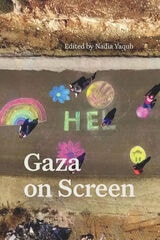
Gaza on Screen
Nadia Yaqub, editor
Duke University Press, 2023
Contributors. Nayrouz Abu Hatoum, Shahd Abusalama, Samirah Alkassim, Basma Alsharif, Hadeel Assali, Azza El-Hassan, Hatim El-Hibri, Mohamed Jabaly, Ahmed Mansour, Arab Nasser, Tarzan Nasser, Kamran Rastegar, Viviane Saglier, Abdelsalam Shehada, Yaron Shemer, Rebecca L. Stein, Helga Tawil-Souri, Shaira Vadasaria, Nadia Yaqub
Imagining Wild Bill
James Butler Hickok in War, Media, and MemoryPaul Ashdown and Edward Caudill
Southern Illinois University Press, 2020
When it came to the Wild West, the nineteenth-century press rarely let truth get in the way of a good story. James Butler “Wild Bill” Hickok’s story was no exception. Mythologized and sensationalized, Hickok was turned into the deadliest gunfighter of all, a so-called moral killer, a national phenomenon even while he was alive.
Rather than attempt to tease truth from fiction, coauthors Paul Ashdown and Edward Caudill investigate the ways in which Hickok embodied the culture of glamorized violence Americans embraced after the Civil War and examine the process of how his story emerged, evolved, and turned into a viral multimedia sensation full of the excitement, danger, and romance of the West.
Journalists, the coauthors demonstrate, invented “Wild Bill” Hickok, glorifying him as a civilizer. They inflated his body count and constructed his legend in the midst of an emerging celebrity culture that grew up around penny newspapers. His death by treachery, at a relatively young age, made the story tragic, and dime-store novelists took over where the press left off. Reimagined as entertainment, Hickok’s legend continued to enthrall Americans in literature, on radio, on television, and in the movies, and it still draws tourists to notorious Deadwood, South Dakota.
American culture often embraces myths that later become accepted as popular history. By investigating the allure and power of Hickok’s myth, Ashdown and Caudill explain how American journalism and popular culture have shaped the way Civil War–era figures are remembered and reveal how Americans have embraced violence as entertainment.
Informing a Nation
The Newspaper Presidency of Thomas JeffersonMel Laracey
University of Michigan Press, 2021
James Dean Transfigured
The Many Faces of Rebel IconographyBy Claudia Springer
University of Texas Press, 2007
After the death of James Dean in 1955, the figure of the teen rebel permeated the globe, and its presence is still felt in the twenty-first century. Rebel iconography—which does not have to resemble James Dean himself, but merely incorporates his disaffected attitude—has become an advertising mainstay used to sell an array of merchandise and messages. Despite being overused in advertisements, it still has the power to surprise when used by authors and filmmakers in innovative and provocative ways.
The rebel figure has mass appeal precisely because of its ambiguities; it can mean anything to anyone. The global appropriation of rebel iconography has invested it with fresh meanings. Author Claudia Springer succeeds here in analyzing both ends of the spectrum—the rebel icon as a tool in upholding capitalism's cycle of consumption, and as a challenge to that cycle and its accompanying beliefs.
In this groundbreaking study of rebel iconography in international popular culture, Springer studies a variety of texts from the United States and abroad that use this imagery in contrasting and thought-provoking ways. Using a cultural studies approach, she analyzes films, fiction, poems, Web sites, and advertisements to determine the extent to which the icon's adaptations have been effective as a response to the actual social problems affecting contemporary adolescents around the world.
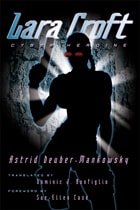
Lara Croft
Cyber HeroineAstrid Deuber-Mankowsky
University of Minnesota Press, 2005
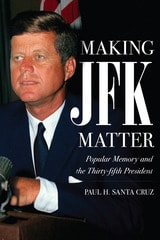
Making JFK Matter
Popular Memory and the Thirty-fifth PresidentPaul H. Santa Cruz
University of North Texas Press, 2015
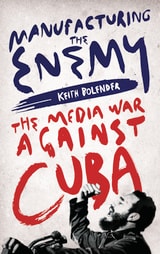
Manufacturing the Enemy
The Media War Against CubaKeith Bolender
Pluto Press, 2019
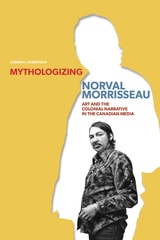
Mythologizing Norval Morrisseau
Art and the Colonial Narrative in the Canadian MediaCarmen L. Robertson
University of Manitoba Press, 2016
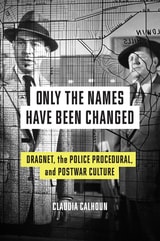
Only the Names Have Been Changed
Dragnet, the Police Procedural, and Postwar CultureClaudia Calhoun
University of Texas Press, 2022
Winner of the 2022 Peter C. Rollins Book Prize, Northeast Popular Culture Association (NEPCA)
In the postwar era, the police procedural series Dragnet informed Americans on the workings of the criminal justice system and instructed them in their responsibilities as citizens.
Among shifting politics, tastes, and technology in television history, one genre has been remarkably persistent: the cop show. Claudia Calhoun returns to Dragnet, the pioneering police procedural and an early transmedia franchise, appearing on radio in 1949, on TV and in film in the 1950s, and in later revivals. More than a popular entertainment, Dragnet was a signifier of America’s postwar confidence in government institutions—and a publicity vehicle for the Los Angeles Police Department.
Only the Names Have Been Changed shows how Dragnet’s “realistic” storytelling resonated across postwar culture. Calhoun traces Dragnet’s “semi-documentary” predecessors, and shows how Jack Webb, Dragnet’s creator, worked directly with the LAPD as he produced a series that would likewise inspire public trust by presenting day-to-day procedural justice, rather than shootouts and wild capers. Yet this realism also set aside the seething racial tensions of Los Angeles as it was. Dragnet emerges as a foundational text, one that taught audiences to see police as everyday heroes not only on TV but also in daily life, a lesson that has come under scrutiny as Americans increasingly seek to redefine the relationship between policing and public safety.
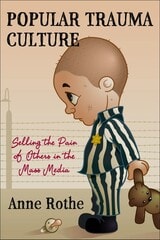
Popular Trauma Culture
Selling the Pain of Others in the Mass MediaRothe, Anne
Rutgers University Press, 2011
In Popular Trauma Culture, Anne Rothe argues that American Holocaust discourse has a particular plot structure—characterized by a melodramatic conflict between good and evil and embodied in the core characters of victim/survivor and perpetrator—and that it provides the paradigm for representing personal experiences of pain and suffering in the mass media. The book begins with an analysis of Holocaust clichés, including its political appropriation, the notion of vicarious victimhood, the so-called victim talk rhetoric, and the infusion of the composite survivor figure with Social Darwinism. Readers then explore the embodiment of popular trauma culture in two core mass media genres: daytime TV talk shows and misery memoirs.
Rothe conveys how victimhood and suffering are cast as trauma kitsch on talk shows like Oprah and as trauma camp on modern-day freak shows like Springer. The discussion also encompasses the first scholarly analysis of misery memoirs, the popular literary genre that has been widely critiqued in journalism as pornographic depictions of extreme violence. Currently considered the largest growth sector in book publishing worldwide, many of these works are also fabricated. And since forgeries reflect the cultural entities that are most revered, the book concludes with an examination of fake misery memoirs.
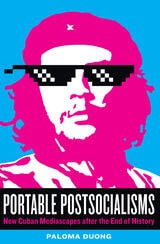
Portable Postsocialisms
New Cuban Mediascapes after the End of HistoryPaloma Duong
University of Texas Press, 2024
2025 Honorable Mention, Bryce Wood Book Award, Latin American Studies Association
A study of Cuban culture and media in the twenty-first century as both a global phenomenon and a local reality, at a time when the declared death of socialism coexists in tension with emerging anticapitalist movements worldwide.
Why does Cuban socialism endure as an object of international political desire, while images of capitalist markets consume Cuba’s national imagination? This bold new study argues that Cuba’s changing media cultures are key to our understanding of the global postsocialist condition and its competing political imaginaries.
Portable Postsocialisms calls on a vast multimedia archive to offer a groundbreaking cultural interpretation of Cuban postsocialism. Paloma Duong examines songs, artworks, advertisements, memes, literature, jokes, and networks that refuse exceptionalist and exoticizing visions of Cuba. Expanding postsocialist critical theory to read this complex mediascape, Duong argues that a materialist critique of Cuba’s revolutionary legacy must account for Cubans’ everyday demands for agency and self-representation. This long overdue reassessment of Cuba’s place in Latin American and post-Marxist studies shows Cuban postsocialism to be an urgent and indispensable referent for core debates on the politics of participatory cultures in new media studies. Portable Postsocialisms performs the crucial task of redefining how we envision imaginaries of social change in Latin America and the Caribbean.
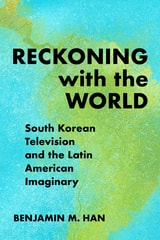
Reckoning with the World
South Korean Television and the Latin American ImaginaryBenjamin M. Han
Temple University Press, 2026
Historical dramas like The Land of Humans, about Korean migrants in Mexico, consider diasporic identity and nationalism, while the fantasy series Secret Garden explores issues of modernity. In addition, the TV drama Encounter and the entertainment show Traveler contrast the cultures of global Korea with Cuba. As these programs create appealing storytelling, characters, and aesthetics, they inspire and resonate with audiences and fans across the globe. However, Korean television’s imaginary of Latin America is not about its investment in fostering greater interculturality with Latin American nations and their cultures but instead projects a façade of progressive racial and cultural politics shaping Korea’s reckoning with the world.
Reflections in a Bloodshot Lens
America, Islam and the War of IdeasLawrence Pintak
Pluto Press, 2006
There exists today a tragic rift between Americans and the world’s Muslims. Yet in the immediate aftermath of 9/11, there was widespread sympathy for the U.S. throughout the Muslim world. This book explores what happened. It examines the disconnect that leads Americans and Muslims to view the same words and images in fundamentally different ways. Partly a result of a centuries-old 'us' against 'them' dichotomy, the problem is exacerbated by an increasingly polarised media and by leaders on both sides who either don't understand or don't care what impact their words and policies have in the world at large.
Journalist-scholar Lawrence Pintak, a former CBS News Middle East correspondent, argues that the Arab media revolution and the rise of 'patriot-journalists' in the US marginalized voices of moderation, distorting perceptions on both sides of the divide with potentially disastrous results.
Built on the author's extensive journalistic experience, the book will appeal to policymakers, students of media studies, Middle East studies and Islamic studies, and general current affairs readers.
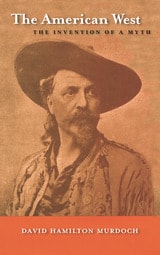
The American West
The Invention Of A MythDavid Hamilton Murdoch
University of Nevada Press, 2001
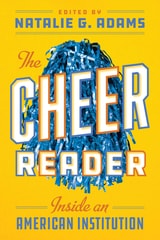
The Cheer Reader
Inside an American InstitutionNatalie G. Adams
University of Texas Press, 2026
Wide-ranging essays on cheerleading, from the pep rally to the NFL sidelines to All-Star competitions, and why it matters.
Cheer is deeply associated with a wholesome, simple Americana. Yet this often clichéd image belies its complex history and current status as a global industry made up of diverse participants and forms. Indeed, cheerleading—its culture, controversies, and evolution—has always offered a revealing lens on race, class, gender, and sexuality in American society..
Cheerleading was born in 1869 as a diversion for Ivy League men. The Cheer Reader collects fourteen wide-ranging essays on what happened next and why it matters: how cheer became feminized, sexualized, professionalized, even radicalized. Contributors examine the role of cheer in the Civil Rights Movement, a landmark student free-speech case, and the emergence of competitive-only and queer cheer teams. Other essays consider cheer’s quest for sport legitimacy, social media “cheerlebrities” and eating disorders, and the working conditions of NFL and NBA cheerleaders. Amid these tensions between empowerment and objectification, cheer is only getting more popular, with some seven million participants worldwide. The Cheer Reader is a nuanced account of the activity they share and what it means today.

The Racial Imaginary of the Cold War Kitchen
From Sokol’niki Park to Chicago’s South SideKate A. Baldwin
Dartmouth College Press, 2016
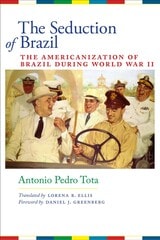
The Seduction of Brazil
The Americanization of Brazil during World War IIBy Antonio Pedro Tota
University of Texas Press, 2009
Following completion of the U.S. air base in Natal, Brazil, in 1942, U.S. airmen departing for North Africa during World War II communicated with Brazilian mechanics with a thumbs-up before starting their engines. This sign soon replaced the Brazilian tradition of touching the earlobe to indicate agreement, friendship, and all that was positive and good—yet another indication of the Americanization of Brazil under way during this period.
In this translation of O Imperialismo Sedutor, Antonio Pedro Tota considers both the Good Neighbor Policy and broader cultural influences to argue against simplistic theories of U.S. cultural imperialism and exploitation. He shows that Brazilians actively interpreted, negotiated, and reconfigured U.S. culture in a process of cultural recombination. The market, he argues, was far more important in determining the nature of this cultural exchange than state-directed propaganda efforts because Brazil already was primed to adopt and disseminate American culture within the framework of its own rapidly expanding market for mass culture. By examining the motives and strategies behind rising U.S. influence and its relationship to a simultaneous process of cultural and political centralization in Brazil, Tota shows that these processes were not contradictory, but rather mutually reinforcing.
The Seduction of Brazil brings greater sophistication to both Brazilian and American understanding of the forces at play during this period, and should appeal to historians as well as students of Latin America, culture, and communications.
The Six-Gun Mystique Sequel
John G. Cawelti
University of Wisconsin Press, 1999
In this expanded version, Cawelti revises his analysis of the structural characteristics of the Western novel and film, synthesizing much of the rich discussion of the Western genre that has appeared since The Six-Gun Mystique's original publication. To this structural analysis he adds a new account of the genre's history and its relationship to the myths of the West that have played such an influential role in American history. The Six-Gun Mystique Sequel concludes with an exploration of the continuing influence of Western themes and symbols on many aspects of postmodern American culture, and an assessment of the critical tradition that has developed around the Western genre. The appendices of the book are also revised and expanded to include useful lists of the most important Western novels and films, as well as the best critical and historical studies of different aspects of the genre.
Visions of Beirut
The Urban Life of Media InfrastructureHatim El-Hibri
Duke University Press, 2021

Visual Encounters in the Study of Rural Childhoods
Mandrona, April R.
Rutgers University Press, 2018
Visual Occupations
Violence and Visibility in a Conflict ZoneGil Z. Hochberg
Duke University Press, 2015
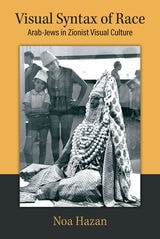
Visual Syntax of Race
Arab-Jews in Zionist Visual CultureNoa Hazan
University of Michigan Press, 2022
Analyzing the visual syntax and display rhetoric applied in newspaper photos, national historical albums, and museum exhibitions, Noa Hazan shows that although racial thought was and still is verbally suppressed in Israel, it is vividly present in its nonverbal official and public visual sphere. The racist perspective of newspaper editors, book publishers, photographers, and museum curators were morally justified in its time by such patronizing ideals as realistic news coverage or the salvation of Jewish heritage assets. Although their perspectives played a dominant role in establishing a visual syntax of race in Israel, they were not seen as racially discriminating at the time. The racist motifs and actions are revealed here by colligating multiple cases into a coherent narrative in retrospect.
This book points to a direct influence of the anti-Semitic discourse in Europe toward Mizrahim in Israel, highlighting the shared visual stereotypes used in both Europe and the fledgling state of Israel. Engraved in their body, these cultural traits were depicted and understood as racial-biological qualities and were visually manipulated to silo Ashkenazim and Mizrahim in Israel as distinct racial types.

Wanted Dead or Alive
THE AMERICAN WEST IN POPULAR CULTUREEdited by Richard Aquila
University of Illinois Press, 1996
Wanted Dead or Alive presents the first-ever comprehensive look at how the American West has been depicted in popular culture. Following Richard Aquila's introduction, which examines the birth and growth of the pop culture West in the context of American history, noted experts explore developments in popular Western fiction, major forms of live Western entertainment, trends in Western movies and television shows, images of the West in popular music, and visual images of the West in popular art and advertising. For the reader on the trail of even more information, each section of the book concludes with suggestions for further reading.