Results by title
18 books match the query 'In-service training'
Advocacy and Awareness for Archivists
Kathleen D. Roe
Society of American Archivists, 2019
COMPUGIRLS
How Girls of Color Find and Define Themselves in the Digital AgeKimberly A. Scott
University of Illinois Press, 2021
Kimberly A. Scott explores this question and others as she details the National Science Foundation-funded enrichment project COMPUGIRLS. This groundbreaking initiative teaches tech skills to adolescent girls of color but, as importantly, offers a setting that emphasizes empowerment, community advancement, and self-discovery. Scott draws on her experience as an architect of COMPUGIRLS to detail the difficulties of translating participants' lives into a digital context while tracing how the program evolved. The dramatic stories of the participants show them blending newly developed technical and communication skills in ways designed to spark effective action and bring about important change.
A compelling merger of theory and storytelling, COMPUGIRLS provides a much-needed roadmap for understanding how girls of color can find and define their selves in today's digital age.

Competency-Based Career Planning for Reference and User Services Professionals
Jo Bell Whitlatch
American Library Association, 2020
Reference and user services librarians need to be in charge of their own careers. And when it comes to their own professional development, that means being proactive. This resource will enable professionals at every stage of their careers to honestly assess their skills and knowledge. Utilizing the RUSA (Reference and User Services Association) Professional Competencies as a framework for reflecting on strengths as well as gaps in expertise, it guides readers through developing strategies to enhance their professional standing and potential, thereby leading to a more satisfying career. In this book former RUSA president Whitlatch, who chaired the initial committee establishing the Competencies, teams up with expert trainer Woodard to
- introduce the seven categories of the RUSA Professional Competencies, explaining the ways in which each is important to both practitioner and institution;
- demonstrate how to create a personal development plan that focuses on development priorities;
- discuss the Association for Talent Development (ATD) Competency Development Model and other action plans;
- offer guidance for setting goals and measuring progress;
- share information on a variety of development activities that readers can undertake to maintain and enhance professional competencies, including formal training opportunities, on-the-job experiences, and self-directed initiatives; and
- provide recommended self-evaluation techniques such as writing up notes from group discussions, exercises, short verbal and written reports, crafting presentations on a topic, and sharing concrete examples of how skills were applied in the workplace.
Core Tech Competencies for Librarians and Library Staff
American Library Association, 2009
Creating Leaders An Examinati On Of Academic And Research Li
Irene Herold
American Library Association, 2015

Creating Leaders
An Examination of Academic and Research Library Leadership InstitutesIrene M. H. Herold
Assoc of College & Research Libraries, 2015
Developing Faculty in Liberal Arts Colleges
Aligning Individual Needs and Organizational GoalsBaker, Vicki L.
Rutgers University Press, 2017
Drawing on research conducted at the thirteen institutions of the Great Lakes Colleges Association, Vicki L. Baker, Laura Gail Lunsford, and Meghan J. Pifer propose a compelling Alignment Framework for Faculty Development in Liberal Arts Colleges to show how these colleges succeed—or sometimes fail—in providing their faculties with the right support to be successful.

Handbook for In-Service Training in Human Services
William Crimando
Southern Illinois University Press, 1988
A practical "how-to" workbook that outlines a plan for the design and implementation of staff in-service training programs for human service agencies and facilities.
Crimando and Riggar have made every effort to guarantee the usefulness of this text to practitioners, instructors, and students. This is a working book designed to assist trainers as they acquire the knowledge and skills needed to provide thorough, systematic in-service training that will enhance human service endeavors.
The authors have organized the nineteen chapters into four parts that treat significant steps in the training-program design process. These include analyzing problems that require training solutions; developing a proposal; writing a plan of action for training; and evaluating a program. Each of the chapters combines text, examples, exercises, and supplementary readings to foster a full appreciation of the process involved. Even those topics frequently overlooked or disregarded are included: budgeting program time and financial resources, obtaining administrative commitment, and transferring and maintaining skills in the work setting.

Schooling, Democracy, and the Quest for Wisdom
Partnerships and the Moral Dimensions of TeachingRobert V. Bullough Jr. and John R. Rosenberg
Rutgers University Press, 2018
In response to growing concern in the 1980s about the quality of public education across the United States, a tremendous amount of energy was expended by organizations such as the Holmes Group and the Carnegie Forum to organize professional development schools (PDS) or “partner schools” for teacher education. On the surface, the concept of partnering is simple; however, the practice is very costly, complex, and difficult. In Schooling, Democracy, and the Quest for Wisdom, Robert V. Bullough, Jr. and John R. Rosenberg examine the concept of partnering through various lenses and they address what they think are the major issues that need to be, but rarely are, discussed by thousands of educators in the U.S. who are involved and invested in university-public school partnerships. Ultimately, they assert that the conversation around partnering needs re-centering (most especially on the purposes of public education), refreshing, and re-theorizing.
Staff Development Strategies That Work!
Stories and Strategies from New LibrariansAmerican Library Association, 2009
Staff Development on a Shoestring
A How-To-Do-It Manual for LibrariansAmerican Library Association, 2011
Staff Development
A Practical GuideCarol Zsulya
American Library Association, 2013
Teaching With Student Texts
Essays Toward an Informed PracticeJoseph Harris
Utah State University Press, 2010
Harris, Miles and Paine ask: What happens when the texts that students write become the focus of a writing course? In response, a distinguished group of scholar/teachers suggests that teaching with students texts is not simply a classroom technique, but a way of working with writing that defines composition as a field.
In Teaching with Student Texts, authors discuss ways of revaluing student writing as intellectual work, of circulating student texts in the classroom and beyond, and of changing our classroom practices by bringing student writings to the table. Together, these essays articulate a variety of ways that student texts can take a central place in classroom work and can, in the process, redefine the ways our field talks about writing.
Technology Training in Libraries
American Library Association, 2010
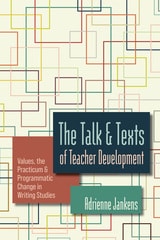
The Talk and Texts of Teacher Development
Values, the Practicum, and Programmatic Change in Writing StudiesAdrienne Jankens
Utah State University Press, 2026
Through her multi-site analysis, Jankens examines the ways values are reflected in syllabi, committee meetings, and classroom practices. She demonstrates how values that are often unstated or assumed can be made explicit and linked to programmatic action, thus supporting development and aligning instructional goals with broader institutional objectives. Offering a nuanced framework on practicum courses, Jankens also highlights the importance of local contexts and distinguishes among tacit, implicit, explicit, emergent, and articulated values. This layered understanding helps reveal the often hidden mechanisms by which writing program values are enacted in day-to-day teaching practices.
Teacher development is a crucial site for enacting and understanding programmatic values, and making these values explicit can guide meaningful programmatic change. Providing an institutional ethnography of Jankens’s own writing program and situating those findings within broader conversations in writing studies, The Talk and Texts of Teacher Development adds to scholarship exploring the focus of the practicum course, the positionality and experience of graduate teaching assistants in writing programs, and the perennial work of the field to identify its core values and disciplinary identity.
The Top Technologies Every Librarian Needs to Know
Kenneth J. Varnum
American Library Association, 2014
Virtual Reference Training
The Complete Guide to Providing Anytime, Anywhere AnswersAmerican Library Association, 2004
Workplace Learning and Leadership
Paul Signorelli
American Library Association, 2011
The best kind of learning is that which never ends—and a culture of training means that staff will be more flexible and responsive to new ideas and strategies, imperative in today's libraries. In this practical resource, leading workplace trainers Reed and Signorelli offer guidance on improving the effectiveness of training programs. Their book takes readers through the entire process of developing, implementing, and sustaining training programs and communities of learning, in order to
- Empower individuals to become leaders and teachers by cultivating a culture of ongoing learning
- Connect library staff and users to information resources so they can effectively use them to their benefit
- Develop skills among both managers and workers for practicing continuous formal and informal training