Results by title
8 books match the query 'Indigenous Food of the Americas'
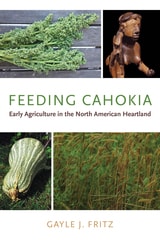
Feeding Cahokia
Early Agriculture in the North American HeartlandGayle J. Fritz
University of Alabama Press, 2019
WINNER OF THE 2020 SOCIETY FOR ECONOMIC BOTANY'S MARY W. KLINGER BOOK AWARD
An authoritative and thoroughly accessible overview of farming and food practices at Cahokia
Agriculture is rightly emphasized as the center of the economy in most studies of Cahokian society, but the focus is often predominantly on corn. This farming economy is typically framed in terms of ruling elites living in mound centers who demanded tribute and a mass surplus to be hoarded or distributed as they saw fit. Farmers are cast as commoners who grew enough surplus corn to provide for the elites.
Feeding Cahokia: Early Agriculture in the North American Heartland presents evidence to demonstrate that the emphasis on corn has created a distorted picture of Cahokia’s agricultural practices. Farming at Cahokia was biologically diverse and, as such, less prone to risk than was maize-dominated agriculture. Gayle J. Fritz shows that the division between the so-called elites and commoners simplifies and misrepresents the statuses of farmers—a workforce consisting of adult women and their daughters who belonged to kin groups crosscutting all levels of the Cahokian social order. Many farmers had considerable influence and decision-making authority, and they were valued for their economic contributions, their skills, and their expertise in all matters relating to soils and crops. Fritz examines the possible roles played by farmers in the processes of producing and preparing food and in maintaining cosmological balance.
This highly accessible narrative by an internationally known paleoethnobotanist highlights the biologically diverse agricultural system by focusing on plants, such as erect knotweed, chenopod, and maygrass, which were domesticated in the midcontinent and grown by generations of farmers before Cahokia Mounds grew to be the largest Native American population center north of Mexico. Fritz also looks at traditional farming systems to apply strategies that would be helpful to modern agriculture, including reviving wild and weedy descendants of these lost crops for redomestication. With a wealth of detail on specific sites, traditional foods, artifacts such as famous figurines, and color photos of significant plants, Feeding Cahokia will satisfy both scholars and interested readers.

Globalizing Chocolate and Tobacco
Medical Exchange in the Early Modern WorldSusan G. Polansky
Bucknell University Press, 2026
This groundbreaking volume explores two early and opposing Spanish medical perspectives on chocolate and other New World substances. In the early 1600s, doctors Bartolomé Marradón and Antonio Colmenero de Ledesma returned from travels to the Americas with starkly different views: Marradón cautioned against tobacco and offered only limited approval of chocolate, while Colmenero vigorously defended chocolate’s health benefits. Their writings, translated and circulated across Europe, helped transform chocolate from a medicinal drink into a global commodity. Featuring the first bilingual edition of Marradón’s Dialogue (1618)—in full Spanish and English—and a new bilingual presentation of Colmenero’s influential Curious Treatise (1631), this book provides rare insight into early modern medical thought, cultural exchange, and the globalization of taste. Essential for readers of food history, early modern medicine, and transatlantic interchange, it uniquely reveals how debates over health, culture, and commerce brewed in a cup of chocolate.
Published by Bucknell University Press. Distributed worldwide by Rutgers University Press.
Good Seeds
A Menominee Indian Food MemoirThomas Pecore Weso
Wisconsin Historical Society Press, 2027
To the Menominee people, the "good seeds” of life are the manomin, or wild rice, that also gives the tribe its name. In this unique food memoir, Tribal member Thomas Pecore Weso takes readers on a cook’s journey through Wisconsin’s North Woods tribal lands, connecting Menominee food—beaver, trout, blackberry, wild rice, maple sugar, partridge—to the colorful individuals who taught him Indigenous values and traditions. Featuring more than forty recipes, Good Seeds keeps those traditions alive for future generations.
With a rare perspective as a Native American anthropologist and artist, Weso mixes a poignant personal story with the seeds of Menominee cooking traditions. He tells of the foods and the people who helped shape the person he became. His grandfather Moon was a medicine man, whose morning prayers formed the foundation for all the day’s meals. His grandmother Jennie “made fire” each morning in a wood-burning stove and oversaw huge breakfasts of wild game, fish, and fruit pies. His uncles taught him to hunt bear, deer, squirrels, raccoons, and skunks for the daily larder. Along with authentic family recipes, Weso recalls favorite foods served at the Menominee fair and at local diners.
In Good Seeds, adventurous cooks will gain insight and inspiration from Weso’s recipes, and readers of all stripes will appreciate the often-humorous stories about reservation life during the mid-twentieth century.
Hopi Cookery
Juanita Tiger Kavena
University of Arizona Press, 1980

Our Precious Corn
YukwanénsteRebecca M. Webster
Michigan State University Press, 2023
Survival Food
North Woods Stories by a Menominee CookThomas Pecore Weso
Wisconsin Historical Society Press, 2023
In these coming-of-age tales set on the Menominee Indian Reservation of the 1980s and 1990s, Thomas Pecore Weso explores the interrelated nature of meals and memories. As he puts it, “I cannot separate foods from the moments in my life when I first tasted them.” Weso’s stories recall the foods that influenced his youth in northern Wisconsin: subsistence meals from hunted, fished, and gathered sources; the culinary traditions of the German, Polish, and Swedish settler descendants in the area; and the commodity foods distributed by the government—like canned pork, dried beans, and powdered eggs—that made up the bulk of his family’s pantry. His mom called this “survival food.”
These stories from the author’s teen and tween years—some serious, some laugh-out-loud funny—will take readers from Catholic schoolyards to Native foot trails to North Woods bowling alleys, while providing Weso’s perspective on the political currents of the era. The book also contains dozens of recipes, from turtle soup and gray squirrel stew to twice-baked cheesy potatoes. This follow-up to Weso’s Good Seeds: A Menominee Indian Food Memoir is a hybrid of modern foodways, Indigenous history, and creative nonfiction from a singular storyteller.
2024 Wisconsin Library Association Outstanding Achievement Award
2024 PEN Oakland Josephine Miles Award for Excellence
Silver winner of the 2023 Midwest Book Award for Cookbooks/Crafts/Hobbies
Thomas Pecore Weso’s Survival Food was selected by the Wisconsin Center for the Book as the Wisconsin entry in the “Great Reads from Great Places” program of the Library of Congress.
“This book is not only about survival food, but about the singular beauty, creativity, and fortitude that comes out of that survival.”
—Chef Sean Sherman, author, The Sioux Chef’s Indigenous Kitchen
“Survival Food is interesting because it’s one part cookbook, three parts memoir, one part history, and one part multidisciplinary exploration of its setting, northern Wisconsin."
—James Norton, The Cookbook Test
“Nothing brings people together like good food and good stories. There’s an abundance of both in Thomas Pecore Weso’s latest memoir. As Weso attests, food can bring back happy, loving memories of times that were far from happy. Even a tray of funeral sandwiches brings a kind of comfort. This is a wonderful, honest portrait of northeastern Wisconsin, enlightening even to those of us who call this area home.”
—Jared Santek, Founder & Artistic Director, Write On Door County
“Survival Food provides ample nourishment for the mind and body. . . . The stories, told with humor and affection, are complemented by recipes ranging from mouth-watering instructions for cooking wild asparagus to ever-so-interesting advice for preparing bear stew.”
—Lucille Lang Day, author of Birds of San Pancho and Other Poems of Place and coeditor of Red Indian Road West: Native American Poetry from California
“His grandmother cooked according to Native traditions; his mother, ‘a nontraditional college student during my teens,’ resorted to instant meals. His grandfather was town constable and days spent with him brought Weso to the meatloaf, sausage and sauerkraut of German and Polish neighbors. Uncle Buddy’s flash car brings buckwheat pancakes to Weso’s mind, and he lived for a time near Cheese Box Curve—so called after a truck hauling dairy products overturned. Weso includes a few recipes, but mostly, Survival Food is an entertaining look back at life in Wisconsin’s rural north.”
—David Luhrssen, Shepherd Express
“Survival Food: North Woods Stories by a Menominee Cook by Thomas Pecore Weso is a posthumous sequel to his celebrated collection of family stories, Good Seeds: A Menominee Food Memoir. . . . Rich with captivating tales that include driving a convertible on logging roads, agreeing on terms before throwing eggs at passing cars, and his grandmother’s brief stay in a jailhouse she’d later purchase, Weso’s entries offer readers catharsis—demonstrating how to laugh, boast, debate, eat, mourn, and heal.”
—Ryan Winn, College of Menominee Nation, Tribal College Journal
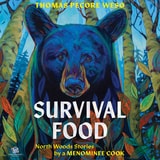
Survival Food
North Woods Stories by a Menominee CookThomas Pecore Weso
Wisconsin Historical Society Press, 2025
In these coming-of-age tales set on the Menominee Indian Reservation of the 1980s and 1990s, Thomas Pecore Weso explores the interrelated nature of meals and memories. As he puts it, “I cannot separate foods from the moments in my life when I first tasted them.” Weso’s stories recall the foods that influenced his youth in northern Wisconsin: subsistence meals from hunted, fished, and gathered sources; the culinary traditions of the German, Polish, and Swedish settler descendants in the area; and the commodity foods distributed by the government—like canned pork, dried beans, and powdered eggs—that made up the bulk of his family’s pantry. His mom called this “survival food.”
These stories from the author’s teen and tween years—some serious, some laugh-out-loud funny—will take readers from Catholic schoolyards to Native foot trails to North Woods bowling alleys, while providing Weso’s perspective on the political currents of the era. The book also contains dozens of recipes, from turtle soup and gray squirrel stew to twice-baked cheesy potatoes. This follow-up to Weso’s Good Seeds: A Menominee Indian Food Memoir is a hybrid of modern foodways, Indigenous history, and creative nonfiction from a singular storyteller.
2024 Wisconsin Library Association Outstanding Achievement Award
2024 PEN Oakland Josephine Miles Award for Excellence
Silver winner of the 2023 Midwest Book Award for Cookbooks/Crafts/Hobbies
Thomas Pecore Weso’s Survival Food was selected by the Wisconsin Center for the Book as the Wisconsin entry in the “Great Reads from Great Places” program of the Library of Congress.
“This book is not only about survival food, but about the singular beauty, creativity, and fortitude that comes out of that survival.”
—Chef Sean Sherman, author, The Sioux Chef’s Indigenous Kitchen
“Survival Food is interesting because it’s one part cookbook, three parts memoir, one part history, and one part multidisciplinary exploration of its setting, northern Wisconsin."
—James Norton, The Cookbook Test
“Nothing brings people together like good food and good stories. There’s an abundance of both in Thomas Pecore Weso’s latest memoir. As Weso attests, food can bring back happy, loving memories of times that were far from happy. Even a tray of funeral sandwiches brings a kind of comfort. This is a wonderful, honest portrait of northeastern Wisconsin, enlightening even to those of us who call this area home.”
—Jared Santek, Founder & Artistic Director, Write On Door County
“Survival Food provides ample nourishment for the mind and body. . . . The stories, told with humor and affection, are complemented by recipes ranging from mouth-watering instructions for cooking wild asparagus to ever-so-interesting advice for preparing bear stew.”
—Lucille Lang Day, author of Birds of San Pancho and Other Poems of Place and coeditor of Red Indian Road West: Native American Poetry from California
“His grandmother cooked according to Native traditions; his mother, ‘a nontraditional college student during my teens,’ resorted to instant meals. His grandfather was town constable and days spent with him brought Weso to the meatloaf, sausage and sauerkraut of German and Polish neighbors. Uncle Buddy’s flash car brings buckwheat pancakes to Weso’s mind, and he lived for a time near Cheese Box Curve—so called after a truck hauling dairy products overturned. Weso includes a few recipes, but mostly, Survival Food is an entertaining look back at life in Wisconsin’s rural north.”
—David Luhrssen, Shepherd Express
“Survival Food: North Woods Stories by a Menominee Cook by Thomas Pecore Weso is a posthumous sequel to his celebrated collection of family stories, Good Seeds: A Menominee Food Memoir. . . . Rich with captivating tales that include driving a convertible on logging roads, agreeing on terms before throwing eggs at passing cars, and his grandmother’s brief stay in a jailhouse she’d later purchase, Weso’s entries offer readers catharsis—demonstrating how to laugh, boast, debate, eat, mourn, and heal.”
—Ryan Winn, College of Menominee Nation, Tribal College Journal
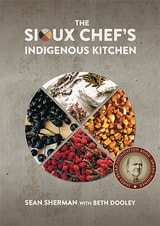
The Sioux Chef's Indigenous Kitchen
Sean Sherman
University of Minnesota Press, 2017
2018 James Beard Award Winner: Best American Cookbook
Named one of the Best Cookbooks of 2017 by NPR, The Village Voice, Smithsonian Magazine, UPROXX, New York Magazine, San Francisco Chronicle, Mpls. St. PaulMagazine and others
Here is real food—our indigenous American fruits and vegetables, the wild and foraged ingredients, game and fish. Locally sourced, seasonal, “clean” ingredients and nose-to-tail cooking are nothing new to Sean Sherman, the Oglala Lakota chef and founder of The Sioux Chef. In his breakout book, The Sioux Chef’s Indigenous Kitchen, Sherman shares his approach to creating boldly seasoned foods that are vibrant, healthful, at once elegant and easy.
Sherman dispels outdated notions of Native American fare—no fry bread or Indian tacos here—and no European staples such as wheat flour, dairy products, sugar, and domestic pork and beef. The Sioux Chef’s healthful plates embrace venison and rabbit, river and lake trout, duck and quail, wild turkey, blueberries, sage, sumac, timpsula or wild turnip, plums, purslane, and abundant wildflowers. Contemporary and authentic, his dishes feature cedar braised bison, griddled wild rice cakes, amaranth crackers with smoked white bean paste, three sisters salad, deviled duck eggs, smoked turkey soup, dried meats, roasted corn sorbet, and hazelnut–maple bites.
The Sioux Chef’s Indigenous Kitchen is a rich education and a delectable introduction to modern indigenous cuisine of the Dakota and Minnesota territories, with a vision and approach to food that travels well beyond those borders.