Results by title
130 books match the query 'Indonesia' and 7 start with a
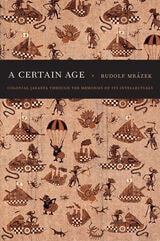
A Certain Age
Colonial Jakarta through the Memories of Its IntellectualsRudolf Mrázek
Duke University Press, 2010
When Mrázek began his interviews, he expected to discuss phenomena such as the transition from colonialism to postcolonialism. His interviewees, however, wanted to share more personal recollections. Mrázek illuminates their stories of the past with evocative depictions of their late-twentieth-century surroundings. He brings to bear insights from thinkers including Walter Benjamin, Bertold Brecht, Le Corbusier, and Marcel Proust, and from his youth in Prague, another metropolis with its own experience of passages and revolution. Architectural and spatial tropes organize the book. Thresholds, windowsills, and sidewalks come to seem more apt as descriptors of historical transitions than colonial and postcolonial, or modern and postmodern. Asphalt roads, homes, classrooms, fences, and windows organize movement, perceptions, and selves in relation to others. A Certain Age is a portal into questions about how the past informs the present and how historical accounts are inevitably partial and incomplete.
A Coincidence of Desires
Anthropology, Queer Studies, IndonesiaTom Boellstorff
Duke University Press, 2007
The case studies contained in A Coincidence of Desires speak to questions about the relation of sexualities to nationalism, religion, and globalization. They include an examination of zines published by gay Indonesians; an analysis of bahasa gay—a slang spoken by gay Indonesians that is increasingly appropriated in Indonesian popular culture; and an exploration of the place of warias (roughly, “male-to-female transvestites”) within Indonesian society. Boellstorff also considers the tension between Islam and sexuality in gay Indonesians’ lives and a series of incidents in which groups of men, identified with Islamic fundamentalism, violently attacked gatherings of gay men. Collectively, these studies insist on the primacy of empirical investigation to any queer studies project that wishes to speak to the specificities of lived experience.
A Death in Bali
A Jenna Murphy MysteryNancy Tingley
Ohio University Press, 2018
Intrepid young curator-turned-private eye Jenna Murphy—whom readers first met in A Head in Cambodia—goes to the tourist town of Ubud to study early twentieth-century Balinese painting. But her first discovery when she arrives in Indonesia is the speared body of expat artist Flip Hendricks. She soon is working with an old friend, a detective for the Ubud police force, to seek the killer. Jenna suspects the motive for the killing has to do with Flip’s paintings. Detective Wayan Tyo is not so sure.
Is Jenna right, or are there other forces at work in this paradise overrun with tourists? The threats to Jenna’s safety pile up, until she can no longer deny that her life is in danger. Her entanglement with various men only clouds her judgment and complicates the situation.
As she did in the first Jenna Murphy book, in A Death in Bali, Nancy Tingley draws on her extensive experience as a scholar of Asian art to bring the armchair traveler an immersive, inside view of the art world.
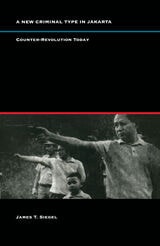
A New Criminal Type in Jakarta
Counter-Revolution TodayJames T. Siegel
Duke University Press, 1998
Examining the links between the concept of criminality and scandal, rumor, fear, and the state, Siegel analyzes daily life in Jakarta through the seemingly disparate but strongly connected elements of family life, gossip, and sensationalist journalism. He offers close analysis of the preoccupation with crime in Pos Kota (a newspaper directed toward the lower classes) and the middle-class magazine Tempo. Because criminal activity has been a sensationalized preoccupation in Jakarta’s news venues and among its people, criminality, according to Siegel, has pervaded the identities of its ordinary citizens. Siegel examines how and why the government, fearing revolution and in an attempt to assert power, has made criminality itself a disturbing rationalization for the spectacular massacre of the people it calls criminals—many of whom were never accused of particular crimes. A New Criminal Type in Jakarta reveals that Indonesians—once united by Sukarno’s revolutionary proclamations in the name of “the people”—are now, lacking any other unifying element, united through their identification with the criminal and through a “nationalization of death” that has emerged with Suharto’s strong counter-revolutionary measures.
A provocative introduction to contemporary Indonesia, this book will engage those interested in Southeast Asian studies, anthropology, history, political science, postcolonial studies, public culture, and cultural studies generally.
Activist Archives
Youth Culture and the Political Past in IndonesiaDoreen Lee
Duke University Press, 2016
Affinities and Extremes
Crisscrossing the Bittersweet Ethnology of East Indies History, Hindu-Balinese Culture, and Indo-European AllureJames A. Boon
University of Chicago Press, 1990
Artists and the People
Ideologies of Art in IndonesiaElly Kent
National University of Singapore Press, 2022
Exploring the work of established and emerging artists in Indonesia’s vibrant art world, this book examines why so many artists in the world’s largest archipelagic nation choose to work directly with people in their art practices. While the social dimension of Indonesian art makes it distinctive in the globalized world of contemporary art, Elly Kent is the first to explore this engagement in Indonesian terms. What are the historical, political, and social conditions that lie beneath these polyvalent practices? How do formal and informal institutions, communities, and artist-run initiatives contribute to the practices and discourses behind socially engaged art in Indonesia? Drawing on interviews with artists, translations of archival material, visual analyses, and participation in artists’ projects, this book presents a unique, interdisciplinary examination of ideologies of art in Indonesia.