Results by title
7 books match the query 'Industrial accidents'
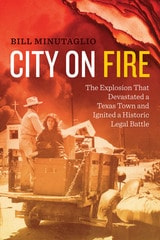
City on Fire
The Explosion that Devastated a Texas Town and Ignited a Historic Legal BattleBy Bill Minutaglio
University of Texas Press, 2014
First published in 2003, City on Fire is a gripping, intimate account of the explosions of two ships loaded with ammonium nitrate fertilizer that demolished Texas City, Texas, in April 1947, in one of the most catastrophic disasters in American history.
[more]
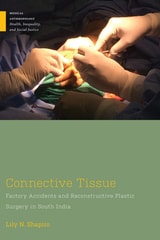
Connective Tissue
Factory Accidents and Reconstructive Plastic Surgery in South IndiaLily N. Shapiro
Rutgers University Press, 2025
An ethnography of factory accidents and their attendant reconstructive plastic surgeries in Coimbatore, Tamil Nadu, Connective Tissue explores notions of risk, work and labor practices, and the way meaning is made from experiences of trauma, care, and recovery. The book charts a rough chronology of the accident—from the workspace that preceded it, the transformation of the workspace by the accident, through journeys to and treatment in the hospital, and then the various and complex ways in which the accident reverberates into the future during recovery.
Connective Tissue revisits scholarship on factory labor by analyzing the accident as constitutive of the experience of work itself, and it refines existing conversations about the body, trauma, and care by introducing an analysis informed by theories of labor and production. Author Lily N. Shapiro argues that care does not happen in spite of or on the margins of capitalism, but rather that capitalism happens in and through care and caring relations. These experiences are intersected by identities of caste, class, and gender, and entangled in state discourse about labor rights, welfare, and industrial law.
Connective Tissue revisits scholarship on factory labor by analyzing the accident as constitutive of the experience of work itself, and it refines existing conversations about the body, trauma, and care by introducing an analysis informed by theories of labor and production. Author Lily N. Shapiro argues that care does not happen in spite of or on the margins of capitalism, but rather that capitalism happens in and through care and caring relations. These experiences are intersected by identities of caste, class, and gender, and entangled in state discourse about labor rights, welfare, and industrial law.
[more]

Costs of Occupational Injuries and Illnesses
J. Paul Leigh, Steven Markowitz, Marianne Fahs, and Philip Landrigan
University of Michigan Press, 2000
As the debate over health care reform continues, costs have become a critical measure in the many plans and proposals to come before us. Knowing costs is important because it allows comparisons across such disparate health conditions as AIDS, Alzheimer's disease, heart disease, and cancer. This book presents the results of a major study estimating the large and largely overlooked costs of occupational injury and illness--costs as large as those for cancer and over four times the costs of AIDS.
The incidence and mortality of occupational injury and illness were assessed by reviewing data from national surveys and applied an attributable-risk-proportion method. Costs were assessed using the human capital method that decomposes costs into direct categories such as medical costs and insurance administration expenses, as well as indirect categories such as lost earnings and lost fringe benefits. The total is estimated to be $155 billion and is likely to be low as it does not include costs associated with pain and suffering or of home care provided by family members.
Invaluable as an aid in the analysis of policy issues, Costs of Occupational Injuryand Illness will serve as a resource and reference for economists, policy analysts, public health researchers, insurance administrators, labor unions and labor lawyers, benefits managers, and environmental scientists, among others.
J. Paul Leigh is Professor in the School of Medicine, Department of Epidemiology and Preventive Medicine, University of California, Davis. Stephen Markowitz, M.D., is Professor in the Department of Community Health and Social Medicine, City University of New York Medical School. Marianne Fahs is Director of the Health Policy Research Center, Milano Graduate School of Management and Urban Policy, New School University. Philip Landrigan, M.D., is Wise Professor and Chair of the Department of Community Medicine, Mount Sinai Medical Center, New York.
[more]
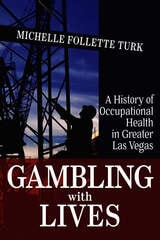
Gambling With Lives
A History of Occupational Health in Greater Las VegasMichelle Follette Turk
University of Nevada Press, 2020
The United States has a long and unfortunate history of exposing employees, the public, and the environment to dangerous work. But in April 2009, the spotlight was on Las Vegas when the Pulitzer committee awarded its public service prize to the Las Vegas Sun for its coverage of the high fatalities on Las Vegas Strip construction sites. The newspaper attributed failures in safety policy to the recent “exponential growth in the Las Vegas market.” In fact, since Las Vegas’ founding in 1905, rapid development has always strained occupational health and safety standards.
A History of Occupational Health and Safety examines the work, hazards, and health and safety programs from the early building of the railroad through the construction of the Hoover Dam, chemical manufacturing during World War II, nuclear testing, and dense megaresort construction on the Las Vegas Strip. In doing so, this comprehensive chronicle reveals the long and unfortunate history of exposing workers, residents, tourists, and the environment to dangerous work—all while exposing the present and future to crises in the region. Complex interactions and beliefs among the actors involved are emphasized, as well as how the medical community interpreted and responded to the risks posed.
Few places in the United States contain this mixture of industrial and postindustrial sites, the Las Vegas area offers unique opportunities to evaluate American occupational health during the twentieth century, and reminds us all about the relevancy of protecting our workers.
[more]
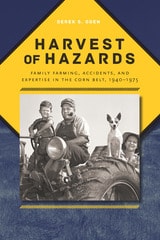
Harvest of Hazards
Family Farming, Accidents, and Expertise in the Corn Belt, 1940-1975Derek S. Oden
University of Iowa Press, 2017
Farming has always been a dangerous occupation. In the middle of the twentieth century, as farmers adopted a wide array of new technologies, from tractors to pesticides and fertilizers, the dangers became more acute. The economic pressures that agriculture faced in this period compounded the perils of these powerful new tools, as farmers struggled to stay profitable in the face of widespread consolidation.
In this study of the farm safety movement in the Corn Belt, historian Derek Oden examines why agriculture was so dangerous and why improvements were so difficult to achieve. Because farmers were self-employed business owners whose employees were mainly family members; because they lived far from aid such as hospitals and fire stations; and because they had to manage such a diverse array of new technologies, they could not easily adopt the workplace safety and public health reforms designed for factories and urban settings. In response, beginning in the 1940s, farmers and a new breed of farm safety specialists relied upon an increasingly elaborate educational campaign to lessen injuries and illnesses on the farm.
Several government, business, and nonprofit organizations—from the US Department of Agriculture to the National Safety Council and 4-H and the Future Farmers of America—worked together to publicize both the dangers of farming and the information farmers needed to stay safe while driving tractors, applying anhydrous ammonia, or repairing machinery. By the 1960s, however, the partnership began to break down, and by the 1970s the safety movement became increasingly contested as professional and policy divisions emerged. This groundbreaking study incorporates agriculture into the histories of occupational safety and public health.
[more]
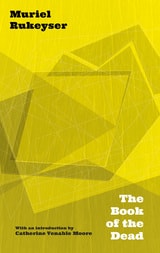
The Book of the Dead
Muriel Rukeyser
West Virginia University Press, 2018
Written in response to the Hawk’s Nest Tunnel disaster of 1931 in Gauley Bridge, West Virginia, The Book of the Dead is an important part of West Virginia’s cultural heritage and a powerful account of one of the worst industrial catastrophes in American history. The poems collected here investigate the roots of a tragedy that killed hundreds of workers, most of them African American. They are a rare engagement with the overlap between race and environment in Appalachia.
Published for the first time alongside photographs by Nancy Naumburg, who accompanied Rukeyser to Gauley Bridge in 1936, this edition of The Book of the Dead includes an introduction by Catherine Venable Moore, whose writing on the topic has been anthologized in Best American Essays.
Published for the first time alongside photographs by Nancy Naumburg, who accompanied Rukeyser to Gauley Bridge in 1936, this edition of The Book of the Dead includes an introduction by Catherine Venable Moore, whose writing on the topic has been anthologized in Best American Essays.
[more]
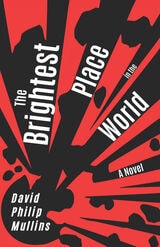
The Brightest Place in the World
A NovelDavid Philip Mullins
University of Nevada Press, 2020
Winner of the 2021 Nebraska Book Award for Fiction!
Inspired by true events, The Brightest Place in the World traces the lives of four characters haunted by an industrial disaster. On an ordinary sunny morning in 2012, a series of explosions level a chemical plant on the outskirts of Las Vegas. The shock waves are felt as far away as Fremont Street. Homes and businesses suffer broken windows and caved-in roofs. Hundreds are injured, and eight employees of the plant are unaccounted for, presumed dead.
One of the missing is maintenance technician Andrew Huntley, a husband and father who is an orbital force in the novel as those who loved him grapple with his loss. Andrew’s best friend, Russell Martin—an anxiety-plagued bartender who calms his nerves with a steady inflow of weed—misses him more than he might a brother. Meanwhile Emma, Russell’s wife—a blackjack dealer at a downtown casino—tries to keep her years-long affair with Andrew hidden. Simon Addison, a manager at the plant who could have saved Andrew’s life, is afflicted by daily remorse, combined with a debilitating knowledge of his own cowardice. And then there’s Maddie, Andrew’s only child, a model high-school student whose response to the tragedy is to experiment with shoplifting and other deviant behavior.
Against the sordid backdrop of Las Vegas—and inspired by the PEPCON disaster of May 4, 1988—this engaging novel is a story of grief and regret, disloyalty and atonement, infatuation and love.
[more]