Results by title
4 books match the query 'Industrial laws and legislation'
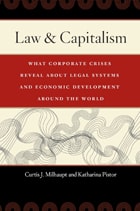
Law & Capitalism
What Corporate Crises Reveal about Legal Systems and Economic Development around the WorldCurtis J. Milhaupt and Katharina Pistor
University of Chicago Press, 2008
Recent high-profile corporate scandals—such as those involving Enron in the United States, Yukos in Russia, and Livedoor in Japan—demonstrate challenges to legal regulation of business practices in capitalist economies. Setting forth a new analytic framework for understanding these problems, Law and Capitalism examines such contemporary corporate governance crises in six countries, to shed light on the interaction of legal systems and economic change. This provocative book debunks the simplistic view of law’s instrumental function for financial market development and economic growth.
Using comparative case studies that address the United States, China, Germany, Japan, Korea, and Russia, Curtis J. Milhaupt and Katharina Pistor argue that a disparate blend of legal and nonlegal mechanisms have supported economic growth around the world. Their groundbreaking findings show that law and markets evolve together in a “rolling relationship,” and legal systems, including those of the most successful economies, therefore differ significantly in their organizational characteristics. Innovative and insightful, Law and Capitalism will change the way lawyers, economists, policy makers, and business leaders think about legal regulation in an increasingly global market for capital and corporate governance.
Using comparative case studies that address the United States, China, Germany, Japan, Korea, and Russia, Curtis J. Milhaupt and Katharina Pistor argue that a disparate blend of legal and nonlegal mechanisms have supported economic growth around the world. Their groundbreaking findings show that law and markets evolve together in a “rolling relationship,” and legal systems, including those of the most successful economies, therefore differ significantly in their organizational characteristics. Innovative and insightful, Law and Capitalism will change the way lawyers, economists, policy makers, and business leaders think about legal regulation in an increasingly global market for capital and corporate governance.
[more]
Political Participation and Government Regulation
Sam Peltzman
University of Chicago Press, 1998
Sam Peltzman is one of the world's leading economists, and the essays in this collection are central to the modern canon in political economy. These ten articles and an original introduction respond to two broad questions: How does government work? How do voters and their elected representatives make decisions? Given the media's portrayal of the cynical political atmosphere in America, Peltzman's responses are rather surprising—the electorate really does make well-informed decisions and elected officials actually do tend to vote according to their constituents' interests. These conclusions bear the stamp of the Chicago approach to political economy (which applies microeconomic principles to political phenomena), an approach that has had considerable success explaining why certain government policies have not achieved their intended effects.
This collection reflects Peltzman's long career studying the interface between the private economy and the public sector. It will be essential to anyone who wishes to study government activity and voting behavior from an economic perspective.
This collection reflects Peltzman's long career studying the interface between the private economy and the public sector. It will be essential to anyone who wishes to study government activity and voting behavior from an economic perspective.
[more]
Regulation versus Litigation
Perspectives from Economics and LawEdited by Daniel P. Kessler
University of Chicago Press, 2010
The efficacy of various political institutions is the subject of intense debate between proponents of broad legislative standards enforced through litigation and those who prefer regulation by administrative agencies. This book explores the trade-offs between litigation and regulation, the circumstances in which one approach may outperform the other, and the principles that affect the choice between addressing particular economic activities with one system or the other. Combining theoretical analysis with empirical investigation in a range of industries, including public health, financial markets, medical care, and workplace safety, Regulation versus Litigation sheds light on the costs and benefits of two important instruments of economic policy.
[more]
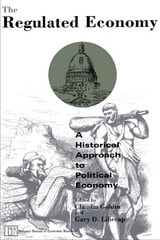
The Regulated Economy
A Historical Approach to Political EconomyEdited by Claudia Goldin and Gary D. Libecap
University of Chicago Press, 1994
How has the United States government grown? What political and economic factors have given rise to its regulation of the economy? These eight case studies explore the late-nineteenth- and early twentieth-century origins of government intervention in the United States economy, focusing on the political influence of special interest groups in the development of economic regulation.
The Regulated Economy examines how constituent groups emerged and demanded government action to solve perceived economic problems, such as exorbitant railroad and utility rates, bank failure, falling agricultural prices, the immigration of low-skilled workers, workplace injury, and the financing of government. The contributors look at how preexisting policies, institutions, and market structures shaped regulatory activity; the origins of regulatory movements at the state and local levels; the effects of consensus-building on the timing and content of legislation; and how well government policies reflect constituency interests.
A wide-ranging historical view of the way interest group demands and political bargaining have influenced the growth of economic regulation in the United States, this book is important reading for economists, political scientists, and public policy experts.
[more]