Results by title
7 books match the query 'Infanticide'
American Infanticide
Sexism, Science, and the Politics of SympathyClara S. Lewis
Rutgers University Press, 2025
Emboldened by fear, the sorority sisters investigated. In the driveway next to the kitchen door, they found Emile’s newborn baby girl dead inside a garbage bag. Emile’s crime seemed senseless and left her family and friends with an aching question: what happened?
American Infanticide situates Emile's tragic act in a long intellectual, social, and legal history, uncovering disturbing missing chapters in our national history that undercut myths that have shaped public reactions to so-called monster moms and dumpster babies since the colonial era. Ultimately, the book uncovers how bias and inconsistency dictate how women accused of infant homicide are perceived and punished and sheds new light on how and why our legal responses to infanticide are so deeply misguided.
Death by Fire
Sati, Dowry Death, and Female Infanticide in Modern IndiaSen, Mala
Rutgers University Press, 2002
The Indian village of Deorala in Rajasthan, the northwestern Indian state that borders Pakistan, is neither remote nor feudal in the strictest sense. A tarmac road links the population of 10,000 to neighboring villages and towns, there is running water and electricity, and the villagers have had television for more than twenty years. On September 4, 1987, Deorala found itself in the center of a furor that awoke age-old conflicts in Indian society. Before a crowd of several thousand people, mostly men, a young woman dressed in her bridal finery was burned alive on her husband’s funeral pyre. The apparent revival of an ancient tradition opened old wounds in Indian society and focused world attention on the status and treatment of women in modern India.
The ancient practice of sati — the self-immolation of a woman on her husband’s funeral pyre — was outlawed by the British administration in India in 1829, and sati was widely believed to have died out. The fate of 18-year-old Roop Kanwar changed that perception. Mala Sen explores the reality of life and death for women in modern India in a study that is both illuminating and terrifying. The book is part journey through the India that the author knows and loves, and part exploration of the enigma that India still remains in the minds of many. Starting with Kanwar, Sen enters the worlds of three women: a goddess, a burned bride, and a woman accused of killing her daughter, and shows how, in this society in which ancient and modern apparently co-exist comfortably, there is increasingly cause for real alarm. She creates an image of a state in which political turmoil is constantly at the surface, and in which the role of women is constantly being redefined.
Driven toward Madness
The Fugitive Slave Margaret Garner and Tragedy on the OhioNikki M. Taylor
Ohio University Press, 2016
Spirit Children
Illness, Poverty, and Infanticide in Northern GhanaAaron R. Denham
University of Wisconsin Press, 2019
Refusing to generalize or oversimplify, Aaron R. Denham offers an ethnographic study of the spirit child phenomenon in Northern Ghana that considers medical, economic, religious, and political realities. He examines both the motivations of the families and the structural factors that lead to infanticide, framing these within the context of global public health. At the same time, he turns the lens on Western societies and the misunderstandings that prevail in discourse about this controversial practice. Engaging the complexity of the context, local meanings, and moral worlds of those confronting a spirit child, Denham offers visceral accounts of families' life and death decisions.
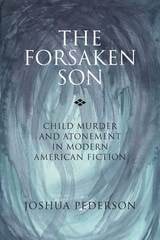
The Forsaken Son
Child Murder and Atonement in Modern American FictionJoshua Pederson
Northwestern University Press, 2015
The Forsaken Son engages the provocative coincidence of the vocabularies of infanticide and Christianity, specifically atonement theology, in six modern American novels: Flannery O’Connor’s The Violent Bear It Away, the first two installments of John Updike’s Rabbit tetralogy, Toni Morrison’s Beloved, Joyce Carol Oates’s My Sister, My Love, and Cormac McCarthy’s Outer Dark.
Christian atonement theology explains why God lets His son be crucified. Yet in recent years, as an increasing number of scholars have come to reject that explanation, the cross reverts from saving grace to trauma—or even crime. More bluntly, without atonement, the cross may be a filicide, in which God forces his son to die for no apparent reason. Pederson argues that the novels about child murder mentioned above likewise give voice to modern skepticism about traditional atonement theology.
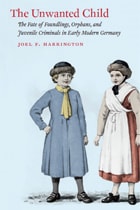
The Unwanted Child
The Fate of Foundlings, Orphans, and Juvenile Criminals in Early Modern GermanyJoel F. Harrington
University of Chicago Press, 2009
The baby abandoned on the doorstep is a phenomenon that has virtually disappeared from our experience, but in the early modern world, unwanted children were a very real problem for parents, government officials, and society. The Unwanted Child skillfully recreates sixteenth-century Nuremberg to explore what befell abandoned, neglected, abused, or delinquent children in this critical period.
Joel F. Harrington tackles this question by focusing on the stories of five individuals. In vivid and poignant detail, he recounts the experiences of an unmarried mother-to-be, a roaming mercenary who drifts in and out of his children’s lives, a civic leader handling the government’s response to problems arising from unwanted children, a homeless teenager turned prolific thief, and orphaned twins who enter state care at the age of nine. Braiding together these compelling portraits, Harrington uncovers and analyzes the key elements that link them, including the impact of war and the vital importance of informal networks among women. From the harrowing to the inspiring, The Unwanted Child paints a gripping picture of life on the streets five centuries ago.
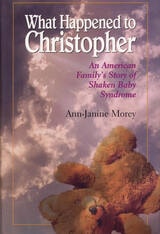
What Happened to Christopher
An American Family's Story of Shaken Baby SyndromeAnn-Janine Morey. Foreword by M. Joan McDermott
Southern Illinois University Press, 1998
A tragedy and a trial placed Ann-Janine Morey in an ideal position to write this wrenching exploration of the havoc wreaked on a family by Shaken Baby Syndrome. As an alternate juror in a 1995 murder trial in Murphysboro, Illinois, she observed a case that has become too common: that of an adult caregiver shaking to death a baby. A seasoned researcher and published scholar, in this book Morey witnesses the court proceedings firsthand, comes to know the families of the toddler intimately, and augments her observations and interviews through research into Shaken Baby Syndrome. The result is an agonizingly human tale supported by the evidence of science, sociology, and criminology.
Morey's What Happened to Christopher memorializes the short life of nineteen-month-old Christopher Attig (1992–1994). To reveal what Christopher meant to those closest to him, Morey conducts extensive interviews with the child's parents and grand-parents. She also interviews the officials involved in the case to set the scene from a legal and police angle. Gary Lynn Gould, who was convicted of and imprisoned for killing Christopher, did not answer Morey's requests for interviews.
Morey characterizes her investigation as a "story of quiet horror because it takes place in a way and a setting that could be any town and many families." Nonetheless, Morey's narrative skill transforms Christopher into much more than an ordinary child, senselessly slain. He is Christopher, irreplaceable and unique. And by the time she reconstructs Christopher's final days and the aftermath of his murder, Morey has depicted the principals in the case so deftly and imbued them with such humanity that we experience their torment and their hope.
Morey also provides a juror's insight into the trial. By showing what happened to Christopher Attig and by presenting the accumulated findings relative to Shaken Baby Syndrome, she seeks through education to help prevent future deaths like Christopher's.