Results by title
7 books match the query 'Inferno'
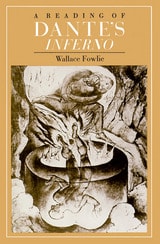
A Reading of Dante's Inferno
Wallace Fowlie
University of Chicago Press, 1981
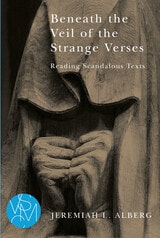
Beneath the Veil of the Strange Verses
Reading Scandalous TextsJeremiah L. Alberg
Michigan State University Press, 2013
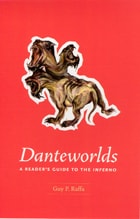
Danteworlds
A Reader's Guide to the InfernoGuy P. Raffa
University of Chicago Press, 2007
One of the greatest works of world literature, Dante Alighieri’s The Divine Comedy has, despite its enormous popularity and importance, often stymied readers with its multitudinous characters, references, and themes. But until now, students of the Inferno have lacked a suitable resource to guide their reading.
Welcome to Danteworlds, the first substantial guide to the Inferno in English. Guy P. Raffa takes readers on a geographic journey through Dante’s underworld circle by circle—from the Dark Wood down to the ninth circle of Hell—in much the same way Dante and Virgil proceed in their infernal descent. Each chapter—or “region”—of the book begins with a summary of the action, followed by detailed entries, significant verses, and useful study questions. The entries, based on a close examination of the poet’s biblical, classical, and medieval sources, help locate the characters and creatures Dante encounters and assist in decoding the poem’s vast array of references to religion, philosophy, history, politics, and other works of literature.
Written by an established Dante scholar and tested in the fire of extensive classroom experience, Danteworlds will be heralded by readers at all levels of expertise, from students and general readers to teachers and scholars.
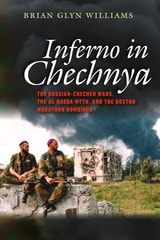
Inferno in Chechnya
The Russian-Chechen Wars, the Al Qaeda Myth, and the Boston Marathon BombingsBrian Glyn Williams
University Press of New England, 2015
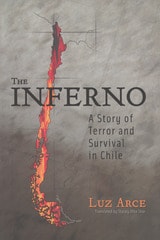
The Inferno
A Story of Terror and Survival in ChileLuz Arce; Translated by Stacey Alba Skar
University of Wisconsin Press, 2004
As a member of Salvador Allende’s Personal Guards (GAP), Luz Arce worked with leaders of the Socialist Party during the Popular Unity Government from 1971 to1973. In the months following the coup, Arce served as a militant with others from the Left who opposed the military junta led by Augusto Pinochet, which controlled the country from 1973 to1990. Along with thousands of others in Chile, Arce was detained and tortured by Chile’s military intelligence service, the DINA, in their attempt to eliminate alternative voices and ideologies in the country. Arce’s testimonial offers the harrowing story of the abuse she suffered and witnessed as a survivor of detention camps, such as the infamous Villa Grimaldi.
But when faced with threats made to her family, including her young son, and with the possibility that she could be murdered as thousands of others had been, Arce began to collaborate with the Chilean military in their repression of national resistance groups and outlawed political parties. Her testimonial thus also offers a unique perspective from within the repressive structures as she tells of her work as a DINA agent whose identifications even lead to the capture of some of her former friends and compañeros.
During Chile’s return to democracy in the early 1990s, Arce experienced two fundamental changes in her life that led to the writing of her story. The first was a deep spiritual renewal through her contacts with the Catholic Church whose Vicariate of Solidarity had fought for human rights in the country during the dictatorship. The second was her decision to participate within the legal system to identify and bring to justice those members of the military who were responsible for the crimes committed from 1973 to1990. Luz Arce’s book invites readers to rethink the definition of testimonial narrative in Latin America through the unique perspective of a survivor-witness-confessor.
The Revelation of Imagination
From Homer and the Bible through Virgil and Augustine to DanteWilliam Franke
Northwestern University Press, 2015
In The Revelation of Imagination, William Franke attempts to focus on what is enduring and perennial rather than on what is accommodated to the agenda of the moment. Franke’s book offers re-actualized readings of representative texts from the Bible, Homer, and Virgil to Augustine and Dante. The selections are linked together in such a way as to propose a general interpretation of knowledge. They emphasize, moreover, a way of articulating the connection of humanities knowledge with what may, in various senses, be called divine revelation. This includes the sort of inspiration to which poets since Homer have typically laid claim, as well as that proper to the biblical tradition of revealed religion. The Revelation of Imagination invigorates the ongoing discussion about the value of humanities as a source of enduring knowledge.
Words Unbound
Teaching Dante's Inferno in the High School ClassroomMilton Burke
University of Arkansas Press, 2017
Words Unbound draws on Milton Burke’s thirty years of teaching experience to help educators bring Inferno alive for today’s young reader. In a conversational, “colleague-to-colleague” style, Burke shares the interpretations, questions, and exercises he found effective in his high-school classroom, emphasizing group discussion to help students, no matter their religious or philosophical moorings, engage meaningfully with the notoriously difficult text.