Results by title
8 books match the query 'Information Management'
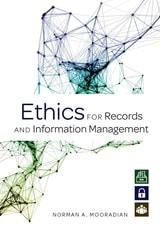
Ethics for Records and Information Management
Norman A. Mooradian
American Library Association, 2018
The scope and reach of information, driven by the explosive growth of information technologies and content types, has expanded dramatically over the past 30 years. The consequences of these changes to records and information management (RIM) professionals are profound, necessitating not only specialized knowledge but added responsibilities. RIM professionals require a professional ethics to guide them in their daily practice and to form a basis for developing and implementing organizational policies, and Mooradian’s new book provides a rigorous outline of such an ethics. Taking an authoritative principles/rules based approach to the subject, this book comprehensively addresses
- the structure of ethics, outlining principles, moral rules, judgements, and exceptions;
- ethical reasoning, from meaning and logic to dilemmas and decision methods;
- the ethical core of RIM, discussing key topics such as organizational context, the positive value of accountability, conflicts of interest, and confidentiality;
- important ethical concerns like copyright and intellectual property, whistleblowing, information leaks, disclosure, and privacy; and
- the relationship between RIM ethics and information governance.

Information and Democratic Processes
Edited by John A. Ferejohn and James H. Kuklinski
University of Illinois Press, 1990
The golden democratic tradition of an informed and involved electorate freely and rationally choosing its public officials seems to be at odds with American political reality. Thus the questions: On what basis do people vote and form opinions? How does the lack of information at the individual level affect system performance?
In this collection twenty-six distinguished political scientists discuss, debate, and define the relationship between information and the democracy it supposedly serves. The contributors address both the empirical and normative aspects of governing in the United States, employing psychological, sociological, and economic perspectives.
Language at Work
Analyzing Communication Breakdown in the Workplace to Inform Systems DesignKeith Devlin and Duska Rosenberg
CSLI, 1996
Records and Information Management
Patricia C. Franks
American Library Association, 2018
As Information Management put it, "On the strength of its currency and coverage alone, Franks' book is poised to take over as the recommended go-to reference for both students and RIM professionals for many years to come.” The new second edition cements this work’s status as an up-to-date classic, its content updated and expanded to address emerging technologies, most notably blockchain, and evolving standards and practices. Inside, Franks presents complete coverage of the records and information lifecycle model, encompassing paper, electronic (databases, office suites, email), and new media records (blogs, chat messages, and software as a service). Informed by an advisory board of experts in the field and with contributions by noted authorities, the text addresses such key topics as
- the origins and development of records and information;
- the discipline of information governance and developing a strategic records management plan;
- creation/capture and classification;
- retention strategies, inactive records management, archives, and long-term preservation;
- access, storage, and retrieval;
- electronic records and electronic records management systems;
- the latest on rapidly evolving technologies such as web records, social media, and mobile devices;
- vital records, disaster preparedness and recovery, and business continuity;
- monitoring, auditing, and risk management; and
- education and training.
This book’s authoritative blend of theory and practice makes it a matchless resource for everyone in the archives and records management field. Instructor/trainer extras include a set of ready-to-go, customizable PowerPoint slides to accompany the text.

Records and Information Management
Patricia C. Franks
American Library Association, 2013
Records and Information Management
Third EditionPatricia C. Franks
American Library Association, 2025
Widely acknowledged as the benchmark text for both students and RIM professionals ("extremely comprehensive and accessible," raves Archival Issues) the new third edition updates its authoritative blend of theory and practice to reflect the field’s dynamically evolving environment, including the rapid rise of applications powered by AI/ML. Franks presents complete coverage of the records and information lifecycle model, encompassing paper, electronic (databases, office suites such as Microsoft 365, and email), and new media records (blogs, chat messages, and software as a service), while acknowledging the influence of emerging and developing technologies and encouraging new ways of meeting the resulting challenges. In this book, enhanced with supplemental contributions from a wide range of thought leaders and practitioners, readers will explore such keys topics as
- the latest advances in disruptive technologies, including blockchain, Web3, the metaverse, and evolving digital communication tools such as enterprise social media;
- an overview of the origins and development of records and information management;
- the discipline of information governance and the steps to develop a strategic records and information management plan;
- a completely new chapter that demystifies data governance, automation, and AI;
- strategies for the creation/capture and classification of records and information;
- approaches to retention strategies, inactive records management, archives, and long-term digital preservation;
- methods for access, storage, and retrieval of records and information;
- insight into electronic records and electronic records management systems;
- practices for safeguarding essential records, including disaster preparedness, recovery, and business continuity;
- approaches to monitoring, auditing, privacy, security, and risk management;
- fresh discussion of the leadership and management skills required of RIM professionals; and
- expert guidance on trendspotting, education, and training.
Rhetorical Memory
A Study of Technical Communication and Information ManagementStewart Whittemore
University of Chicago Press, 2015
In Rhetorical Memory, Stewart Whittemore demonstrates that strategies we use to manage information—techniques often acquired through trial and error, rarely studied, and generally invisible to us—are as important to our success as the end products of our work. First, he situates information management within the larger field of rhetoric, showing that both are tied to purpose, audience, and situation. He then dives into an engaging and tightly focused workplace study, presenting three cases from a team of technical communicators making use of organizational memory during their everyday work. By examining which techniques succeed and which fail, Whittemore illuminates the challenges faced by technical communicators. He concludes with a number of practical strategies to better organize information, that will help employees, managers, and anyone else suffering from information overload.
The Economics of Privacy
Edited by Avi Goldfarb and Catherine E. Tucker
University of Chicago Press, 2024
A foundational new collection examining the mechanics of privacy in the digital age.
The falling costs of collecting, storing, and processing data have allowed firms and governments to improve their products and services, but have also created databases with detailed individual-level data that raise privacy concerns. This volume summarizes the research on the economics of privacy and identifies open questions on the value of privacy, the roles of property rights and markets for privacy and data, the relationship between privacy and inequality, and the political economy of privacy regulation.
Several themes emerge across the chapters. One is that it may not be possible to solve privacy concerns by creating a market for the right to privacy, even if property rights are well-defined and transaction costs are low. Another is that it is difficult to measure and value the benefits of privacy, particularly when individuals have an intrinsic preference for privacy. Most previous attempts at valuation have focused only on quantifiable economic outcomes, such as innovation. Finally, defining privacy through an economic lens is challenging. The broader academic and legal literature includes many distinct definitions of privacy, and different definitions may be appropriate in different contexts. The chapters explore a variety of frameworks for examining these questions and provide a range of new perspectives on the role of economics research in understanding the benefits and costs of privacy and of data flows. As the digital economy continues to expand the scope of economic theory and research, The Economics of Privacy provides the most comprehensive survey to date of this field and its next steps.