Results by title
28 books match the query 'Inner cities'
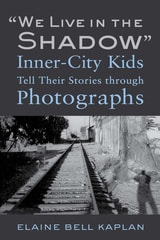
"We Live in the Shadow"
Inner-City Kids Tell Their Stories through PhotographsElaine Bell Kaplan
Temple University Press, 2013
Looking at their photo of railroad tracks, a group of preteen students in South Central Los Angeles see either "a way out of the ghetto," or a "dirty, bad environment." Such are the impressions expressed in the poignant "We Live in the Shadow": Inner-City Kids Tell Their Stories through Photographs.
In Elaine Bell Kaplan's perceptive book, at-risk youth were given five-dollar cameras to tell stories about their world. Their photos and stories show us their response to negative inner-city teen images. We follow them into their schools, and we hear about their creative coping strategies. While these kids see South Central as dangerous, they also see themselves as confident enough to not let the inner city take them down. They refuse to be labeled as "ghetto thugs," as outsiders sometimes do. These outsiders include police, teachers, and other groups representing the institutional voices governing their daily lives.
The kids in "We Live in the Shadow": Inner-City Kids Tell Their Stories through Photographs have developed a multilayered view of society. This impressive book gives voice to their resilience.
Between Good and Ghetto
African American Girls and Inner-City ViolenceNikki Jones
Rutgers University Press, 2009
Drawing on personal encounters, traditions of urban ethnography, Black feminist thought, gender studies, and feminist criminology, Nikki Jones gives readers a richly descriptive and compassionate account of how African American girls negotiate schools and neighborhoods governed by the so-called "code of the street"ùthe form of street justice that governs violence in distressed urban areas. She reveals the multiple strategies they use to navigate interpersonal and gender-specific violence and how they reconcile the gendered dilemmas of their adolescence. Illuminating struggles for survival within this group, Between Good and Ghetto encourages others to move African American girls toward the center of discussions of "the crisis" in poor, urban neighborhoods.
Black Chicago
The Making of a Negro Ghetto, 1890-1920Allan H. Spear
University of Chicago Press, 1969
Brownsville, Brooklyn
Blacks, Jews, and the Changing Face of the GhettoWendell E. Pritchett
University of Chicago Press, 2001
The story of these two different, but in many ways similar, Brownsvilles is compellingly told in this probing new work. Focusing on the interaction of Brownsville residents with New York's political and institutional elites, Wendell Pritchett shows how the profound economic and social changes of post-World War II America affected the area. He covers a number of pivotal episodes in Brownsville's history as well: the rise and fall of interracial organizations, the struggles to deal with deteriorating housing, and the battles over local schools that culminated in the famous 1968 Teachers Strike. Far from just a cautionary tale of failed policies and institutional neglect, the story of Brownsville's transformation, he finds, is one of mutual struggle and frustrated cooperation among whites, blacks, and Latinos.
Ultimately, Brownsville, Brooklyn reminds us how working-class neighborhoods have played, and continue to play, a central role in American history. It is a story that needs to be read by all those concerned with the many challenges facing America's cities today.
Coming of Age in the Other America
Stefanie DeLuca
Russell Sage Foundation, 2016
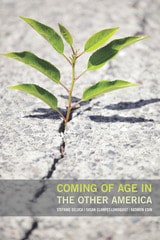
Recent research on inequality and poverty has shown that those born into low-income families, especially African Americans, still have difficulty entering the middle class, in part because of the disadvantages they experience living in more dangerous neighborhoods, going to inferior public schools, and persistent racial inequality. Coming of Age in the Other America shows that despite overwhelming odds, some disadvantaged urban youth do achieve upward mobility. Drawing from ten years of fieldwork with parents and children who resided in Baltimore public housing, sociologists Stefanie DeLuca, Susan Clampet-Lundquist, and Kathryn Edin highlight the remarkable resiliency of some of the youth who hailed from the nation’s poorest neighborhoods and show how the right public policies might help break the cycle of disadvantage.
Coming of Age in the Other America illuminates the profound effects of neighborhoods on impoverished families. The authors conducted in-depth interviews and fieldwork with 150 young adults, and found that those who had been able to move to better neighborhoods—either as part of the Moving to Opportunity program or by other means—achieved much higher rates of high school completion and college enrollment than their parents. About half the youth surveyed reported being motivated by an “identity project”—or a strong passion such as music, art, or a dream job—to finish school and build a career.
Yet the authors also found troubling evidence that some of the most promising young adults often fell short of their goals and remained mired in poverty. Factors such as neighborhood violence and family trauma put these youth on expedited paths to adulthood, forcing them to shorten or end their schooling and find jobs much earlier than their middle-class counterparts. Weak labor markets and subpar postsecondary educational institutions, including exploitative for-profit trade schools and under-funded community colleges, saddle some young adults with debt and trap them in low-wage jobs. A third of the youth surveyed—particularly those who had not developed identity projects—were neither employed nor in school. To address these barriers to success, the authors recommend initiatives that help transform poor neighborhoods and provide institutional support for the identity projects that motivate youth to stay in school. They propose increased regulation of for-profit schools and increased college resources for low-income high school students.
Coming of Age in the Other America presents a sensitive, nuanced account of how a generation of ambitious but underprivileged young Baltimoreans has struggled to succeed. It both challenges long-held myths about inner-city youth and shows how the process of “social reproduction”—where children end up stuck in the same place as their parents—is far from inevitable.
Communities and Crime
An Enduring American ChallengePamela Wilcox
Temple University Press, 2017
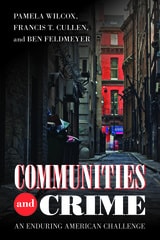
Social scientists have long argued over the links between crime and place. The authors of Communities and Crime provide an intellectual history that traces how varying images of community have evolved over time and influenced criminological thinking and criminal justice policy.
The authors outline the major ideas that have shaped the development of theory, research, and policy in the area of communities and crime. Each chapter examines the problem of the community through a defining critical or theoretical lens: the community as social disorganization; as a system of associations; as a symptom of larger structural forces; as a result of criminal subcultures; as a broken window; as crime opportunity; and as a site of resilience.
Focusing on these changing images of community, the empirical adequacy of these images, and how they have resulted in concrete programs to reduce crime, Communities and Crime theorizes about and reflects upon why some neighborhoods produce so much crime. The result is a tour of the dominant theories of place in social science today.
Coping With Poverty
The Social Contexts of Neighborhood, Work, and Family in the African-American CommunitySheldon Danziger and Ann Chih Lin, Editors
University of Michigan Press, 2000
Detroit Is No Dry Bones
The Eternal City of the Industrial AgeCamilo José Vergara
University of Michigan Press, 2016
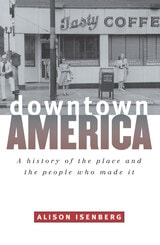
Downtown America
A History of the Place and the People Who Made ItAlison Isenberg
University of Chicago Press, 2005
Downtown America cuts beneath the archetypal story of downtown's rise and fall and offers a dynamic new story of urban development in the United States. Moving beyond conventional narratives, Alison Isenberg shows that downtown's trajectory was not dictated by inevitable free market forces or natural life-and-death cycles. Instead, it was the product of human actors—the contested creation of retailers, developers, government leaders, architects, and planners, as well as political activists, consumers, civic clubs, real estate appraisers, even postcard artists. Throughout the twentieth century, conflicts over downtown's mundane conditions—what it should look like and who should walk its streets—pointed to fundamental disagreements over American values.
Isenberg reveals how the innovative efforts of these participants infused Main Street with its resonant symbolism, while still accounting for pervasive uncertainty and fears of decline. Readers of this work will find anything but a story of inevitability. Even some of the downtown's darkest moments—the Great Depression's collapse in land values, the rioting and looting of the 1960s, or abandonment and vacancy during the 1970s—illuminate how core cultural values have animated and intertwined with economic investment to reinvent the physical form and social experiences of urban commerce. Downtown America—its empty stores, revitalized marketplaces, and romanticized past—will never look quite the same again.
A book that does away with our most clichéd approaches to urban studies, Downtown America will appeal to readers interested in the history of the United States and the mythology surrounding its most cherished institutions.
A Choice Oustanding Academic Title.
Winner of the 2005 Ellis W. Hawley Prize from the Organization of American Historians.
Winner of the 2005 Lewis Mumford Prize for Best Book in American
Planning History.
Winner of the 2005 Historic Preservation Book Price from the University of Mary Washington Center for Historic Preservation.
Named 2005 Honor Book from the New Jersey Council for the Humanities.

Environmentally Devastated Neighborhoods
Perceptions, Policies, and RealitiesGreenberg, Michael
Rutgers University Press, 1996

Gabriel's Fire
A MemoirLuis Gabriel Aguilera
University of Chicago Press, 2000
Aguilera's memoir is not just an account of race relations and street life in the inner city, nor of the plight of the immigrant and the dilemma of class identity for a "minority" family. Gabriel's Fire also movingly recounts the peculiarly daunting and inspiring moments of a particular age, riddled with confusion, desires, and duties and recorded by an exceptionally observant and articulate young man. Aguilera writes that he "grew into" the English language when he was eleven or twelve, and his recollections reflect his newfound delight with words—the conversations, arguments, taunts, song lyrics, and casual interchanges of his youth are rendered here with an immediacy and directness rare in contemporary memoirs.
Both a picture of American culture of the 1980s and 1990s and a coming-of-age story, Gabriel's Fire counters mainstream and mass-mediated images of the inner city, Hispanic culture, and troubled youth. In its honesty and energy, it is a poignant and compelling story of one man's formative years.
Philadelphia
Neighborhoods, Division, and Conflict in a Post-Industrial CityCarolyn Adams
Temple University Press, 1993
Poverty and Place
Ghettos, Barrios, and the American CityPaul A. Jargowsky
Russell Sage Foundation, 1997
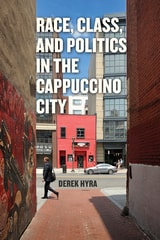
Race, Class, and Politics in the Cappuccino City
Derek S. Hyra
University of Chicago Press, 2017
Race, Class, and Politics in the Cappuccino City is an in-depth ethnography of this gilded ghetto. Derek S. Hyra captures here a quickly gentrifying space in which long-time black residents are joined, and variously displaced, by an influx of young, white, relatively wealthy, and/or gay professionals who, in part as a result of global economic forces and the recent development of central business districts, have returned to the cities earlier generations fled decades ago. As a result, America is witnessing the emergence of what Hyra calls “cappuccino cities.” A cappuccino has essentially the same ingredients as a cup of coffee with milk, but is considered upscale, and is double the price. In Hyra’s cappuccino city, the black inner-city neighborhood undergoes enormous transformations and becomes racially “lighter” and more expensive by the year.
Restoring America's Neighborhoods
How Local People Make a DifferenceMichael R Greenberg
Rutgers University Press, 1999
What does it take to mobilize a grass-roots force dedicated to bringing new life into a decaying neighborhood? Can any one person or group successfully halt physical deterioration, drug-related crime, or the encroachment of clusters of factories, highways, and other noxious land uses? Michael Greenberg demonstrates in this book that it can and has been done against all odds.
Restoring America's Neighborhoods profiles twenty-four such cases from across the United States. It tells the story of people determined to make the blighted, crime-ridden urban enclaves in which they live and work a better place for everybody. These are people from many different walks of life: ministers working to bring jobs to their communities; city planners and federal employees trying to relocated residents of potential disaster areas; and locals taking matters into their own hands to create a healthier, more pleasing living environment for their children. Greenberg's is a heartening account of courage and unwavering resolve as well as of hope that individuals can make a difference, that violent criminals and uncaring bureaucrats need not carry the day. He calls them "streetfighters," a fitting tribute to their efforts to take back their neighborhoods, block by block and street by street.
Separate Societies
William Goldsmith
Temple University Press, 1992
Separate Societies
Poverty and Inequality in U.S. CitiesAuthored by William W. Goldsmith and Edward J. Blakely with a foreword by President Bill Clinton
Temple University Press, 2010
“Economic and political forces no longer combat poverty—they generate poverty!" exclaim William Goldsmith and Edward Blakely in their report on the plight of American's urban poor. In this revised and updated edition of their 1992 book Separate Societies,the authors present a compelling examination of the damaging divisions that isolate poor city minority residents from the middle-class suburban majority. They pay special attention to how the needs of the permanently poor have been unmet through the alternating years of promises and neglect, and propose a progressive turn away from 30 years of conservative policies.
Separate Societies vividly documents how the urban working class has been pushed out of industrial jobs through global economic restructuring, and how the Wall Street meltdown has aggravated underemployment, depleted public services, and sharpened racial and class inequalities.
The authors insist that the current U.S. approach puts Americans out of work and lowers the standard of living for all. As such, Goldsmith and Blakely urge the Obama administration to create better urban policy and foster better metropolitan management to effectively and efficiently promote equality.

Soulside
Inquiries into Ghetto Culture and CommunityUlf Hannerz
University of Chicago Press, 2004
Originally published 35 years ago, Soulside became an urban anthropological classic. The book helped to dispel many false impressions about ghetto life and questioned the idea, precipitated in the influential Moynihan Report and in notions of a "culture of poverty," that the poor had chosen to lead the lives they do. Raising central moral and political questions about American society in a turbulent period, Soulside became an example of public engagement in anthropology. In a new afterword, Ulf Hannerz discusses the book's place in the debates of the time and its relevance to current arguments in anthropology.
Stagnant Dreamers
How the Inner City Shapes the Integration of the Second GenerationMaria G. Rendon
Russell Sage Foundation, 2019
Winner of the 2020 Robert E. Park Award for Best Book from the Community and Urban Sociology Section of the American Sociological Association
Winner of the 2020 Distinguished Contribution to Research Award from the Latino/a Section of the American Sociological Association
Honorable Mention for the 2020 Thomas and Znaniecki Award from the International Migration Section of the American Sociological Association
A quarter of young adults in the U.S. today are the children of immigrants, and Latinos are the largest minority group. In Stagnant Dreamers, sociologist and social policy expert María Rendón follows 42 young men from two high-poverty Los Angeles neighborhoods as they transition into adulthood. Based on in-depth interviews and ethnographic observations with them and their immigrant parents, Stagnant Dreamers describes the challenges they face coming of age in the inner city and accessing higher education and good jobs, and demonstrates how family-based social ties and community institutions can serve as buffers against neighborhood violence, chronic poverty, incarceration, and other negative outcomes.
Neighborhoods in East and South Central Los Angeles were sites of acute gang violence that peaked in the 1990s, shattering any romantic notions of American life held by the immigrant parents. Yet, Rendón finds that their children are generally optimistic about their life chances and determined to make good on their parents’ sacrifices. Most are strongly oriented towards work. But despite high rates of employment, most earn modest wages and rely on kinship networks for labor market connections. Those who made social connections outside of their family and neighborhood contexts, more often found higher quality jobs. However, a middle-class lifestyle remains elusive for most, even for college graduates.
Rendón debunks fears of downward assimilation among second-generation Latinos, noting that most of her subjects were employed and many had gone on to college. She questions the ability of institutions of higher education to fully integrate low-income students of color. She shares the story of one Ivy League college graduate who finds himself working in the same low-wage jobs as his parents and peers who did not attend college. Ironically, students who leave their neighborhoods to pursue higher education are often the most exposed to racism, discrimination, and classism.
Rendón demonstrates the importance of social supports in helping second-generation immigrant youth succeed. To further the integration of second-generation Latinos, she suggests investing in community organizations, combating criminalization of Latino youth, and fully integrating them into higher education institutions. Stagnant Dreamers presents a realistic yet hopeful account of how the Latino second generation is attempting to realize its vision of the American dream.
Streetwise
Race, Class, and Change in an Urban CommunityElijah Anderson
University of Chicago Press, 1990
"The sharpness of his observations and the simple clarity of his prose recommend his book far beyond an academic audience. Vivid, unflinching, finely observed, Streetwise is a powerful and intensely frightening picture of the inner city."—Tamar Jacoby, New York Times Book Review
"The book is without peer in the urban sociology literature. . . . A first-rate piece of social science, and a very good read."—Glenn C. Loury, Washington Times

Sugar's Life in the Hood
The Story of a Former Welfare MotherBy Sugar Turner and Tracy Bachrach Ehlers
University of Texas Press, 2002
All her life, Sugar Turner has had to hustle to survive. An African American woman living in the inner city, she has been a single mother juggling welfare checks, food stamps, boyfriends and husbands, illegal jobs, and home businesses to make ends meet for herself and her five children. Her life's path has also wandered through the wilderness of crack addiction and prostitution, but her strong faith in God and her willingness to work hard for a better life pulled her through. Today, Turner is off welfare and is completing her education. She is computer literate, holds a job in the local school system, has sent three of her children to college, and is happily married.
In this engrossing book, Sugar Turner collaborates with anthropologist Tracy Bachrach Ehlers in telling her story. Through conversations with Ehlers, diary entries, and letters, Turner vividly and openly describes all aspects of her life, including motherhood, relationships with men, welfare and work, and her attachment to her friends, family, and life in the "hood." Ehlers also gives her reactions to Turner's story, discussing not only how it belies the "welfare queen" stereotype, but also how it forced her to confront her own lingering confusions about race, her own bigotry.
What emerges from this book is a fascinating story of two women from radically different backgrounds becoming equal witnesses to each other's lives. By allowing us into the real world of an inner-city African American mother, they replace with compassion and insight the stereotypes, half-truths, and scorn that too often dominate public discourse.
Supersizing Urban America
How Inner Cities Got Fast Food with Government HelpChin Jou
University of Chicago Press, 2017
What doesn’t get mentioned in all this? The fact that the federal government helped create the obesity crisis in the first place—especially where it is strikingly acute, among urban African-American communities. Supersizing Urban America reveals the little-known story of how the U.S. government got into the business of encouraging fast food in inner cities, with unforeseen consequences we are only beginning to understand. Chin Jou begins her story in the late 1960s, when predominantly African-American neighborhoods went from having no fast food chain restaurants to being littered with them. She uncovers the federal policies that have helped to subsidize that expansion, including loan guarantees to fast food franchisees, programs intended to promote minority entrepreneurship, and urban revitalization initiatives. During this time, fast food companies also began to relentlessly market to urban African-American consumers. An unintended consequence of these developments was that low-income minority communities were disproportionately affected by the obesity epidemic.
In the first book about the U.S. government’s problematic role in promoting fast food in inner-city America, Jou tells a riveting story of the food industry, obesity, and race relations in America that is essential to understanding health and obesity in contemporary urban America.
The Grind
Black Women and Survival in the Inner CityMcCurn, Alexis S
Rutgers University Press, 2018
Alexis S. McCurn draws on nearly two years of naturalistic field research among adolescents and adults in Oakland, California to provide an ethnographic account of how black women accomplish the routine tasks necessary for basic survival in poor inner-city neighborhoods and how the intersections of race, gender, and class shape how black women interact with others in public. This book makes the case that the daily consequences of racialized poverty in the lives of African Americans cannot be fully understood without accounting for the personal and collective experiences of poor black women.
The Harvest of American Racism
The Political Meaning of Violence in the Summer of 1967Robert Shellow
University of Michigan Press, 2018
In the summer of 1967, in response to violent demonstrations that rocked 164 U.S. cities, the National Advisory Commission on Civil Disorders, a.k.a. the Kerner Commission, was formed. The Commission sought reasons for the disturbances, including the role that law enforcement played. Chief among its research projects was a study of 23 American cities, headed by social psychologist Robert Shellow. An early draft of the scientists’ analysis, titled “The Harvest of American Racism: The Political Meaning of Violence in the Summer of 1967,” provoked the Commission’s staff in November 1967 by uncovering political causes for the unrest; the team of researchers was fired, and the controversial report remained buried at the LBJ Presidential Library until now.
The first publication of the Harvest report half a century later reveals that many of the issues it describes are still with us, including how cities might more effectively and humanely react to groups and communities in protest. In addition to the complete text of the suppressed Harvest report, the book includes an introduction by Robert Shellow that provides useful historical context; personal recollections from four of the report’s surviving social scientists, Robert Shellow, David Boesel, Gary T. Marx, and David O. Sears; and an appendix outlining the differences between the unpublished Harvest analysis and the well-known Kerner Commission Report that followed it.
“The [Harvest of American Racism] report was rejected by Johnson administration functionaries as being far too radical—politically ‘unviable’… Social science can play an extremely positive role in fighting racial and other injustice and inequality, but only if it is matched with a powerful political will to implement the findings. That will has never come from within an American presidential administration—that will has only been forged in black and other radical communities’ movements for justice. The political power for change, as incremental as it has been, has come from within those communities. Washington responds, it does not lead."
—from the Foreword by Michael C. Dawson
The Truly Disadvantaged
The Inner City, the Underclass, and Public PolicyWilliam Julius Wilson
University of Chicago Press, 1987
"'Must reading' for civil-rights leaders, leaders of advocacy organizations for the poor, and for elected officials in our major urban centers."—Bernard C. Watson, Journal of Negro Education
"Required reading for anyone, presidential candidate or private citizen, who really wants to address the growing plight of the black urban underclass."—David J. Garrow, Washington Post Book World
Selected by the editors of the New York Times Book Review as one of the sixteen best books of 1987.
Winner of the 1988 C. Wright Mills Award of the Society for the Study of Social Problems.
The Truly Disadvantaged
The Inner City, the Underclass, and Public Policy, Second EditionWilliam Julius Wilson
University of Chicago Press, 2012
Renowned American sociologist William Julius Wilson takes a look at the social transformation of inner city ghettos, offering a sharp evaluation of the convergence of race and poverty. Rejecting both conservative and liberal interpretations of life in the inner city, Wilson offers essential information and a number of solutions to policymakers. The Truly Disadvantaged is a wide-ranging examination, looking at the relationship between race, employment, and education from the 1950s onwards, with surprising and provocative findings. This second edition also includes a new afterword from Wilson himself that brings the book up to date and offers fresh insight into its findings.
“The Truly Disadvantaged should spur critical thinking in many quarters about the causes and possible remedies for inner city poverty. As policymakers grapple with the problems of an enlarged underclass they—as well as community leaders and all concerned Americans of all races—would be advised to examine Mr. Wilson's incisive analysis.”—Robert Greenstein, New York Times Book Review
Unsettled
Cambodian Refugees in the New York City HyperghettoEric Tang
Temple University Press, 2015
After surviving the Khmer Rouge genocide, followed by years of confinement to international refugee camps, as many as 10,000 Southeast Asian refugees arrived in the Bronx during the 1980s and ‘90s. Unsettled chronicles the unfinished odyssey of Bronx Cambodians, closely following one woman and her family for several years as they survive yet resist their literal insertion into concentrated Bronx poverty.
Eric Tang tells the harrowing and inspiring stories of these refugees to make sense of how and why the displaced migrants have been resettled in the “hyperghetto.” He argues that refuge is never found, that rescue discourses mask a more profound urban reality characterized by racialized geographic enclosure, economic displacement and unrelenting poverty, and the criminalization of daily life.
Unsettled views the hyperghetto as a site of extreme isolation, punishment, and confinement. The refugees remain captives in late-capitalist urban America. Tang ultimately asks: What does it mean for these Cambodians to resettle into this distinct time and space of slavery’s afterlife?
Urban Nightmares
The Media, The Right, And The Moral Panic Over The CitySteve Macek
University of Minnesota Press, 2006