Results by title
6 books match the query 'Insanity (Law)'
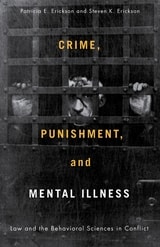
Crime, Punishment, and Mental Illness
Law and the Behavioral Sciences in ConflictErickson, Patricia
Rutgers University Press, 2008
In Crime, Punishment, and Mental Illness, Patricia E. Erickson and Steven K. Erickson explore how societal beliefs about free will and moral responsibility have shaped current policies and they identify the differences among the goals, ethos, and actions of the legal and health care systems. Drawing on high-profile cases, the authors provide a critical analysis of topics, including legal standards for competency, insanity versus mental illness, sex offenders, psychologically disturbed juveniles, the injury and death rates of mentally ill prisoners due to the inappropriate use of force, the high level of suicide, and the release of mentally ill individuals from jails and prisons who have received little or no treatment.
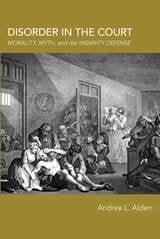
Disorder in the Court
Morality, Myth, and the Insanity DefenseAndrea L. Alden
University of Alabama Press, 2018
The first book-length rhetorical history and analysis of the legal and moral questions behind the insanity defense.
The insanity defense is considered one of the most controversial, most misunderstood, and least straightforward subjects in the American legal system. Disorder in the Court: Morality, Myth, and the Insanity Defense traces the US legal standards for the insanity defense as they have evolved from 1843, when they were first codified in England, to 1984, when the US government attempted to revise them through the Insanity Defense Reform Act. Throughout this period “insanity” existed primarily as a legal term rather than a medical one; yet the testimony of psychiatric experts is required in cases in which an insanity defense is raised.
The adjudication of such cases by courtroom practice is caught between two different but overlapping discourses, the legal and the medical, both of which have historically sought to assert and maintain firm disciplinary boundaries. Both expert and lay audiences have struggled to understand and apply commonplace definitions of sanity, and the portrayal of the insanity defense in popular culture has only served to further frustrate such understandings.
Andrea L. Alden argues that the problems with understanding the insanity defense are, at their foundation, rhetorical. The legal concept of what constitutes insanity and, therefore, an abdication of responsibility for one’s actions does not map neatly onto the mental health professions’ understandings of mental illness and how that affects an individual’s ability to understand or control his or her actions. Additionally, there are multiple layers of persuasion involved in any effort to convince a judge, jury—or a public, for that matter—that a defendant is or is not responsible for his or her actions at a particular moment in time.
Alden examines landmark court cases such as the trial of Daniel McNaughtan, Durham v. United States, and the trial of John Hinckley Jr. that signal the major shifts in the legal definitions of the insanity defense. Combining archival, textual, and rhetorical analysis, Alden offers a close reading of texts including trial transcripts, appellate court opinions, and relevant medical literature from the time period. She contextualizes these analyses through popular texts—for example, newspaper articles and editorials—showing that while all societies have maintained some version of mental illness as a mitigating factor in their penal systems, the insanity defense has always been fraught with controversy.

Freeman's Challenge
The Murder That Shook America's Original Prison for ProfitRobin Bernstein
University of Chicago Press, 2024
An award-winning historian tells a gripping, morally complicated story of murder, greed, race, and the true origins of prison for profit.
In the early nineteenth century, as slavery gradually ended in the North, a village in New York State invented a new form of unfreedom: the profit-driven prison. Uniting incarceration and capitalism, the village of Auburn built a prison that enclosed industrial factories. There, “slaves of the state” were leased to private companies. The prisoners earned no wages, yet they manufactured furniture, animal harnesses, carpets, and combs, which consumers bought throughout the North. Then one young man challenged the system.
In Freeman’s Challenge, Robin Bernstein tells the story of an Afro-Native teenager named William Freeman who was convicted of a horse theft he insisted he did not commit and sentenced to five years of hard labor in Auburn’s prison. Incensed at being forced to work without pay, Freeman demanded wages. His challenge triggered violence: first against him, then by him. Freeman committed a murder that terrified and bewildered white America. And white America struck back—with aftereffects that reverberate into our lives today in the persistent myth of inherent Black criminality. William Freeman’s unforgettable story reveals how the North invented prison for profit half a century before the Thirteenth Amendment outlawed slavery “except as a punishment for crime”—and how Frederick Douglass, Harriet Tubman, and other African Americans invented strategies of resilience and resistance in a city dominated by a citadel of unfreedom.
Through one Black man, his family, and his city, Bernstein tells an explosive, moving story about the entangled origins of prison for profit and anti-Black racism.
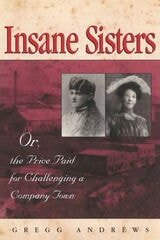
Insane Sisters
Or, the Price Paid for Challenging a Company TownGregg Andrews
University of Missouri Press, 2020
Insane Sisters is the extraordinary tale of two sisters, Mary Alice Heinbach and Euphemia B. Koller, and their seventeen- year property dispute against the nation's leading cement corporation—the Atlas Portland Cement Company.
In 1903, Atlas built a plant on the border of the small community of Ilasco, located just outside Hannibal—home of the infamous cave popularized in Mark Twain's most acclaimed novels. The rich and powerful Atlas quickly appointed itself as caretaker of Twain's heritage and sought to take control of Ilasco. However, its authority was challenged in 1910 when Heinbach inherited her husband's tract of land that formed much of the unincorporated town site. On grounds that Heinbach's husband had been in the advanced stages of alcoholism when she married him the year before, some of Ilasco's political leaders and others who had ties to Atlas challenged the will, charging Heinbach with undue influence.
To help fight against the local lawyers and politicians who wanted Atlas to own the land, Heinbach enlisted the help of her shrewd and combative sister, Euphemia Koller, by making her co-owner of the tract. In a complex case that went to the Missouri Supreme Court four times, the sisters fiercely sought to hang on to the tract. However, in 1921 the county probate court imposed a guardianship over Heinbach and a circuit judge ordered a sheriff's sale of the property. After Atlas purchased the tract, Koller waged a lonely battle to overturn the sale and expose the political conspiracies that had led to Ilasco's conversion into a company town. Her efforts ultimately resulted in her court- ordered confinement in 1927 to Missouri's State Hospital Number One for the Insane, where she remained until her death at age sixty-eight.
Insane Sisters traces the dire consequences the sisters suffered and provides a fascinating look at how the intersection of gender, class, and law shaped the history and politics of Ilasco. The book also sheds valuable new light on the wider consolidation of corporate capitalism and the use of guardianships and insanity to punish unconventional women in the early twentieth century.
Law's Madness
Austin Sarat, Lawrence Douglas, and Martha Merrill Umphrey, Editors
University of Michigan Press, 2006
The distinguished contributors to Law's Madness propose a fascinating interdisciplinary approach to the instability and mutual permeability of law and madness. Their essays examine a variety of discursive forms—from the literary to the historical to the psychoanalytic—in which law is driven more by narrative than by reason. Their studies delineate the ways in which the law takes its definition in part from that which it excludes, suppresses, or excises from itself, illuminating the drive to enforce barriers between non-reason and legality, while simultaneously shedding new light on the constitutive force of the irrational in legal doctrine.
Law's Madness suggests that the tense and paradoxical relationship between law and madness is precisely what erects and sustains law. This provocative collection asks what must be forgotten in order to uphold the rule of law.
Austin Sarat is William Nelson Cromwell Professor of Jurisprudence and Political Science at Amherst College. Lawrence Douglas is Associate Professor of Law, Jurisprudence, and Social Thought at Amherst College. Martha Merrill Umphrey is Associate Professor of Law, Jurisprudence, and Social Thought at Amherst College.
The Hunters or the Hunted?
An Introduction to African Cave TaphonomyC. K. Brain
University of Chicago Press, 1981