Results by title
23 books match the query 'Inspiration & Personal Growth'
Agape Love
Tradition In Eight World ReligionsSir John Templeton
Templeton Press, 1999
The tradition of agape, or unconditional love, is not exclusive to any religion. It is a primary underlying principle found in religions worldwide. The concept of altruistic love challenges the spiritual person to "love your enemies" or to "love without thought of return." It is a love that flows out to others through compassion, kindness, tenderness, and charitable giving.
Buddhists have a path of compassion, where caring for others becomes the motivating force behind existence. Hindus have a branch of yoga, the heart-centered path, that leads to enlightenment through an overwhelming love for God that takes the form of loving all humanity. Eastern religions, such as Taoism and Confucianism, see transcendent love as essential to true wisdom.
Love is a universal theme of love found in all religious traditions, Buddhist, Christian, Islam, or others. As we realize that all religions have this spiritual principle of love at their core, we can develop a sense of shared humanity. The religious tradition of agape love examined in this book will inspire those who are learning to grow in compassion and love for all people.

Body Story
Julia K. De Pree
Ohio University Press, 2004
For De Pree, between being a girl and being a woman, there was starvation. Body Story is her intimate account of girlhood, virginity, anorexia, and motherhood. De Pree's prose is spare and unguarded, revealing in vivid flashbacks and poignant vignettes the sources of her inner pain.
In high school, the five-foot-ten De Pree weighed as little as 114 pounds. She was too weak to raise her arms above her head. “In a paradoxical way, I starved my body in order to understand my life,” she writes. “I had to place my body in suspension before I could move physically into sexuality. Starving allowed me to create an interim space between innocence and experience.”
De Pree renders the starkness of anorexia along with the process of recovery, relapse, and, ultimately, redemption. She also tells the story of the physical landscape, from her origins in the Midwest to the American South, Paris, and the vast New Mexican desert, as well as the psychic landscape of her body as it encounters the joys and challenges of maturation, childbirth, and motherhood.
De Pree offers readers a new way of understanding women¿s bodily experience, as she writes about the mystery and the meaning of her illness. As many as eight million Americans suffer from eating disorders. Body Story, unlike clinical reports or news accounts, illuminates the complexity of anorexia as the narrative moves toward a subjective and deeply personal truth.
This evocative and often radiant vision is a unique window into womanhood and selfhood in middle-class, contemporary America.
Choosing Wisdom
Strategies and Inspiration for Growing through Life-Changing DifficultiesMargaret Plews-Ogan
Templeton Press, 2012
We all know the saying, “That which does not kill us makes us stronger,” but is that really true? After all, for some people, traumatic experiences ultimately lead to genuinely debilitating outcomes. For others, though, adversity does seem to lead to “post-traumatic growth,” where individuals move through suffering and find their lives changed in positive ways. Why does this growth happen for some people and not others? How exactly does it happen? Can the positive results be purposefully replicated?
Discovering the Laws of Life
Sir John Templeton
Templeton Press, 2009
Do Nothing
Peace for Everyday Living: Reflections on Chuang Tzu's PhilosophySiroj Sorajjakool
Templeton Press, 2009
"Words," writes Chuang Tzu, "are for catching ideas; once you've caught the idea, you can forget the words." In Do Nothing, author Siroj Sorajjakool lends us some of his insightful words to help us all "catch" the provocative ideas of one of China's most important literary and philosophical giants—one who emerged at a time when China had several such giants philosophizing on Tao or "the Way."
Though his thinking dates back to the fourth century, Chuang Tzu's Tao has profound implications for our modern lives. He welcomes an existence that is radically removed from the image of normalcy that society often projects, wherein the individual must always strive for more, always seek greater productivity, and always try to better him or herself and his or her place in life. Chuang Tzu would posit that the definitions of normalcy, success, and happiness are arbitrarily assigned and that our rigid and unquestioning adherence to these so-called "norms" leads to existential restlessness and unease. Instead of striving, he would say, be still. Instead of acquiring, embrace nothingness. Instead of seeking to understand the limitlessness of the universe during your brief and extremely limited existence, enjoy the wonder of it.
Siroj Sorajjakool suggests that when we can embrace nothingness, we undergo a spiritual transformation that liberates us to see more clearly and truly find ourselves. He offers a very personal exploration of Chuang Tzu's Tao, first in its historical and literary context, and then in the context of our twenty-first century existence. What emerges is a liberating and highly readable meditation on the many lessons we can "catch" from Chuang Tzu on how we view our aspirations, our joys and sorrows, our successes and failures, and what it means to be a worthwhile person.
Expecting Teryk
An Exceptional Path to ParenthoodDawn Prince-Hughes
Ohio University Press, 2005
“Expecting Teryk is a rich and sumptuous work that speaks to the deeper realities and represents a unique viewpoint of experiences shared by all individuals who choose the path to parenthood.”—Disability, Pregnancy, and Parenthood
The period just prior to the birth of a child is a time of profound personal transformation for expectant parents. Expecting Teryk: An Exceptional Path to Parenthood is an intimate exploration, written in the form of a letter from a parent to her future son, that reclaims a rite of passage that modern society would strip of its magic.
Dawn Prince-Hughes, renowned author of Songs of the Gorilla Nation: My Journey through Autism, considers the ways being autistic might inform her parenting. She also candidly narrates her experience of becoming a parent as part of a lesbian couple—from meeting her partner to the questions they ask about their readiness to become parents and the practical considerations of choosing a sperm donor.
Expecting Teryk is viewed through the lens of autism as Prince-Hughes shares the unique way she sees and experiences the world—as well as her aching will to be fully present for her son. Contemplating the evolutionary traditions of parenting from both animal and human perspectives and the reassurances that nature offers, Expecting Teryk is a work of sensuous wonder that speaks to the deeper realities and archetypal experiences shared by all who embark on the journey of parenthood.
Golden Nuggets
from Sir John TempletonJohn Marks Templeton
Templeton Press, 1998
For young or old, rich or poor, this wisdom will find many applications in people's lives. This inspiring collection of time wisdom by Sir John Templeton, presented in a beautiful gift book, is perfect for a person seeking deeper meaning in life. Practical and uplifting advice based on a lifetime of experience is gathered in an attractive package for personal use or as a perfect gift. Juxtaposed to his sayings are short essays that elaborate on the ideas and make them easier to understand and apply. Themes, such as thanksgiving, forgiveness, positive thinking, love, humility, and happiness, arrange the thoughts.
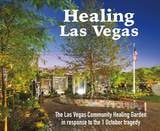
Healing Las Vegas
The Las Vegas Community Healing Garden in response to the 1 October tragedyMcAleer
University of Nevada Press, 2019
The story of the garden unfolds through photographs and the words of survivors, first responders, family members, medical professionals, counselors, and members of the community. In only a matter of days, volunteers and local businesses transformed a vacant downtown lot into a serene urban oasis. Families and friends of those lost in the tragedy soon adopted each of the fifty-eight trees planted in honor of their loved ones, and visitors left behind colorful mementos, including painted rocks, photographs, and ornaments, as well as words of encouragement, love, loss, and strength.
In the aftermath of 1 October, an often misunderstood city revealed its soul under the most heartbreaking of circumstances. The inspirational voices and stories from a community touched by tragedy provide comfort and encouragement. And the organic response to the unthinkable is a testament to how one community came together at its darkest hour, chose hope over despair, unity over hate.
Hope is the Thing
Wisconsinites on Perseverance in a PandemicB. J. Hollars
Wisconsin Historical Society Press, 2021
As the one hundred essays and poems gathered here demonstrate, hope comes in many forms: a dad dance, a birth plan, an unblemished banana, a visit from a neighborhood dog, the revival of an old tradition, empathy. The contributors are racially, geographically, and culturally diverse, representing a rough cross section of Wisconsin voices, from truck driver to poet laureate, from middle school student to octogenarian, from small business owner to seasoned writer. The result is a book-length exploration of the depth and range of hope experienced in times of crisis, as well as an important record of what Wisconsinites were facing and feeling through these historic times.
House Hold
A Memoir of PlaceAnn Peters
University of Wisconsin Press, 2013
More than a memoir of remembered landscapes, House Hold is also an expansive contemplation of America, a meditation on place and property, and an exploration of how literature shapes our thinking about the places we live. A gifted prose stylist, Peters seamlessly combines her love of buildings with her love of books. She wanders through the rooms of her past but also through what Henry James called “the house of fiction,” interweaving personal narrative with musings on James, Willa Cather, William Dean Howells, Paule Marshall, William Maxwell, and others. Peters reflects on the romance of pastoral retreat, the hazards of nostalgia, America’s history of expansion and land ownership, and the conflicted desires to put down roots and to hit the road. Throughout House Hold, she asks how places make us who we are.
How They Linger
Stories of Unforgettable SoulsDonald Davis
Parkhurst Brothers, Inc., 2024
Although everyone has a story, not everybody has a remarkable storyteller like Donald Davis to tell theirs.
Legacy
A Step-By-Step Guide To Writing Personal HistoryLinda Spence
Ohio University Press, 1997
When Linda Spence asked her aging mother to write her life story, her mother stared at a blank sheet of paper and asked—“How? Where do I begin?” In this practical guide to capturing those memories that have been stored away, Linda Spence provides the questions that are the keys to unlocking the memories that make up a life.
Beyond the vital statistics are the personal stories that tell what it was like, what we did, and why we did it, how we feel about our choices, and what our circumstances were. Through encouraging coaching, shared memories, and open-ended questions, the process of producing a personal history becomes intriguing and engaging.
With Legacy the possibilities expand: a personal record is preserved—with its myths, traditions, joys, pains, gains, and losses; a family opens a potential dialogue that will last for generations; the writer has an opportunity for insight and resolution; the culture of a time and place is noted; the tradition of personal story is revitalized, and our present and future find nourishment and knowledge in the past.
Either as a gift that can act as a shared experience as the memories are recounted or as a personal way to take account of one’s experiences, often long since forgotten, Legacy is indeed a way to get one’s story down.
Noble Purpose
Joy Of Living A Meaningful LifeWilliam Bill Damon
Templeton Press, 2003
This book describes the personal and spiritual benefits of living life in a way that matters, with an awareness that one's life can reflect a sense of higher purpose no matter what the circumstances. The book draws upon religious, philosophical, and literary writings to show how humans in many cultures and historical epochs have pursued noble purposes by answering God's call as each hears it.
Noble purpose can be pursued both in heroic acts and in everyday behavior. The book shows how ordinary people—teachers, business professionals, parents, citizens—can ennoble what they do by being mindful of its deepest meaning. It also points out that humility is a necessary virtue for those who pursue a noble purpose. Great heroes are bold, courageous, and sometimes audacious in their determination to succeed; but they are also humble in their awareness of their own limitations. Moreover, a person must never violate basic moral laws while pursuing a noble purpose—the means must be as moral as the ends.
Purpose brings coherence and satisfaction to people's lives, producing joy in good times and resilience in hard times. It also presents a paradox: hard work in service of noble purpose that transcends personal gain is a surer path to happiness than the self-indulgent pursuit of happiness for its own sake. The closer we come to God's purpose for us, the more satisfied our lives become.
From the inspiration and examples conveyed in this book, we learn that all individuals have the capacity to discover their own God-given abilities, to learn the world's need for the services they can provide, and to experience joy in serving society and God in their special ways. As theologian Frederick Buechner writes, "The place God calls you to is the place where your deep gladness and the world's deep hunger meet."
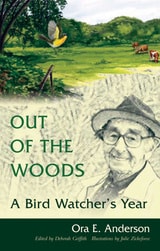
Out of the Woods
A Bird Watcher’s YearOra E. Anderson
Ohio University Press, 2007
Out of the Woods: A Bird Watcher’s Year is a journey through the seasons and a joyous celebration of growing old. In fifty-nine essays and poems, Ora E. Anderson, birder, bird carver, naturalist, and nature writer, reveals the insights and recollections of a keen-eyed observer of nature, both human and avian. The essays follow the rivers and creeks, the highways and little-known byways of Appalachia, and along the way we become nearly as familiar with its numerous bird, plant, and animal species as with the author himself.
These are not the memories of a single year, however, but of a long lifetime spent immersed in the natural world. Out of the Woods, presented with humor and passion, is an account of a well-lived, productive, and satisfying life. The essays offer an intimate portrait of a half century of Anderson's life on his beloved old farm (more nearly a nature preserve), where he lived in harmony with birds and nature and followed the rhythm of the seasons. We are invited to share the joys—and the disappointments and sorrows—inherent in such a life.
Generously illustrated with Julie Zickefoose’s detailed and evocative drawings, this book will delight bird watchers, artists, naturalists, backyard gardeners, and anyone who is ever tempted to take a rutted, overgrown path just to see where it leads.
Science Of Love
Wisdom Of Well BeingThomas Oord
Templeton Press, 2004
We all know the saying, "Love can change the world." When science looks at love, it considers cosmology, sociobiology, evolutionary psychology, neurology, sex and romance, and the role of emotions as each relates to love. It also explores religious, ethical, and philosophical issues, such as virtue, creation ex nihilo, progress, divine action, agape, values, religious practices, pacifism, sexuality, friendship, freedom, and marriage. All affect the ways in which people understand each other and interact with one another. In this book, Oord explores these varied dimensions of love, illuminating the love-science symbiosis for both scholars and general readers.
His definition of love is "to act intentionally, in sympathetic response to others (including God), to promote overall well-being. Love acts are influenced by previous actions and executed in the hope of attaining a high degree of good for all." He begins his study with an exploration of the role love plays in all major world religions: Hinduism, Buddhism, Confucianism, Judaism, Islam, and Christianity. He explains how divine love in action can be viewed as consonant with the big bang theory and the continual creation of the universe.
He looks at pacifism and concludes that nonviolence is not always the most loving thing (sometimes violence must be used to rescue victims or prevent holocausts). He explores the animal kingdom to see how creatures work together with the Creator to make the world a better place. And he analyzes the fundamentals of love, the basic characteristics of existence that must be present for love to be expressed. He concludes with the important argument that progress can best be made when religion and science work together to both understand and promote love.
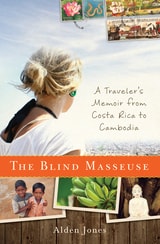
The Blind Masseuse
A Traveler's Memoir from Costa Rica to CambodiaAlden Jones
University of Wisconsin Press, 2013
Gold Winner for Travel Essays, Foreword Books of the Year
Gold Medal for Travel Essays, Independent Publisher Book Awards
Winner, Bisexual Book Awards, Bisexual Biography/Memoir Category
Finalist, Housatonic Book Awards
Longlist of eight, PEN/Diamonstein Spielvogel Award for the Art of the Essay
Finalist, Travel Book or Guide Award, North American Travel Journalists Association
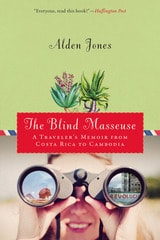
The Blind Masseuse
A Traveler's Memoir from Costa Rica to CambodiaAlden Jones
University of Wisconsin Press, 2017
By way of explorations to Costa Rica, Bolivia, Nicaragua, Cuba, Burma, Cambodia, Egypt, and around the world on a ship, Jones chronicles her experience as a young American traveler while pondering her role as an outsider in the cultures she temporarily inhabits. Her wanderlust fuels a strong, high-adventure story and, much in the vein of classic travel literature, Jones's picaresque tale of personal evolution informs her own transitions, rites of passage, and understandings of her place as a citizen of the world. With sharp insight and stylish prose, Jones asks: Is there a right or wrong way to travel? The Blind Masseuse concludes that there is, but that it's not always black and white.
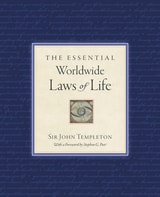
The Essential Worldwide Laws of Life
Sir John Templeton
Templeton Press, 2012
What does it mean to live a good life?
The major scriptures of the world, various schools of philosophical thought, storytellers, scientists, artists, and historians have all offered answers to this question. Surprisingly, these answers are common among nearly all sources. Famed investor and philanthropist Sir John Templeton called these commonalities the “laws of life.”
Templeton gathers the best of these teachings in The Essential Worldwide Laws of Life. This handsome volume shows readers of all ages, from all parts of the world, how to make their lives more joyous and useful by learning the universal truths that transcend time and culture.
Each law is presented in an essay format, with stories, commentary, and quotations to illustrate its importance. The material is designed to inspire the reader to put these laws into practice and to enjoy the rewarding life that will result.
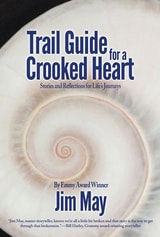
Trail Guide for a Crooked Heart
Stories and Reflections for Life's JourneyJim May
Parkhurst Brothers, Inc., 2016
"A brilliant mixture of story, philosophy, humor and wisdom, this book reminds us that---if we are open to story, dreams, imagination, and myth---we can open doors within our soul."
—Jay O’Callahan, author, storyteller, and NPR commentator
A lifetime collection of stories, wise words, assembled musings and quotations about overcoming hurdles, elusive enlightenment, personal evolution, persistence in the face of discouragement, this pastiche is designed to encourage the downhearted, lift up the strivers, and add wings to the heels of spiritual seekers.
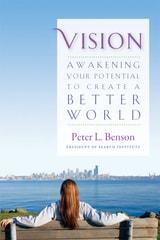
Vision
Awakening Your Potential to Create a Better WorldPeter Benson
Templeton Press, 2009
According to Peter L. Benson, the capacity to generate vision is among life's most beautiful and unheralded gifts. To him, a vision is more than just a goal, more than just a dream of what could be—it is a summons, a pull towards the future, an inspired call to make real that which should be. In Vision: Awakening Your Potential to Create a Better World, Benson takes readers on an uplifting exploration of this powerful concept.
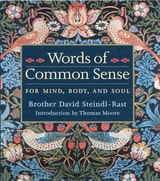
Words Of Common Sense
Brother David Steindl-Rast
Templeton Press, 2002
Brother David Steindl-Rast takes us on a journey to discover the wisdom preserved in common sense sayings that have been passed down through generations. These timeless words reflect the shared values cherished by people all over the world.
"When you drink from a stream,” says one Chinese proverb, “remember the spring." From these simple words we are reminded to be grateful for even the smallest graces that we receive. Another homespun phrase tells us that "a contented heart is a continual feast," reminding us to look within, rather than without, for the source of our happiness.
Words of Common Sense reveals the thread of human experience expressed in the world’s proverbs and sayings. It helps us connect with cultures other than our own and recognize our shared humanity. These words resonate around the world because they are timeless reflections on how to cultivate a life of love, gratitude, and meaning.
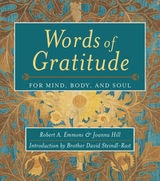
Words Of Gratitude Mind Body & Soul
Robert A. Emmons
Templeton Press, 2001
"The test of all happiness,” said G.K. Chesterton, “is gratitude."
Learning to experience gratitude involves being grateful as an attitude, not as a reaction when good things occur. To be grateful, one does not need to wait until things are perfect. In fact, practicing gratitude makes one receptive to life's blessings, and these blessings continue as we continue to be thankful.
In one study, described by author Robert Emmons, participants who wrote about five things for which they were grateful experienced more positive emotional states and were more likely to help others over a period of ten weeks than were participants who wrote about the hassles and stressors they experienced during the same time.
"Love wholeheartedly,” says Brother David Steindl-Rast, “be surprised, give thanks and praise—then you will discover the fullness of your life."
Gratitude provides gifts to both the giver and the receiver, and this illuminating book will inspire readers to recognize just how truly blessed we are.
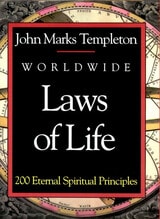
Worldwide Laws Of Life
200 Eternal Spiritual PrinciplesJohn Marks Templeton
Templeton Press, 1998
Worldwide Laws of Life is full of wisdom drawn from the major sacred Scriptures of the world and various schools of philosophical thought, as well as from scientists, artists, historians, and others. Its aim is to assist people of all ages to learn more about the universal truths of life that transcend modern times or particular cultures.