Results by title
13 books match the query 'Installations (Art)'
Aspects
Fred Sandback's SculptureEdward A. Vazquez
University of Chicago Press, 2017
Drawing on Sandback’s substantial archive, Edward A. Vazquez demonstrates that the artist’s work—with all its physical slightness and attentiveness to place, as well as its relationship to minimal and conceptual art of the 1960s—creates a link between viewers and space that is best understood as sculptural even as it almost surpasses physical form. At the same time, the economy of Sandback’s site-determined practice draws viewers’ focus to their connection to space and others sharing it. As Vazquez shows, Sandback’s art aims for nothing less than a total recalibration of the senses, as the spectator is caught on neither one side nor the other of an object or space, but powerfully within it.
Bound to Appear
Art, Slavery, and the Site of Blackness in Multicultural AmericaHuey Copeland
University of Chicago Press, 2013
Digital Baroque
New Media Art and Cinematic FoldsTimothy Murray
University of Minnesota Press, 2008
A surprising and original application of theories of new media art
In this intellectually groundbreaking work, Timothy Murray investigates a paradox embodied in the book’s title: What is the relationship between digital, in the form of new media art, and baroque, a highly developed early modern philosophy of art? Making an exquisite and unexpected connection between the old and the new, Digital Baroque analyzes the philosophical paradigms that inform contemporary screen arts.
Examining a wide range of art forms, Murray reflects on the rhetorical, emotive, and social forces inherent in the screen arts’ dialogue with early modern concepts. Among the works discussed are digitally oriented films by Peter Greenaway, Jean-Luc Godard, and Chris Marker; video installations by Thierry Kuntzel, Keith Piper, and Renate Ferro; and interactive media works by Toni Dove, David Rokeby, and Jill Scott. Sophisticated readings reveal the electronic psychosocial webs and digital representations that link text, film, and computer. Murray puts forth an innovative Deleuzian psychophilosophical approach—one that argues that understanding new media art requires a fundamental conceptual shift from linear visual projection to nonlinear temporal folds intrinsic to the digital form.
Doris Salcedo
Edited by Julie Rodrigues Widholm and Madeleine Grynsztejn
University of Chicago Press, 2015
Published to accompany Salcedo’s first retrospective exhibition and the American debut of her major work Plegaria muda, Doris Salcedo is the most comprehensive survey of her sculptures and installations to date. In addition to featuring new contributions by respected scholars and curators, the book includes over one hundred color illustrations highlighting many pieces from Salcedo’s thirty-year career. Offering fresh perspectives on a vital body of work, Doris Salcedo is a testament to the power of one of today’s most important international artists.
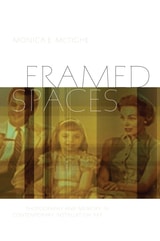
Framed Spaces
Photography and Memory in Contemporary Installation ArtMonica E. McTighe
Dartmouth College Press, 2012
Irina Nakhova
Museum on the EdgeJane A. Sharp
Rutgers University Press, 2019
Released in conjunction with Nakhova’s first museum retrospective exhibition in the United States, this book includes many full-color illustrations of her work, spanning the entirety of her forty-year career and demonstrating her facility with a variety of media. It also includes essays by a variety of world-renowned curators and art historians, each cataloging Nakhova’s artistic innovations and exploring how she deals with themes of everyday life, memory, viewer engagement, and moral responsibility. It concludes with a new interview with Nakhova herself, giving new insight into her creative process and artistic goals. Irina Nakhova: Museum on the Edge provides a vivid look at the work of a visionary artist. Published in partnership with the Zimmerli Museum.
Object—Event— Performance
Art, Materiality, and Continuity Since the 1960sEdited by Hanna B. Hölling
Bard Graduate Center, 2021
Much of the artwork that rose to prominence in the second half of the twentieth century took on novel forms—such as installation, performance, event, video, film, earthwork, and intermedia works with interactive and networked components—that pose a new set of questions about what art actually is, both physically and conceptually. For conservators, this raises an existential challenge when considering what elements of these artworks can and should be preserved.
This provocative volume revisits the traditional notions of conservation and museum collecting that developed over the centuries to suit a conception of art as static, fixed, and permanent objects. Conservators and museums increasingly struggle with issues of conservation for works created from the mid-twentieth to the twenty-first century that are unstable over time. The contributors ask what it means to conserve artworks that fundamentally address and embody the notion of change and, through this questioning, guide us to reevaluate the meaning of art, of objects, and of materiality itself. Object—Event—Performance considers a selection of post-1960s artworks that have all been chosen for their instability, changeability, performance elements, and processes that pose questions about their relationship to conservation practices. This volume will be a welcome resource on contemporary conservation for art historians, scholars of dance and theater studies, curators, and conservators.
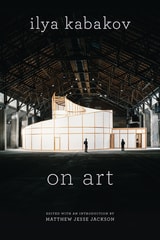
On Art
Ilya Kabakov
University of Chicago Press, 2018
Devoted to themes that range from the “cosmism” of pre-Revolutionary Russian modernism to the philosophical implications of Moscow’s garbage, Kabakov’s handmade booklets were typed out on paper, then stapled or sewn together using rough butcher paper for their covers. Among these writings are faux Socialist Realist verses, theoretical explorations, art historical analyses, accompaniments to installation projects, and transcripts of dialogues between the artist and literary theorists, critics, journalists, and other artists.
This volume offers for the first time in English the most significant texts written by Kabakov. The writings have been expressly selected for this English-language volume and there exists no equivalent work in any language.
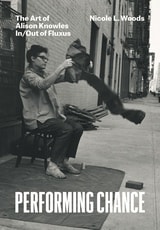
Performing Chance
The Art of Alison Knowles In/Out of FluxusNicole L. Woods
University of Chicago Press, 2026
Alison Knowles stands out as the sole female artist among the founders of Fluxus, yet she has remained an enigmatic, underrecognized figure in the history of art. Performing Chance fills a gap in the record, bringing to light Knowles’s transformative body of work as it evolved from abstract painting in the late 1950s, to silkscreens, print media, and performance in the early 1960s, to groundbreaking works in digital poetry, acoustical art, and large-scale installations in the late 1960s-70s.
Through her access to previously unpublished archival materials and direct interviews with the artist, Nicole L. Woods provides close readings of pivotal works, disclosing the ways Knowles instituted formal tactics that moved beyond modernist painting, championed principles of indeterminacy and chance, and fostered sociopolitical consciousness. Situating Knowles’s innovations in various media within the distinct cultural contexts of Wiesbaden, London, Paris, New York City, and Los Angeles, Performing Chance brings this key artist back to her rightful place as a leader of the postwar avant-garde and provides a nuanced history of the role of women artists in Fluxus and beyond.
Pope.L
Showing Up to WithholdThe Renaissance Society at the University of Chicago
University of Chicago Press, 2014
Published to accompany his wonderfully inscrutable exhibition Forlesen at the Renaissance Society at the University of Chicago, Pope.L: Showing Up to Withhold is simultaneously an artist’s book and a monograph. In addition to reproductions of a number of his most recent artworks, it includes images of significant works from the past decade, and presents a forum for reflection and analysis on art making today with contributions by renowned critics and scholars, including Lawrie Balfour, Nick Bastis, Lauren Berlant, and K. Silem Mohammad.
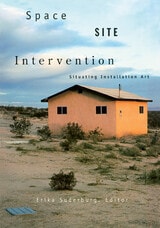
Space, Site, Intervention
Situating Installation ArtErika Suderburg
University of Minnesota Press, 2000
In Space, Site, Intervention, some of today's most prominent art critics, curators, and artists view installation art as a diverse, multifaceted, and international art form that challenges institutional assumptions and narrow conceptual frameworks. Together, the essays in Space, Site, Intervention investigate how installation resonates within modern culture and society, as well as its ongoing influence on contemporary visual culture.
Contributors: C. Ondine Chavoya, John Coleman, Sean Cubitt, Colin Gardner, Chrissie Iles, Miwon Kwon, Ernest Larsen, Tiffany Ana López, Catherine Lord, Kevin McMahon, James Meyer, Alessandra Moctezuma, Leda Ramos, Laurence A. Rickels, Barbara Maria Stafford, Susan Stewart, Marita Sturken, and John C. Welchman.
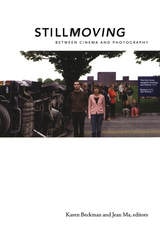
Still Moving
Between Cinema and PhotographyKaren Beckman and Jean Ma, eds.
Duke University Press, 2008
Foregrounding the productive tension between stasis and motion, two terms inherent to cinema and to photography, the contributors trace the shifting contours of the encounter between still and moving images across the realms of narrative and avant-garde film, photography, and installation art. Still Moving suggests that art historians and film scholars must rethink their disciplinary objects and boundaries, and that the question of medium specificity is a necessarily interdisciplinary question. From a variety of perspectives, the contributors take up that challenge, offering new ways to think about what contemporary visual practice is and what it will become.
Contributors: George Baker, Rebecca Baron, Karen Beckman, Raymond Bellour, Zoe Beloff,Timothy Corrigan, Nancy Davenport, Atom Egoyan, Rita Gonzalez, Tom Gunning, Louis Kaplan,
Jean Ma, Janet Sarbanes, Juan A. Suárez
Your Place in the Multiverse
Jean LoweJohn C. Welchman
University Press of Colorado, 2021
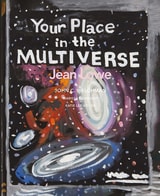
Dating from 2003-2020, the exhibition consists of fourteen separate installations: Empire Style, 2003; Dr’s Notes, 2004; Baby Grand, 2005; Love for Sale and Look 20 Years Younger, 2008-11; Discount Barn, 2008-2020; Bookshelf Prints, 2013; Last Call, 2013-20; Posters and Pallet, 2014; Last Call, 2017-21, Forgotten Corner, 2019; Garden Carpet, 2019; Art and About with Bill Mackelry, 2019-2020, Town Crier (Self-Portrait as Analog), 2020, and POW!, 2021. Lowe’s installations are primarily comprised of unpretentious media such as papier-mâché and paint, which are coupled with a sophisticated and literary use of language, and a loose painterly style. Room-sized and incorporating artist made furniture, rugs, and even pianos, these beautifully-staged installations are often overwhelming, playing both on sensory overload and the irony of abundance as presented daily in our consumer culture. Through her work Lowe references European art, especially German Baroque and French Empire style, for their exceptionally ornamental and theatrical style. By conflating the French Empire style with the stylistics of American consumer culture, and big box store marketing, Lowe offers up a striking, thoughtful and revealing comparison of cultural contexts.
POW! (2020) and Art and About with Bill Mackelry (2019-2020), shown for the first time in this exhibition, look at the imbalance of male to female power in the art-world. Art and About with Bill Mackelry is a video piece in which Lowe stars as a mock male interviewer named Bill Mackelry, who interviews the artist Jean Lowe on a visual arts talk show. The installation POW! will be filled with ersatz portraits of women as fierce, crazy hags by painters such as Picasso, Willem De Kooning, and Frances Bacon painted directly on the wall.
Your Place in the Multiverse: Jean Lowe is organized by Executive Director and Chief Curator Katie Lee-Koven for the Nora Eccles Harrison Museum of Art. This fully illustrated accompanying publication, of the same title, will be the first to include art historical essays with in-depth analysis of Lowe’s work written by USU Art History Assistant Professor Marissa Vigneault and John C. Welchman, professor of Art History and Critical Studies at the University of California, San Diego.