Results by title
28 books match the query 'Instruction and study'
American Gamelan and the Ethnomusicological Imagination
Elizabeth A. Clendinning
University of Illinois Press, 2020
Basic Concepts in Music Education, II
Richard J. Cowell
University Press of Colorado, 1991
A continuation on the first edition, Basic Concepts in Music Education, II features revisions and updates by the living authors as well as contributions by new authors who delineate concepts of music education that are particularly important to the nineties and beyond. These topics include growth processes, learning theory, functional music, messages for teachers, the range of musical experience, technology, and evaluation.
Chapters from the most noted authorities in music education promise to provide definitive guidance in Basic Concepts, II that Basic Concepts, I has provided for the past quarter century. Among the contributors are Charles Fowler, Harry S. Broudy, Foster McMury, Wayne Bowman, Marilyn Zimmerman, Bennett Reimer, Clifton Burmeister, Richard Colwell, Robert Ehle, and Allen P. Britton. Like its predecessor, Basic Concepts, II offers rich and stimulating discussions on the most pertinent issues facing music education today - discussions that are vital to professionals and enlightening to the general reader.
Gamelan Girls
Gender, Childhood, and Politics in Balinese Music EnsemblesSonja Lynn Downing
University of Illinois Press, 2019

In Search of Music Education
Estelle R. Jorgensen
University of Illinois Press, 1997
and inadequate conceptions of the field, Estelle Jorgensen raises the
possibility of alternative views that can dignify the teacher's task,
enrich and enliven the profession, and validate an exciting range of additional
ways in which music education can be undertaken in the contemporary world.
One of the most respected leaders in music education, Jorgensen emphasizes
world music and ethnomusicology as equal partners alongside the more conventional
sounds and styles that have dominated the classroom. Exemplifying sound
scholarship, thorough research, and compelling argument, In Search
of Music Education will be especially welcome wherever teachers strive
to deal with requirements for responsible music education.
Inside John Haynie's Studio
A Master Teacher's Lessons on Trumpet and LifeJohn Haynie
University of North Texas Press, 2007
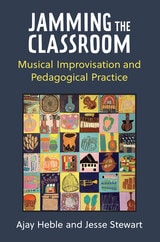
Jamming the Classroom
Musical Improvisation and Pedagogical PracticeAjay Heble and Jesse Stewart
University of Michigan Press, 2023
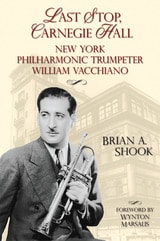
Last Stop, Carnegie Hall
New York Philharmonic Trumpeter William VacchianoBrian A. Shook
University of North Texas Press, 2011
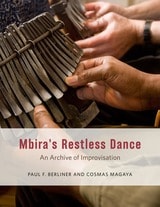
Mbira's Restless Dance
An Archive of ImprovisationPaul F. Berliner and Cosmas Magaya
University of Chicago Press, 2020
Mbira’s Restless Dance is written to be played. This two-volume, spiral-bound set features musical transcriptions of thirty-nine compositions and variations, annotated with the master player’s advice on technique and performance, his notes and observations, and commentary by Berliner. Enhanced with extensive website audiovisuals, Mbira’s Restless Dance is in effect a series of masterclasses with Magaya, suitable for experienced mbira players and those learning the fundamentals.
Together with Berliner's The Art of Mbira, in which he provides an indispensable historical and cultural guide to mbira in a changing world, Mbira's Restless Dance breaks new ground in the depth and specificity of its exploration of an African musical tradition, and in the entwining of the authors’ collaborative voices. It is a testament to the powerful relationship between music and social life—and the rewards of lifelong musical study, performance, and friendship.
Music Education in the United States
Contemporary IssuesJ. Terry Gates
University of Alabama Press, 1988
Exploring the ideas, innovations, and challenges shaping the future of music education.
This solid collection of essays, written by outstanding American music educators, reflects the current issues in music education and the ongoing attempt to overcome obstacles to excellence in teaching music. It stands as the most important and far-ranging professional overview of the discipline since the publication of the landmark Basic Concepts in Music Education in 1958, and early reviews indicate that it will generate both critical discussion and acclaim.
Several themes recur:(1) that music and, therefore, music education exist in a variety of social and cultural contexts, even when examined in controlled situations; (2) that music teaching has not yet freed itself from its traditional over-reliance on technical training, in spite of attention to aesthetic education; and (3) that there is a remarkable undercurrent of agreement among this diverse group of authors concerning the profession’s basic obligation to expand and refine the musical sensitivity of all age group of Americans. This book reflects some advanced thinking about these themes, which establishes new foundations for next generation theorizing and research.
Music Talent & Performance
Conservatory Cultural SystemHenry Kingsbury
Temple University Press, 2001
Author Henry Kingbury, a conservatory-trained pianist and music educator turned anthropologist forgoes the traditional ethnomusicologist approach of looking at a non-Western musical culture to focus on the "field" of an American conservatory. The result is a penetrating look at the distinction between teaching music and the nurturing of musicality. Kingsbury offers an innovative anthropological analysis of the western notion of "talent" and its cultural character, noting that many non-western societies have no such concept. Furthermore, he examines various contexts in which music is produced, experienced, and evaluated. His discussion includes the dynamics of orchestra rehearsals in the conservatory, "master class" lessons with a distinguished performer-pedagogue, the ritual characteristics of solo recitals, and an interpretive analysis of stage fright.
Ultimately, Kingsbury argues that music "is highly shifting and indeterminate in meaning," a concept that has important implications for all interpreters of culture and for the artists themselves.
Music from the Hilltop
Organs and Organists at Southern Methodist UniversityBenjamin A. Kolodziej
University of North Texas Press, 2023
Musical Ethics and Islam
The Art of Playing the NeyBanu Senay
University of Illinois Press, 2020
Banu Şenay documents the years-long training required to become a neyzen—a player of the ney. The process holds a transformative power that invites students to create a new way of living that involves alternative relationships with the self and others, changing perceptions of the city, and a dedication to craftsmanship. Şenay visits reed harvesters and travels from studios to workshops to explore the practical processes of teaching and learning. She also becomes an apprentice ney-player herself, exploring the desire for spirituality that encourages apprentices and masters alike to pursue ney music and its scaffolding of Islamic ethics and belief.
Musical Improvisation
Art, Education, and SocietyEdited by Gabriel Solis and Bruno Nettl
University of Illinois Press, 2008
Contributors are Stephen Blum, Patricia Shehan Campbell, Sabine M. Feisst, Lawrence Gushee, Robert S. Hatten, William Kinderman, Natalie Kononenko, Robert Levin, Charlotte Mattax Moersch, Ingrid Monson, John P. Murphy, Bruno Nettl, A. Jihad Racy, Anne K. Rasmussen, Stephen Slawek, Gabriel Solis, Nicholas Temperley, John Toenjes, and Thomas Turino.
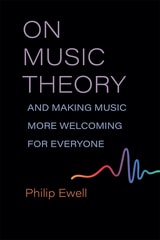
On Music Theory, and Making Music More Welcoming for Everyone
Philip Ewell
University of Michigan Press, 2023
Winner of the 2024 Association of American Publishers PROSE Award for Music and Performing Arts
Since its inception in the mid-twentieth century, American music theory has been framed and taught almost exclusively by white men. As a result, whiteness and maleness are woven into the fabric of the field, and BIPOC music theorists face enormous hurdles due to their racial identities. In On Music Theory, Philip Ewell brings together autobiography, music theory and history, and theory and history of race in the United States to offer a black perspective on the state of music theory and to confront the field’s white supremacist roots. Over the course of the book, Ewell undertakes a textbook analysis to unpack the mythologies of whiteness and western-ness with respect to music theory, and gives, for the first time, his perspective on the controversy surrounding the publication of volume 12 of the Journal of Schenkerian Studies. He speaks directly about the antiblackness of music theory and the antisemitism of classical music writ large and concludes by offering suggestions about how we move forward. Taking an explicitly antiracist approach to music theory, with this book Ewell begins to create a space in which those who have been marginalized in music theory can thrive.
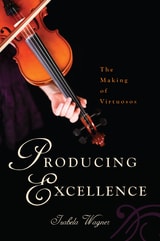
Producing Excellence
The Making of VirtuososWagner, Izabela
Rutgers University Press, 2015
A musician and a parent of a young violinist, sociologist Izabela Wagner offers an inside look at how her young subjects set out on the long road to becoming a soloist. The remarkable research she conducted—at rehearsals, lessons, and in other educational settings—enabled her to gain deep insight into what distinguishes these talented prodigies and their training. She notes, for instance, the importance of a family culture steeped in the values of the musical world. Indeed, more than half of these students come from a family of professional musicians and were raised in an atmosphere marked by the importance of instrumental practice, the vitality of music as a vocation, and especially the veneration of famous artists. Wagner also highlights the highly structured, rigorous training system of identifying, nurturing, and rewarding talent, even as she underscores the social, economic, and cultural factors that make success in this system possible.
Offering an intimate portrait of the students, their parents, and their instructors, Producing Excellence sheds new light on the development of exceptional musical talent, as well as draw much larger conclusions as to “producing prodigy” in other competition-prone areas, such as sports, sciences, the professions, and other arts. Wagner’s insights make this book valuable for academics interested in the study of occupations, and her clear, lively writing is perfect for general readers curious about the ins and outs of training to be a violin soloist.
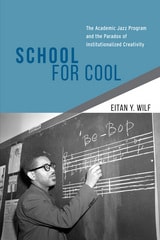
School for Cool
The Academic Jazz Program and the Paradox of Institutionalized CreativityEitan Y. Wilf
University of Chicago Press, 2014
Few art forms epitomize the anti-institutional image more than jazz, but it’s precisely at the academy where jazz is now flourishing. This shift has introduced numerous challenges and contradictions to the music’s practitioners. Solos are transcribed, technique is standardized, and the whole endeavor is plastered with the label “high art”—a far cry from its freewheeling days. Wilf shows how students, educators, and administrators have attempted to meet these challenges with an inventive spirit and a robust drive to preserve—and foster—what they consider to be jazz’s central attributes: its charisma and unexpectedness. He also highlights the unintended consequences of their efforts to do so. Ultimately, he argues, the gap between creative practice and institutionalized schooling, although real, is often the product of our efforts to close it.

Solfege, Ear Training, Rhythm, Dictation, and Music Theory
A Comprehensive CourseMarta Arkossy Ghezzo
University of Alabama Press, 1993
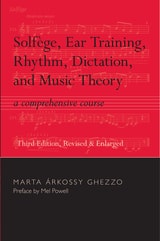
Solfege, Ear Training, Rhythm, Dictation, and Music Theory
A Comprehensive CourseMarta Arkossy Ghezzo
University of Alabama Press, 2005
One of the most highly acclaimed resources for the study of ear training in music education today
Solfège has become one of the most highly acclaimed resources for the study of ear training in music education today. This revised and expanded third edition includes a multitude of new musical examples and dictations covering the entire continuum of musical development from classical to modern. This edition is enhanced with a free online companion library of rich and definitive audio performances of each of the 51 musical dictations, keyed by track number to the musical notation in the text. As students progress from the simple to the complex by following these carefully interrelated lessons, the results are, according to Mel Powell, “akin to miracle-making.”

Sonorous Worlds
Musical Enchantment in VenezuelaYana Stainova
University of Michigan Press, 2021
Sonorous Worlds is an ethnography of the young Venezuelan musicians who participate in El Sistema, many of whom live in urban barrios and face everyday gang violence, state repression, social exclusion, and forced migration in response to sociopolitical crisis. This book looks at how these young people engage with what the author calls “enchantment,” that is, how through musical practices they create worlds that escape, rupture, and critique dominant structures of power. Stainova’s focus on artistic practice and enchantment allows her to theorize the successes and failures of political projects through the lens of everyday transformations in people’s lives.
Sound Pedagogy
Radical Care in MusicEdited by Colleen Renihan, John Spilker, and Trudi Wright. Foreword by William Cheng
University of Illinois Press, 2024
Contributors: Molly M. Breckling, William A. Everett, Kate Galloway, Sara Haefeli, Eric Hung, Stephanie Jensen-Moulton, Mark Katz, Nathan A. Langfitt, Matteo Magarotto, Mary Natvig, Frederick A. Peterbark, Laura Moore Pruett, Colleen Renihan, Amanda Christina Soto, John Spilker, Reba A. Wissner, and Trudi Wright
Sounding Together
Collaborative Perspectives on U.S. Music in the 21st CenturyCharles Hiroshi Garrett and Carol J. Oja, Editors
University of Michigan Press, 2021
Sounding Together: Collaborative Perspectives on U.S. Music in the Twenty-21st Century is a multi-authored, collaboratively conceived book of essays that tackles key challenges facing scholars studying music of the United States in the early twenty-first century. This book encourages scholars in music circles and beyond to explore the intersections between social responsibility, community engagement, and academic practices through the simple act of working together. The book’s essays—written by a diverse and cross-generational group of scholars, performers, and practitioners—demonstrate how collaboration can harness complementary skills and nourish comparative boundary-crossing through interdisciplinary research. The chapters of the volume address issues of race, nationalism, mobility, cultural domination, and identity; as well as the crisis of the Trump era and the political power of music. Each contribution to the volume is written collaboratively by two scholars, bringing together contributors who represent a mix of career stages and positions. Through the practice of and reflection on collaboration, Sounding Together breaks out of long-established paradigms of solitude in humanities scholarship and works toward social justice in the study of music.
Teaching Approaches in Music Theory, Second Edition
An Overview of Pedagogical PhilosophiesMichael R. Rogers
Southern Illinois University Press, 2004
Drawing on decades of teaching experience and the collective wisdom of dozens of the most creative theorists in the country, Michael R. Rogers’s diverse survey of music theory—one of the first to comprehensively survey and evaluate the teaching styles, techniques, and materials used in theory courses—is a unique reference and research tool for teachers, theorists, secondary and postsecondary students, and for private study. This revised edition of Teaching Approaches in Music Theory: An Overview of Pedagogical Philosophies features an extensive updated bibliography encompassing the years since the volume was first published in 1984.
In a new preface to this edition, Rogers references advancements in the field over the past two decades, from the appearance of the first scholarly journal devoted entirely to aspects of music theory education to the emergence of electronic advances and devices that will provide a supporting, if not central, role in the teaching of music theory in the foreseeable future. With the updated information, the text continues to provide an excellent starting point for the study of music theory pedagogy.
Rogers has organized the book very much like a sonata. Part one, “Background,” delineates principal ideas and themes, acquaints readers with the author’s views of contemporary musical theory, and includes an orientation to an eclectic range of philosophical thinking on the subject; part two, “Thinking and Listening,” develops these ideas in the specific areas of mindtraining and analysis, including a chapter on ear training; and part three, “Achieving Teaching Success,” recapitulates main points in alternate contexts and surroundings and discusses how they can be applied to teaching and the evaluation of design and curriculum.
Teaching Approaches in Music Theory emphasizes thoughtful examination and critique of the underlying and often tacit assumptions behind textbooks, materials, and technologies. Consistently combining general methods with specific examples and both philosophical and practical reasoning, Rogers compares and contrasts pairs of concepts and teaching approaches, some mutually exclusive and some overlapping. The volume is enhanced by extensive suggested reading lists for each chapter.
Teaching Difficult Topics
Reflections from the Undergraduate Music ClassroomOlivia R. Lucas and Laura Moore Pruett
University of Michigan Press, 2024
The teaching reflections in Teaching Difficult Topics examine difficult themes that fall into three primary categories: subjects that instructors sense to be controversial or emotionally challenging to discuss, those that derive from or intersect with real-world events that are difficult to process, and bigger-picture discussions of how music studies often focuses on dominant narratives while overlooking other perspectives. Some chapters offer practical guidance, lesson plans, and teaching materials to enable instructors to build discussions of race, gender, sexuality, and traumatic histories into their own classrooms; others take a more global view, reflecting on the importance and relevance of teaching these difficult topics and on how to respond in the music classroom when external events disrupt daily life.

The Art of Trumpet Teaching
The Legacy of Keith JohnsonLeigh Anne Hunsaker
University of North Texas Press, 2022

The Lucidarium of Marchetto of Padua
A Critical Edition, Translation, and CommentaryEdited by Jan W. Herlinger
University of Chicago Press, 1985
"An almost archetypal example of unpretentious and honest scholarship."—Alejandro Enrique Planchart, Journal of the American Musicological Society
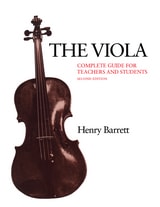
The Viola
Complete Guide for Teachers and StudentsBetsy Mason Barrett
University of Alabama Press, 1996
The second edition is extensively expanded in its graded lists of studies and solos
This book, in its encyclopedic catalog of viola literature in print, and (perhaps most important) in its treatment of the musical and pedagogical aspects of teaching the viola. A work already unique has been augmented in all its major aspects. The excerpts that follow are from reviews of the out-of-print first edition.
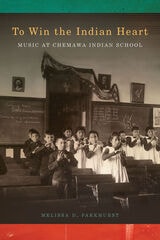
To Win the Indian Heart
Music at Chemawa Indian SchoolMelissa D. Parkhurst
Oregon State University Press, 2014
In To Win the Indian Heart: Music at Chemawa Indian School, Melissa Parkhurst records the history of the school’s musical life. She explores the crucial role music was meant to play in the total transformation of Indian children, and the cultural recovery and resiliency it often inspired instead. Parkhurst chronicles the complex ways in which students, families, faculty, and administrators employed music, both as a tool for assimilation and, conversely, as a vehicle for student resistance—a subject long overlooked in literature on Indian education and the assimilation campaign.
Combining oral histories of Chemawa alumni with archival records of campus life, the book examines the prominent forms of music making at Chemawa—school band, choirs, private lessons, pageants, dance, garage bands, and powwows. Parkhurst traces the trajectory of federal Indian policy, highlighting students’ creative responses and the ways in which music reveals the inherent contradictions in the U.S. government’s assimilation practices.
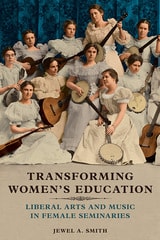
Transforming Women's Education
Liberal Arts and Music in Female SeminariesJewel A. Smith
University of Illinois Press, 2019