Results by title
5 books match the query 'Insulin'
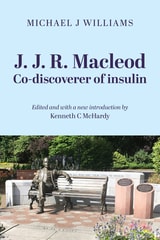
J. J. R. Macleod
Co-discoverer of insulinBy Michael J Williams, edited by Kenneth C McHardy
Aberdeen University Press, 2026
This biography reveals the little-known story of medically qualified research physiologist and biochemist, John Macleod (1876-1935). A child of a Free Kirk minister in rural Perthshire, Macleod was educated at the Grammar School and University in Aberdeen. Rapid career progress in Leipzig, Aberdeen and London culminated in his appointment as Professor of Physiology in Cleveland, Ohio aged only 27. He moved on to similar positions in Toronto then back in Aberdeen. In Cleveland he became an expert on carbohydrate physiology; in Toronto in 1922, he led the four-man team that discovered the world’s first clinically useful insulin. The following year, he was jointly awarded the Nobel Prize in Medicine or Physiology for this life-saving scientific breakthrough, together with colleague, Frederick Banting. The latter unfairly claimed that Macleod had stolen credit for the work.
In a 1982 book, The Discovery of Insulin, Canadian historian Michael Bliss gave a new, detailed interpretation of what had happened in Macleod’s department, concluding that history had underestimated Macleod’s magnificent contributions. Aberdeen-based diabetologist, Michael Williams, went on to produce this detailed account of Macleod’s life and work, originally published in 1993. This refreshed edition, J. J. R. Macleod: Co-discoverer of insulin, adds a description of several interventions over recent years to restore Macleod’s reputation as a scientist whose work contributed to saving hundreds of millions of lives.
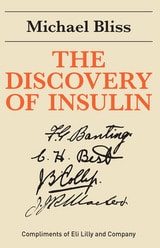
The Discovery of Insulin
Michael Bliss
University of Chicago Press, 1982
The Discovery of Insulin
Enlarged EditionMichael Bliss
University of Chicago Press, 2021
When insulin was discovered in the early 1920s, even jaded professionals marveled at how it brought starved, sometimes comatose patients with diabetes back to life. Defying the average timeline, the 1923 Nobel Prize in Physiology or Medicine was awarded for its discovery. To recount the fascinating story behind the discovery of insulin, in this classic work Michael Bliss draws on archival records and personal interviews with witnesses to the events. He unearths scientists’ memoirs and confidential appraisals of insulin by members of the Nobel Committee, bringing science to life and resolving a longstanding controversy about scientific collaboration at its most fractious and fascinating: who among the Canadian team of Frederick Banting, Charles Best, James Collip, and John Macleod ultimately deserves credit for the discovery of insulin? Or is credit due farther afield—to Georg Zuelzer in Berlin, E.L. Scott in Chicago, Israel Kleiner in New York, Nicolas Paulescu in Bucharest, John Murlin in Rochester?
Bliss’s life-and-death saga illuminates one of the most important breakthroughs in the history of medicine. With a new preface by the author and a foreword by historian Alison Li, this enlarged edition celebrates the lasting impact of insulin’s discovery and ongoing importance.
The Discovery of Insulin
Twenty-fifth Anniversary EditionMichael Bliss
University of Chicago Press, 2007
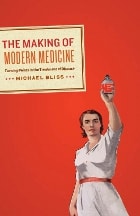
The Making of Modern Medicine
Turning Points in the Treatment of DiseaseMichael Bliss
University of Chicago Press, 2011
At the dawn of the twenty-first century, we have become accustomed to medical breakthroughs and conditioned to assume that, regardless of illnesses, doctors almost certainly will be able to help—not just by diagnosing us and alleviating our pain, but by actually treating or even curing diseases, and significantly improving our lives.
For most of human history, however, that was far from the case, as veteran medical historian Michael Bliss explains in The Making of Modern Medicine. Focusing on a few key moments in the transformation of medical care, Bliss reveals the way that new discoveries and new approaches led doctors and patients alike to discard fatalism and their traditional religious acceptance of suffering in favor of a new faith in health care and in the capacity of doctors to treat disease. He takes readers in his account to three turning points—a devastating smallpox outbreak in Montreal in 1885, the founding of the Johns Hopkins Hospital and Medical School, and the discovery of insulin—and recounts the lives of three crucial figures—researcher Frederick Banting, surgeon Harvey Cushing, and physician William Osler—turning medical history into a fascinating story of dedication and discovery.
Compact and compelling, this searching history vividly depicts and explains the emergence of modern medicine—and, in a provocative epilogue, outlines the paradoxes and confusions underlying our contemporary understanding of disease, death, and life itself.