Results by title
2 books match the query 'Interagency coordination'
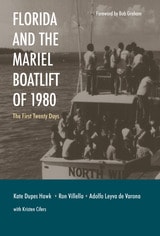
Florida and the Mariel Boatlift of 1980
The First Twenty DaysKate Dupes Hawk, Ron Villella, and Adolfo Leyva de Varona, with Kristen Cifers
University of Alabama Press, 2014
The 1980 Mariel Boatlift was a profound episode in twentieth-century American history, impacting not just Florida, but the entire country. During the first twenty days of the boatlift, with little support from the federal government, the state of Florida coordinated and responded to the sudden arrival in Key West of more than thirty thousand Cuban refugees, the first wave of immigrants who became known as “Marielitos.”
Kathleen Dupes Hawk, Ron Villella, Adolfo Leyva de Varona, and Kristen Cifers combine the insights of expert observers with the experiences of actual participants. The authors organize and present a wealth of primary sources, first-hand accounts, archival research, government records, and interviews with policy-makers, volunteers, and refugees that bring into focus the many far-reaching human, political, and cultural outcomes of the Mariel Boatlift that continue to influence Florida, the United States, and Cuba today.
Emerging from these key records and accounts is a grand narrative of high human drama. Castro’s haphazard and temporary opening of Cuba spurred many thousands of Cubans to depart in calamitously rushed, unprepared, and dangerous conditions. The book tells the stories of these Cuban citizens, most legitimately seeking political asylum but also including subversive agents, convicted criminals, and the mentally ill, who began arriving in the US beginning in April 1980. It also recounts how local and state agencies and private volunteers with few directives or resources were left to improvise ways to provide the Marielitos food, shelter, and security as well as transportation away from Key West.
The book provides a definitive account of the political, legal, and administrative twists on the local, state, and federal levels in response to the crisis as well as of the often-dysfunctional attempts at collaboration between governmental and private institutions. Vivid and readable, Florida and the Mariel Boatlift of 1980 presents the significant details that illuminate and humanize this complex humanitarian, political, and logistical crisis.
Implementing City Sustainability
Overcoming Administrative Silos to Achieve Functional Collective ActionRachel M. Krause and Christopher V. Hawkins
Temple University Press, 2021
Implementing City Sustainability examines the structures and processes that city governments employ to pursue environmental, social, and economic well-being within their communities. As American cities adopt sustainability objectives, they are faced with the need to overcome fuzzy-boundary, coordination, and collective action challenges to achieve successful implementation.
Sustainability goals often do not fit neatly into traditional city government structures, which tend to be organized around specific functional responsibilities, such as planning, public works, parks and recreation, and community development. The authors advance a theory of Functional Collective Action and apply it to local sustainability to explain how cities can—and in some cases do—organize to successfully administer changes to achieve complex objectives that transcend these organizational separations. Implementing City Sustainability uses a mixed-method research design and original data to provide a national overview of cities’ sustainability arrangements, as well as eight city case studies highlighting different means of organizing to achieve functional collective action.
By focusing not just on what cities are doing to further sustainability, but also on how they are doing it, the authors show how administrative structure enables—or inhibits—cities to overcome functional divides and achieve successful outcomes.